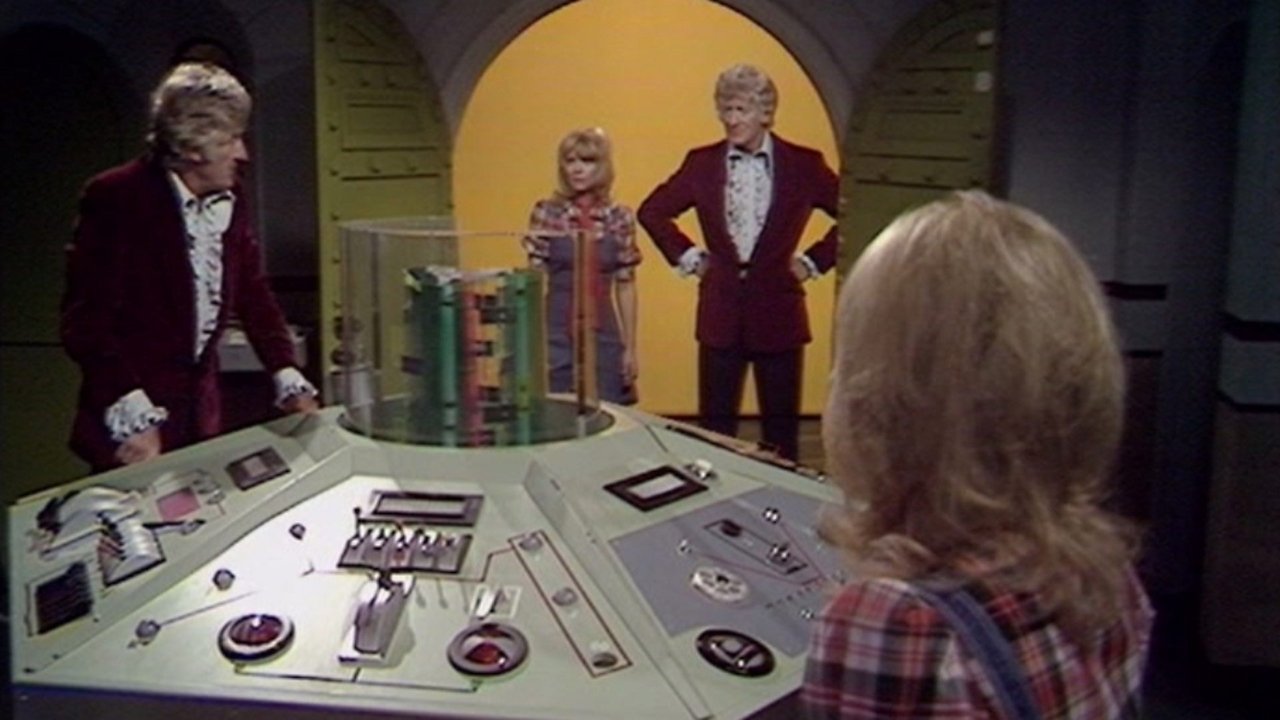
More from the episode
The story in 5 beats
- The vanishing assassin
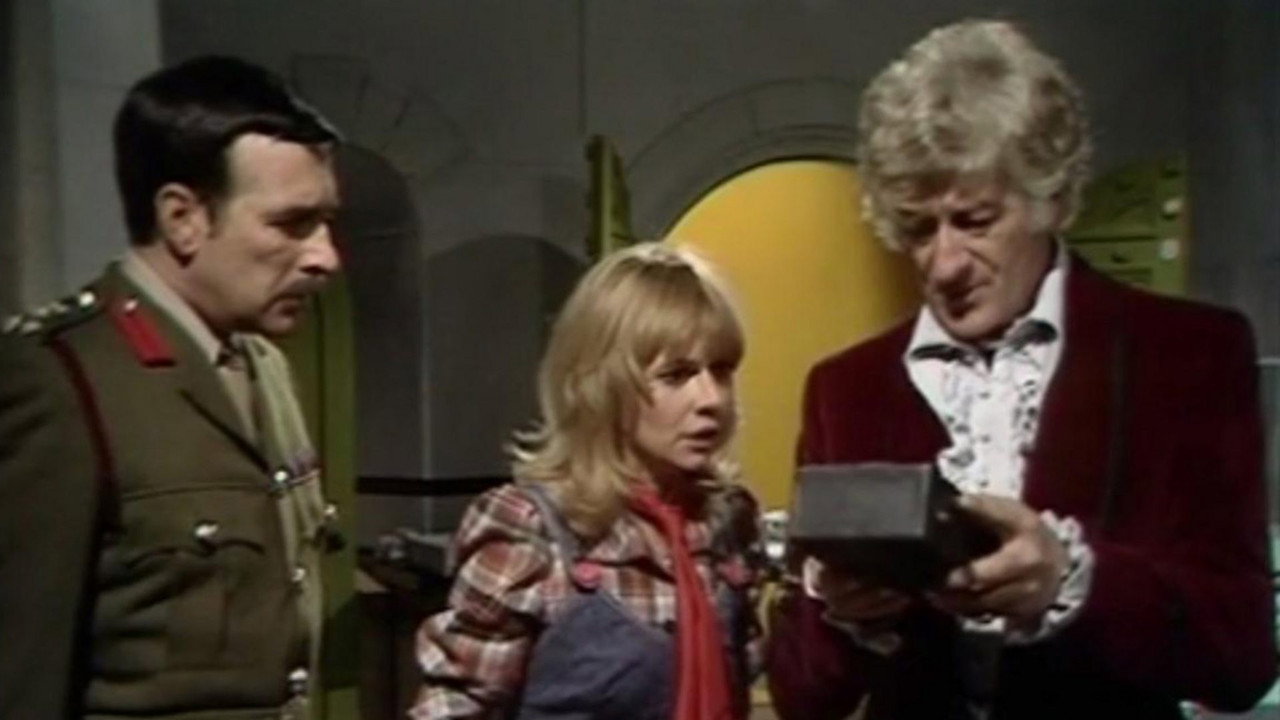
Sir Reginald Styles, organising a conference to head off a world war, is held at gunpoint at Auderly House by a soldier who disappears. He thinks he's seen a ghost.
- A night at Auderly House
The Doctor and Jo stay the night to watch, with wine and cheese. Three guerrillas from the 22nd century come through, on a mission to kill Styles.
- Earth under the Daleks
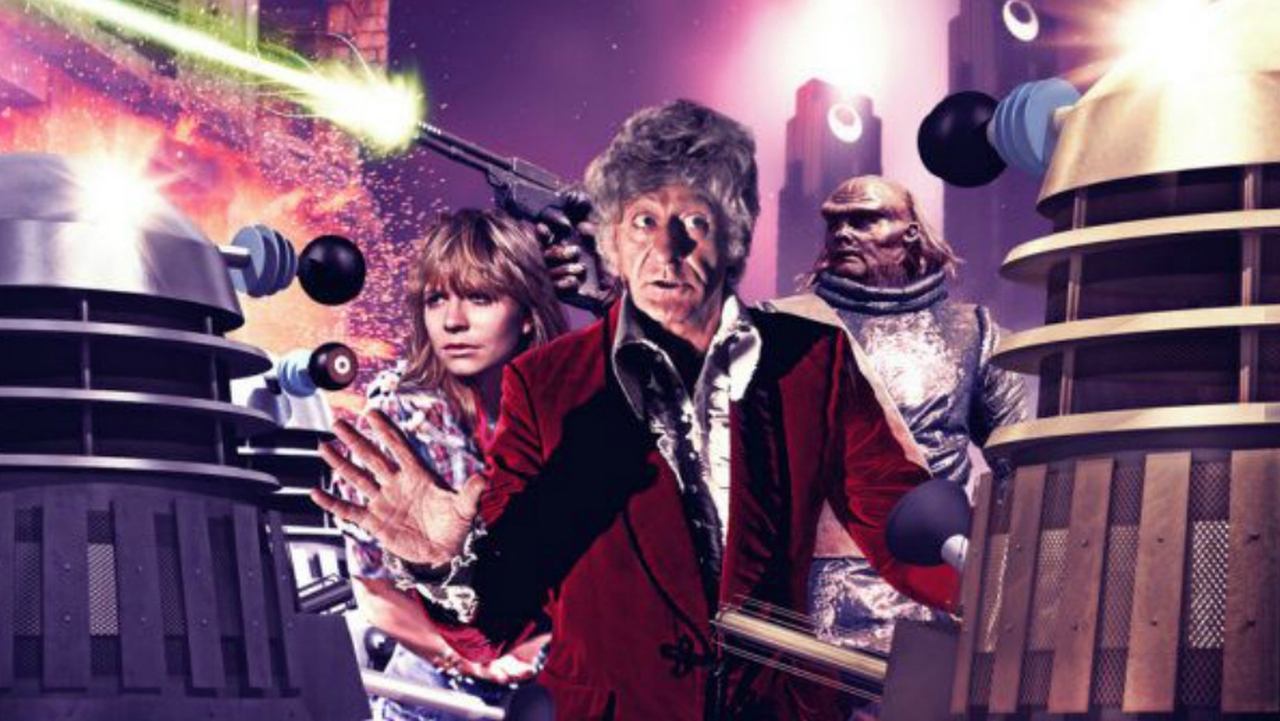
The Doctor and Jo end up in the future, where Ogrons police an enslaved population and a smooth human Controller serves the Daleks.
Who caused the explosion?Spoiler · tap to reveal
The guerrillas blame the war on a blast at the peace conference. The Doctor works out where that blast really came from.
The Daleks come to the houseSpoiler · tap to reveal
UNIT clears the delegates out and the Daleks and Ogrons close in on Auderly House.
Why it still matters
This is the story where Doctor Who took a proper look at what time travel does to cause and effect. Guerrillas come back from a wrecked future to kill one man and stop the war that wrecked it, and the Doctor has to work out whether the past can be changed at all. The Discontinuity Guide called it the series' first proper look at the complexities of time travel, and Mark Campbell, in Doctor Who: The Complete Guide, called it an "intelligently scripted Terminator prototype", a dozen years before the film.
It also brought back the Daleks, though they were a late addition. Louis Marks wrote it around the Ogrons, apelike hired muscle; the production team, wanting a big hook for the season opener, asked him to add the Daleks instead of saving them for later in the year. The Ogrons stayed, and reviewers have tended to like them more than their bosses. Patrick Mulkern of Radio Times praised them, and the Telegraph called them well designed.
The 22nd-century scenes give the Third Doctor, usually stuck on Earth, a whole dystopia to walk around in: human slaves, Ogron guards and a human Controller who keeps the system running for the Daleks. There's a comics footnote too: John Byrne has said he unconsciously lifted the basic plot of the X-Men story "Days of Future Past" from this serial.
The rebels were the cause
The guerrillas trace the war back to an explosion at Styles's conference, and believe killing him will stop it. The Doctor sees that they have it backwards: the explosion is their own attack. By coming back to change history, they are the ones who set it in motion, which makes the whole thing a closed loop.
The way out is to give the explosion a different target. UNIT evacuates the delegates, the Daleks and Ogrons storm the empty house, and Shura sets off his dalekanium bomb with the enemy inside. The conference goes ahead, the future the rebels came from is put right, and the Doctor tells Styles he must make it a success, because they know what will happen if it fails.
Challenge the DNA
Were the guerrillas right to come back and change history?
Or skip ahead to our reading
They were right to want it and wrong about how. The paradox is the point: their attack is the explosion. It's one of the show's neatest time stories, and the Doctor's answer is the only one that breaks the loop.
Behind the scenes
- The serial was written around the Ogrons. The plan had been to bring the Daleks back at the end of the season in a Robert Sloman story, The Daleks in London, but the team felt the season opener needed a hook (Season 7 had introduced Pertwee, Season 8 the Master), and Sloman's story was reportedly looking too like The Dalek Invasion of Earth. Louis Marks was asked to add the Daleks.
- Jon Pertwee said, "I have never liked the Daleks", and couldn't see why they were so popular. He preferred the Ogrons, whose masks left the actors' mouths free. He also talked Barry Letts into the trikes, and remembered the chase on them as one of the more dangerous stunts he insisted on doing.
- Only three Dalek props were available, one of them painted gold, so no more than three Daleks are ever on screen. Viewers disliked the thin final battle. The 2011 DVD added a special edition with CGI, newly shot footage and new Dalek voices by Nicholas Briggs, the voice of the Daleks since 2005.
- Parts two and three open with a reprise of the cliffhanger music that ended the part before, which is unusual for the series.
- It's the earliest Doctor Who story for which all the original colour videotapes survive.
- The four parts drew 9.8, 10.4, 9.1 and 9.1 million viewers. A one-part omnibus edition on BBC1 on September 3, 1973 drew 7.4 million.
- John Byrne has said he unconsciously lifted the basic plot of the X-Men story "Days of Future Past" from this serial.
The thread
A ruined future sends assassins into the present, and the present turns out to be the cause.
Came before
Shares DNA with
Left its mark on
DNA strand
Time Loops & Timelines
Everyone in this story is sure the past can be fixed if you shoot the right person. The Doctor is the only one who stops to ask where the damage started. It's a tidy loop, and an early TV example of the idea that going back to change history might be what made it.
Every great sci-fi story is built from a handful of strands like this one. Each strand page explains how it works and traces it across shows, books and films.
If this one stayed with you
Where to go next, and why.
Watch · Star Trek S1
"The City on the Edge of Forever"
Another trip into the past where one small act decides the future, and the people who know it have to choose what to do.
Watch · TNG S3
"Yesterday's Enterprise"
The alternate future here is a war, and the people living in it have to decide whether to put history back.
Watch · Film
The Terminator
The comparison Mark Campbell made: a soldier and a killer from a ruined future fighting over one moment in the present.
Read · Novelisation
Doctor Who and the Day of the Daleks — Terrance Dicks
The serial's script editor adapted it for Target Books in 1974. It went on to Dutch, Turkish, Japanese, Polish and Portuguese editions.
Read · Comic
"Days of Future Past" — Chris Claremont and John Byrne
The X-Men's version of a ruined future sending someone back to stop an assassination, which Byrne traced back to this serial.
Your next episode
Three directions to go from here, all on Sci-Fi DNA.
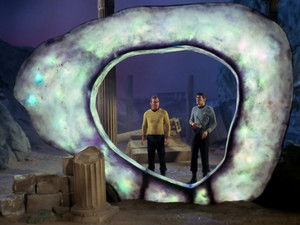
More of this feeling
The City on the Edge of Forever
Star Trek
Another story where changing history is the whole problem.
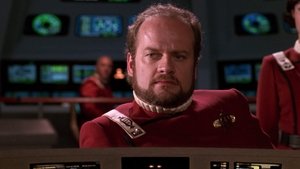
Same question, different answer
Cause and Effect
Star Trek: The Next Generation
How do you break out of a loop you don't know you're in?
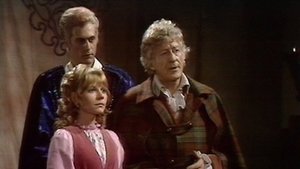
Something completely different
The Curse of Peladon
Doctor Who
A medieval planet, a royal court and a delegation of aliens with a past.
Sources
- “Day of the Daleks,” Wikipedia
- “Day of the Daleks (Doctor Who Classic Episode Guide),” BBC
- Patrick Mulkern, “Doctor Who: Day of the Daleks,” Radio Times, 2009
- “Doctor Who: the 56 greatest stories and episodes, ranked,” The Daily Telegraph, 2018
- “'Doctor Who': 'Day of the Daleks' Special Edition DVD review,” CultBox, 2011
- “Broadcasting for Day of the Daleks,” Doctor Who News (Doctor Who Guide)
- “Days of Future Past,” Wikipedia