More from the episode

The story in 5 beats
- The overdose
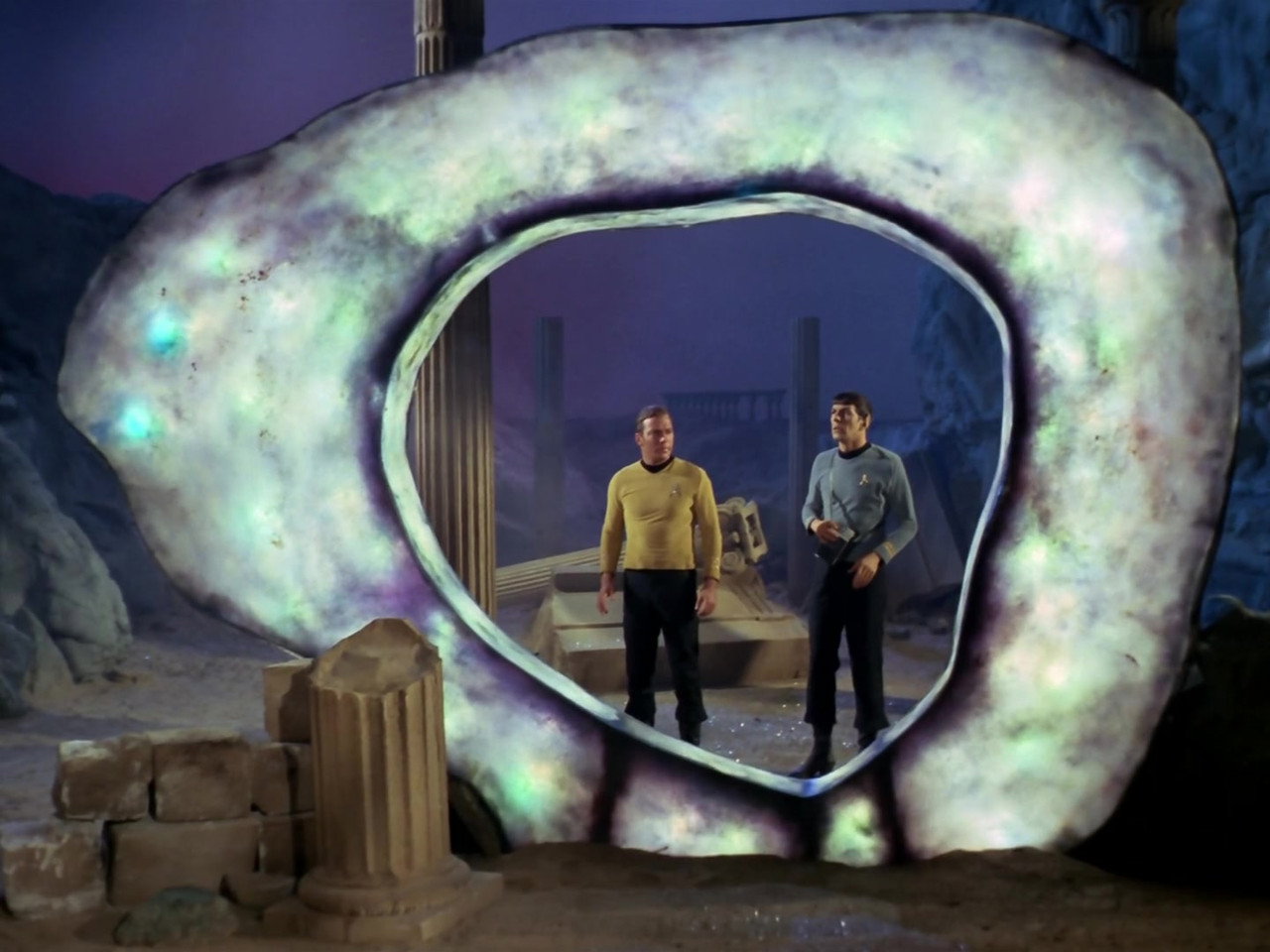
An accidental shot of cordrazine sends McCoy into a paranoid frenzy. He beams down to a planet of ruins.
- The Guardian
A ring of stone that speaks calls itself the Guardian of Forever. McCoy leaps through it, and the Enterprise vanishes.
- New York, 1930
Kirk and Spock land in the Depression. They steal clothes, find work at Edith Keeler's mission and wait for McCoy.
What Spock findsSpoiler · tap to reveal
In one future, Edith dies in a traffic accident. In the other, she leads a peace movement that delays America's entry into the war.
The streetSpoiler · tap to reveal
McCoy goes to save her. Kirk stops him.
Why it still matters
Most time-travel stories ask whether you can change the past. This one asks what it costs to put it back. Dr. McCoy, out of his mind on an accidental overdose, jumps through an ancient time portal and erases the Federation. Kirk and Spock follow him to Depression-era New York to undo whatever he did, and Kirk meets Edith Keeler, who runs a soup kitchen and talks about a future where people will reach the stars. She's right about the future. She's also the problem.
It's the episode fans voted the best of the whole franchise at the 50th-anniversary convention in Las Vegas in 2016, and it won the Hugo Award for Best Dramatic Presentation. Leonard Nimoy called it good tragedy. It's also the most fought-over script in Star Trek history: Harlan Ellison's original was rewritten by at least four other people, and he spent decades saying so.
What Kirk has to do
Spock's tricorder shows two histories. In ours, Edith Keeler dies in 1930 when a truck hits her. In the one McCoy creates by saving her, she lives to lead a pacifist movement that keeps the United States out of World War II long enough for Germany to develop the atomic bomb and win. Kirk is in love with her by then. When she steps into the street and McCoy runs to pull her back, Kirk holds him. Edith dies, history snaps back, and the Enterprise returns. Kirk's last line, "Let's get the hell out of here," is one the network wanted cut.
The Question Underneath
Would you let something terrible happen to one person if it saved millions?
Edith Keeler is right about peace, and right too early. Kirk has to let her die because her goodness, in that moment, would let something far worse win. The episode refuses to make the choice easy or the price small. It's one of the rare stories where doing the right thing feels exactly like doing the wrong one, and Kirk's last line carries all of that.
Challenge the DNA
Did Kirk make the right choice?
Or skip ahead to our reading
Yes, and it costs him everything he has. The episode doesn't ask you to like the choice; it asks you to watch him make it.
Behind the scenes
- The writing took more than ten months. After Ellison's script, story editor Steven W. Carabatsos rewrote it, Ellison rewrote his own draft, producer Gene L. Coon worked on it, D. C. Fontana wrote the version the episode is built on, and Gene Roddenberry did the final pass. Only Ellison is credited.
- In Ellison's version, a crewman named Beckwith deals drugs and kills a shipmate who threatens to expose him, the time portal is run by actual robed Guardians, and the Enterprise reappears as a pirate ship. Production thought it would cost too much, and objected to Kirk being too passive at the end. The pirate-ship idea resurfaced in "Mirror, Mirror" later that year.
- Ellison's original teleplay won the Writers Guild of America Award; the episode as aired won the 1968 Hugo. Ellison later published his own version as a book, with a long essay about the rewrite.
- It was the most expensive episode of the first season and ran a day and a half over schedule.
- When Kirk and Edith walk down the street, the shop behind them is Floyd's Barber Shop. The New York street scenes were shot on Desilu's Forty Acres backlot in Culver City, the same streets that played Mayberry on The Andy Griffith Show.
The thread
Where the idea came from, what shares it, and the Guardian's long life since.
Came before
Shares DNA with
Left its mark on
DNA strand
Time Loops & Timelines
Timeline stories run on a rule, and the rule here is brutal: history has one shape, and it doesn't care who you love. What makes the episode great is that the rule is never questioned. There's no clever third option and no last-minute loophole. The time machine is just a way of putting Kirk on that street corner with a choice nobody should have to make.
Every great sci-fi story is built from a handful of strands like this one. Each strand page explains how it works and traces it across shows, books and films.
If this one stayed with you
Where to go next, and why.
Read · Teleplay
Harlan Ellison's The City on the Edge of Forever
Ellison's original script, with his essay on the fight over it. Read it to see how different the episode almost was, and to decide whose version you like better.
Watch · Star Trek: TNG S3
"Yesterday's Enterprise" (1990)
The Next Generation's answer: a broken timeline, a crew that has to go back to its death, and a character who chooses to go with them.
Read · Novel
11/22/63 — Stephen King
A man goes back to stop the Kennedy assassination and falls in love along the way. If the street corner stayed with you, King spends 800 pages on the same dilemma.
Watch · Star Trek S1
"Tomorrow Is Yesterday" (1967)
Earlier the same season, the Enterprise lands in 1960s America by accident. It's the light, funny version of the problem.
Your next episode
Three directions to go from here, all on Sci-Fi DNA.

More of this feeling
Yesterday's Enterprise
Star Trek: The Next Generation
Another fight to put history back where it belongs, and another price somebody pays.

Same question, different answer
San Junipero
Black Mirror
Can love outlast time? Black Mirror gives a very different answer.

Something completely different
Dimension Jump
Red Dwarf
Other timelines played for laughs: Rimmer meets the man he could have been.
On the trail Time loops that do more than repeat the day (stop 5 of 6).
Sources
- “The City on the Edge of Forever,” Wikipedia
- “Star Trek – The City On The Edge Of Forever,” PowerPop
- “The City on the Edge of Forever (Ellison's teleplay),” OverDrive catalog listing
- “Star Trek Re-watch: "The City on the Edge of Forever",” Reactor (Tor.com)
- “Today in Star Trek History: A Score Is Born,” Daily Star Trek News
- “RKO Forty Acres,” Wikipedia
- “Harlan Ellison's original City on the Edge of Forever (behind the scenes),” TrekCore