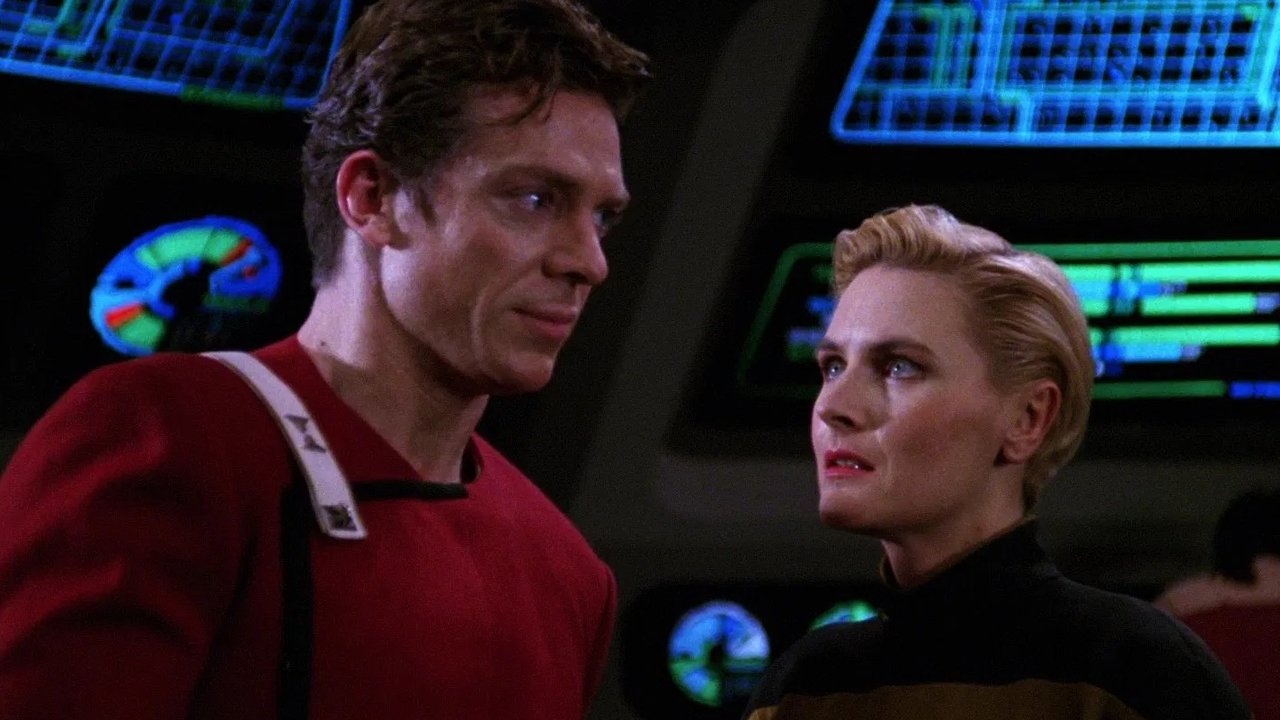
The story in 5 beats
- The rift
The Enterprise-C, lost more than two decades ago, comes through a rift in space. The present rewrites itself around it.
- A warship
No Worf, no Troi. Tasha Yar is alive and at tactical. Only Guinan senses that this isn't how things should be.
- Narendra III
The old ship left history while answering a Klingon outpost's distress call. Guinan says it has to go back, even if it means dying.
Yar's choiceSpoiler · tap to reveal
Guinan tells Tasha that in the other timeline her death meant nothing. Tasha asks to go back on the Enterprise-C.
RestoredSpoiler · tap to reveal
The Enterprise-C goes through. History snaps back, and Guinan asks Geordi to tell her about Tasha Yar.
Why it still matters
One minute the Enterprise is on a survey. The next, a ship thought destroyed more than twenty years ago comes out of a rift, and everything changes around it without a cut. The bridge is darker, the Enterprise is a warship, the Federation is at war with the Klingons, and Tasha Yar, killed off in season one, is back at tactical as if she never left. Nobody notices except Guinan, who can't explain how she knows.
It's the episode that convinced a lot of viewers The Next Generation had arrived. It drew the highest rating of its season, and fans at the 50th-anniversary convention voted it the fifth best episode of the whole franchise. It also gave Denise Crosby what she wanted: a second, better death for a character the show had thrown away.
Let history never forget
The Enterprise-C was destroyed defending a Klingon outpost from Romulans, and that sacrifice was what eventually made peace between the Klingons and the Federation. Pulled out of time, it never happened, and the war followed. Picard agrees to send the ship back, though he won't order anyone to their death on a hunch. Captain Garrett is killed in a Klingon ambush, so young helmsman Richard Castillo takes command, with Tasha Yar beside him. The Enterprise-D holds off three Klingon cruisers while the old ship goes through, losing Riker and much of its crew. Then the timeline resets, nobody remembers a thing, and Guinan, quietly, asks Geordi about a woman she has never met.
The Question Underneath
Would you accept an unhappy fate if it was the only way to set things right?
The crew of the old Enterprise are asked to go back and die, because their sacrifice is what history needs. Tasha learns that in the right timeline she died for nothing, and chooses to go with them so her death means something. The episode makes a war story about how much one act of courage can carry, and how much one person can give it.
Challenge the DNA
Should Tasha have gone back?
Or skip ahead to our reading
Yes. Picard won't order anyone back on a hunch, and he doesn't have to. Tasha chooses it, which is everything her first death wasn't.
Behind the scenes
- It began as a spec script from fan Trent Christopher Ganino, sent in through the show's open-submission policy. Separately, staffer Eric A. Stillwell had met Denise Crosby at a 1989 fan convention, and she suggested bringing Yar back. Michael Piller merged the two ideas.
- To fit the schedules of Crosby and Whoopi Goldberg, the episode was moved up from January 1990 to December 1989. Four staff writers split the teleplay, with Piller finishing it, to make the deadline. Filming ran seven days, December 11–19.
- For the war timeline, the bridge was redressed: steps instead of ramps, a raised captain's chair, and a "military log" instead of a captain's log.
- Greg Jein built the Enterprise-C model, for more than $10,000.
- It drew a 13.1 Nielsen rating, the highest of the season and the third highest of the series.
The thread
Where it fits in Trek's time-travel history, what else asks the same question, and what grew from it.
Came before
Shares DNA with
Left its mark on
DNA strand
Time Loops & Timelines
Most timeline stories show you the change and then fix it. This one makes the broken timeline real enough to grieve: the crew in it fight and die, and when history resets, their sacrifice disappears with them. Only Guinan carries anything across, and all she has is a feeling. The episode is sadder for it, and better.
Every great sci-fi story is built from a handful of strands like this one. Each strand page explains how it works and traces it across shows, books and films.
If this one stayed with you
Where to go next, and why.
Watch · Star Trek S1
"The City on the Edge of Forever" (1967)
The original version of the dilemma: history depends on a death, and the crew has to let it happen. Same question, smaller and more personal.
Watch · Star Trek: TNG S7
"Parallels" (1993)
Worf slides between versions of reality, each slightly wrong. If the altered bridge was your favorite part, this is a whole episode of it.
Read · Novel
The Man in the High Castle — Philip K. Dick
An America where the Axis won, and characters who start to suspect the world shouldn't be like this. Guinan's unease, stretched across a novel.
Watch · Film
It's a Wonderful Life (1946)
Take one person out of history and watch the whole town turn mean. It's the Christmas-movie version of the same idea.
Your next episode
Three directions to go from here, all on Sci-Fi DNA.
More of this feeling
The City on the Edge of Forever
Star Trek
The original fight to put history back the way it was, and what it costs.
Same question, different answer
Mirror, Mirror
Star Trek
Another Enterprise that went a different way. This one comes with goatees.

Something completely different
Nosedive
Black Mirror
From a war-torn timeline to a pastel world of five-star ratings.