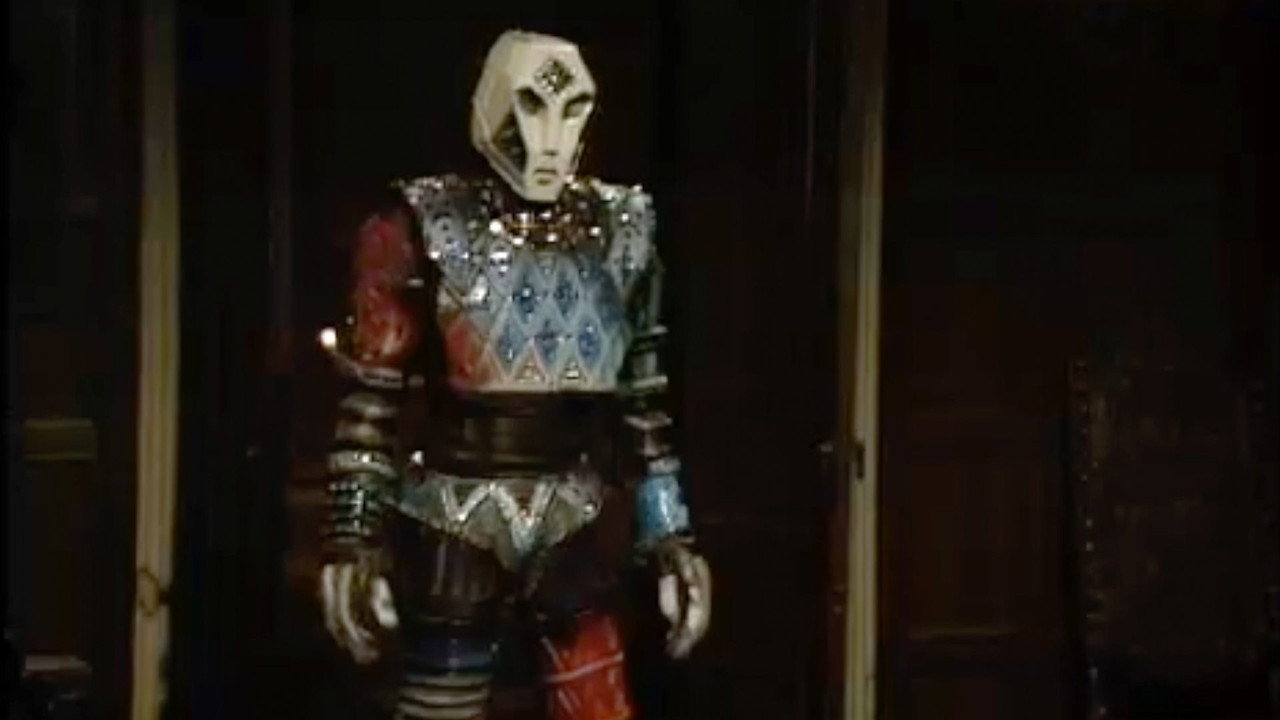
More from the episode


The story in 5 beats
- Sulphur in the air
The TARDIS lands near London in the 17th century. The Doctor, Adric, Nyssa and Tegan step out, smell sulphur and go looking for the source.
- Richard Mace, thespian
A highwayman who insists he is really an actor gets the travellers to safety in a barn and tells them about a comet that came down nearby.
- Rats in the cellar
The comet was a ship. A Terileptil fugitive is controlling villagers with bracelets, and a manor cellar is full of caged rats bred to carry a stronger plague.
To LondonSpoiler · tap to reveal
The Doctor follows the Terileptils to a building in London, where a fight leaves the leader's weapon overloading.
Pudding LaneSpoiler · tap to reveal
The blast starts a fire. Mace stays to fight it, the TARDIS leaves, and the street turns out to have a famous name.
Why it still matters
This is the story where the Doctor loses his sonic screwdriver, and the show chose not to give it back. A Terileptil destroys it, and Peter Davison's Doctor says he feels as if someone has just killed an old friend. Eric Saward explained in a 2005 DVD interview that he wrote it out on producer John Nathan-Turner's instructions; Saward assumed the Doctor kept spares, but Nathan-Turner thought a device that could get him out of any situation made the scripts too easy. Apart from a brief turn in the 1996 TV movie, it stayed out of the series until 2005.
It was also Saward's first script for the show. He was a radio dramatist when script editor Christopher H. Bidmead asked him for ideas on the strength of a recommendation from BBC Radio, and this commission led to him becoming the programme's script editor himself, a job he held until 1986. The result is a pseudo-historical, real English history with aliens hidden inside it, and its best invention is human: Richard Mace, an out-of-work actor making a living as a highwayman. The Discontinuity Guide called it "a stylish slice of pseudo-historical nonsense" and said Davison and Michael Robbins turn in "a pair of lovely performances."
Audiences liked it too. Season 19 had moved the show from Saturdays to Monday and Tuesday evenings, and The Visitation's four parts climbed from 9.1 million viewers to 10.1 million. Davison later picked it out as one of his favourites in a 2013 BBC News interview.
Who really started the Great Fire
In London the Doctor and Mace confront the Terileptil leader and two others. The Doctor stops them, but the leader's weapon overloads and explodes, destroying the building and setting it ablaze. Mace stays behind to help fight the fire while the Doctor and his friends leave in the TARDIS, and the street they leave burning turns out to be Pudding Lane. The real Great Fire of London broke out at Thomas Farriner's bakery in Pudding Lane on September 2, 1666.
So the Doctor, in this version of history, started the Great Fire of London. Davison told BBC News in 2013 that as a boy he had loved the stories where the Doctor tinkered with history, "so I liked The Visitation, where I started the Great Fire of London." The next story, Black Orchid, opens with the Doctor assuring his companions that nothing could have prevented the fire.
Challenge the DNA
Is it a fun joke that the Doctor starts the Great Fire of London?
Or skip ahead to our reading
It's a joke the show likes, and it works here because it's an accident. The Doctor doesn't set out to burn London. History just catches up with him, which is a running gag the series kept enjoying.
Behind the scenes
- Christopher H. Bidmead approached Eric Saward, then a radio writer, after BBC Radio's senior drama script editor recommended him. The Visitation came out of that, and Antony Root, who briefly replaced Bidmead, then recommended Saward as the show's next script editor.
- Saward said in a 2005 DVD interview that he wrote out the sonic screwdriver on John Nathan-Turner's instructions. Saward assumed the Doctor had "a cupboard full of them" in the TARDIS; Nathan-Turner decided it would not come back.
- Antony Root script-edited this story and Four to Doomsday before Saward took over. Peter Moffatt directed.
- The Television Companion (1998) called it "a very enjoyable story, and one of the highlights of the season," praising the location filming but naming "Matthew Waterhouse's peculiar performance as Adric" as a weakness.
- Patrick Mulkern of Radio Times gave the story four stars out of five in 2012, and The Discontinuity Guide singled out Michael Robbins's performance as Mace. SFX's Nick Setchfield called it a throwback, "brimful of oaky, shadowy 17th-century atmosphere."
- BBC1 repeated it on four consecutive evenings in August 1983, to between 3.6 and 4.8 million viewers.
- Paddy Kingsland's score, made with the BBC Radiophonic Workshop, came out on CD and vinyl from Silva Screen in May 2020.
The thread
Aliens hiding inside real English history, and a plague that the history books blame on something else.
Came before
Shares DNA with
Left its mark on
DNA strand
First Contact & Invaders
The Terileptils aren't conquerors with a fleet. They're a handful of escaped fugitives who want the planet emptied, and their weapon is the most ordinary thing in 1666: rats. It's an invasion story told at the scale of one village, a manor cellar and a single London street.
Every great sci-fi story is built from a handful of strands like this one. Each strand page explains how it works and traces it across shows, books and films.
If this one stayed with you
Where to go next, and why.
Watch · Doctor Who
"Black Orchid"
The very next story stays in English history, drops the aliens altogether and opens with the crew still discussing their trip to 1666.
Watch · Doctor Who
"Pyramids of Mars"
Tom Baker's version of the same recipe: a period English house with an alien menace, and a Doctor trying to keep history on its rails.
Watch · TNG S5
"Time's Arrow: Part One"
Star Trek's take on aliens hiding among the sick and poor of a real historical city.
Read · Novel
A Journal of the Plague Year — Daniel Defoe
Defoe's novel of London in 1665, the plague year the Terileptils mean to make worse, told street by street.
Your next episode
Three directions to go from here, all on Sci-Fi DNA.
More of this feeling
The Time Warrior
Doctor Who
Another alien hiding out in English history.
Same question, different answer
The City on the Edge of Forever
Star Trek
What happens when time travellers become part of a famous moment?

Something completely different
Black Orchid
Doctor Who
A country-house party in 1925, with no aliens at all.