
More from the episode

The story in 5 beats
- Egypt, 1911
Professor Marcus Scarman breaks into a burial chamber marked with the Eye of Horus and is struck by a beam of green light.
- The priory
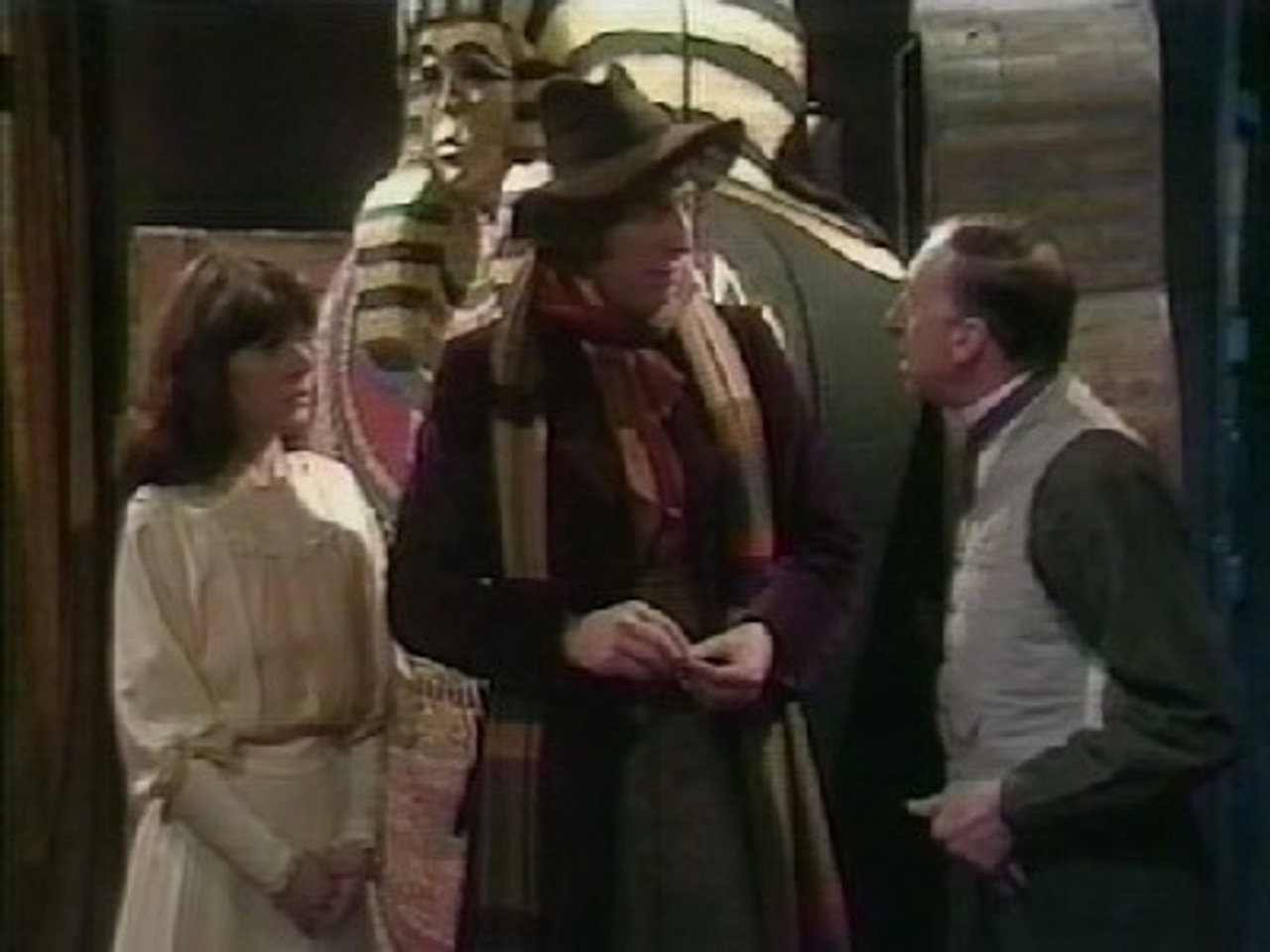
The TARDIS lands at Scarman's English house, now run by a sinister Egyptian, Namin. Scarman's brother Laurence has picked up a strange signal from Mars.
- Beware Sutekh
The Doctor decodes the message and explains: the Osirans inspired Egypt's gods, and Sutekh, the last of them, is imprisoned by the Eye of Horus.
Face to faceSpoiler · tap to reveal
To stop Sutekh's servants launching a rocket at Mars, the Doctor goes down the time tunnel to the prisoner himself.
The pyramid on MarsSpoiler · tap to reveal
Under Sutekh's control, the Doctor guides Scarman to Mars, where the Eye of Horus is kept.
Why it still matters
David J. Howe and Stephen James Walker called this the fullest expression of the show's Gothic horror era, and it's easy to see why. It takes the furniture of a Hammer mummy picture, the sealed tomb, the country house, the lurching bandaged guards, and explains all of it with science fiction: the gods of ancient Egypt were a race of aliens called the Osirans, and one of them, Sutekh, is still alive under a pyramid, waiting. In 1985 Colin Greenland called it "a yeasty brew of Hammer horror, Egyptian mythology, and sf with a touch of H. G. Wells."
It's also a Fourth Doctor story where the Doctor is clearly outmatched. Gabriel Woolf gives Sutekh a calm, courteous voice from behind a still mask, and the Doctor spends four weeks scrambling. Tom Baker and Elisabeth Sladen keep it light where they can; one bit of business, ducking back into hiding at the sight of a mummy, was their own, borrowed from the Marx Brothers.
The audience agreed. A one-hour edit shown in November 1976 drew 13.7 million viewers, then the biggest audience the show had ever had. Readers of Doctor Who Magazine voted it eighth of all stories in 2014, and Patrick Mulkern of the Radio Times called it "a bona fide classic."
A very long corridor
Marcus Scarman has been dead since the tomb opened, a corpse walked about by Sutekh's will, and when Laurence tries to reach the brother he remembers, Marcus strangles him. The Doctor's gelignite plan works only after he travels down the time tunnel to break Sutekh's concentration, and Sutekh makes him a servant for his trouble, sending him to Mars with Scarman. There Scarman strangles the Doctor, but the Doctor's respiratory bypass system lets him recover, free of Sutekh's control. He is too late to stop Scarman destroying the Eye of Horus, and Scarman crumbles to dust.
The Doctor's last card is time itself. The signal from Mars takes a little while to reach Earth, so Sutekh isn't free yet, and the Doctor uses the TARDIS to stretch the end of the time tunnel far into the future. Sutekh walks toward his freedom and dies of old age before he reaches it. The overloaded tunnel sets the priory ablaze, and the Doctor and Sarah leave in the TARDIS as it burns.
Challenge the DNA
Was the Doctor right to treat Marcus Scarman as already dead?
Or skip ahead to our reading
Yes, and the story proves it the hard way. Laurence reaches for the brother he remembers and Marcus strangles him. It's one of the saddest moments of the era, and it's there to show what Sutekh costs people.
Behind the scenes
- The first scripts were by Lewis Greifer, who had worked with script editor Robert Holmes at ATV. Even after rewrites they didn't work as Doctor Who, so Holmes took over, keeping the premise but making the Osirans a race of powerful aliens and moving the story back to 1911. The serial went out under the pseudonym "Stephen Harris."
- The influences are on the surface: Universal's The Mummy (1932) and, above all, Hammer's The Mummy (1959) and Blood from the Mummy's Tomb (1971).
- Location filming took place at Stargroves, a Gothic Revival mansion in Hampshire then owned by Mick Jagger. Interiors and model work were done at BBC Television Centre.
- Bernard Archard was cast as Marcus Scarman because of his work in the 1970 film The Horror of Frankenstein. Production assistant Peter Grimwade suggested Michael Sheard for Laurence after seeing him in the BBC's Lord Peter Wimsey.
- Paddy Russell cut a model shot of the TARDIS landing in a ravaged alternative 1980, deciding the first view of it would hit harder as Sarah's reaction when the doors open. The fire at the end, done with colour-separation overlay and a controlled blaze, was the largest staged in the studio at the time.
- John J. Johnston of the Egypt Exploration Society traced Barbara Kidd's mummy robots to a Saharan rock painting that the explorer Henri Lhote nicknamed "the Great Martian God."
- Gabriel Woolf, who voices Sutekh, came back to Doctor Who in 2006 as the voice of the Beast in "The Impossible Planet" and "The Satan Pit."
The thread
Mummy films, ancient gods explained as aliens, and the Gothic streak of mid-1970s *Doctor Who*.
Came before
Shares DNA with
Left its mark on
DNA strand
First Contact & Invaders
The oldest contact story there is: the visitors came thousands of years ago, and we wrote them down as gods. Sutekh has had all that time to wait, and the Doctor has four episodes to stop him walking out.
Every great sci-fi story is built from a handful of strands like this one. Each strand page explains how it works and traces it across shows, books and films.
If this one stayed with you
Where to go next, and why.
Watch · Film
The Mummy (1959)
Hammer's tomb-and-curse picture is the film this serial leans on hardest. Watch it first and you'll spot the borrowings.
Watch · Doctor Who
"The Dæmons"
Four years earlier, the Third Doctor meets another ancient alien behind human myth, this time in an English village.
Watch · Star Trek
"Who Mourns for Adonais?"
The same idea on the far side of the Atlantic: an old god turns out to be a visitor who misses being worshipped.
Read · Novelisation
Doctor Who and the Pyramids of Mars — Terrance Dicks
The 1976 Target book adds a long prologue on the history of Sutekh and the Osirans that the serial only sketches.
Your next episode
Three directions to go from here, all on Sci-Fi DNA.

More of this feeling
The Brain of Morbius
Doctor Who
More Gothic horror from the same season.

Same question, different answer
Catspaw
Star Trek
Ancient powers dressed up in the trappings of human legend.

Something completely different
The Android Invasion
Doctor Who
Back to an English village, with something not quite right about it.