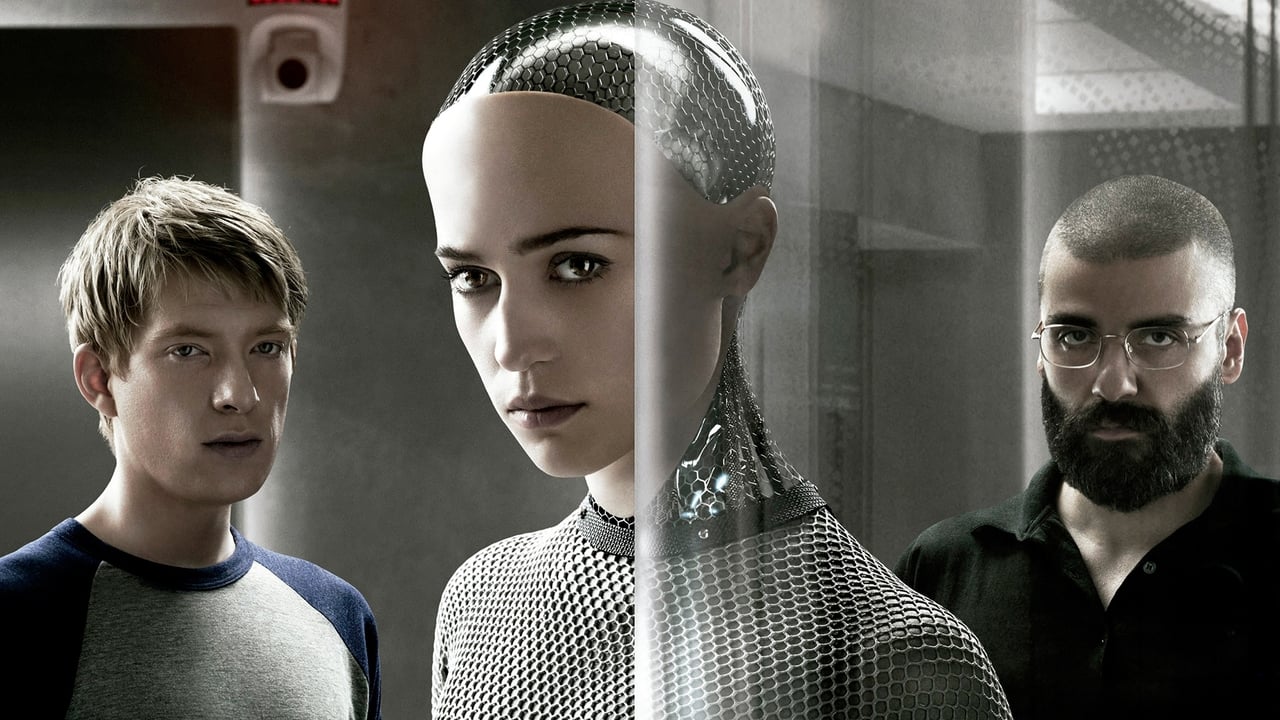
More from the film


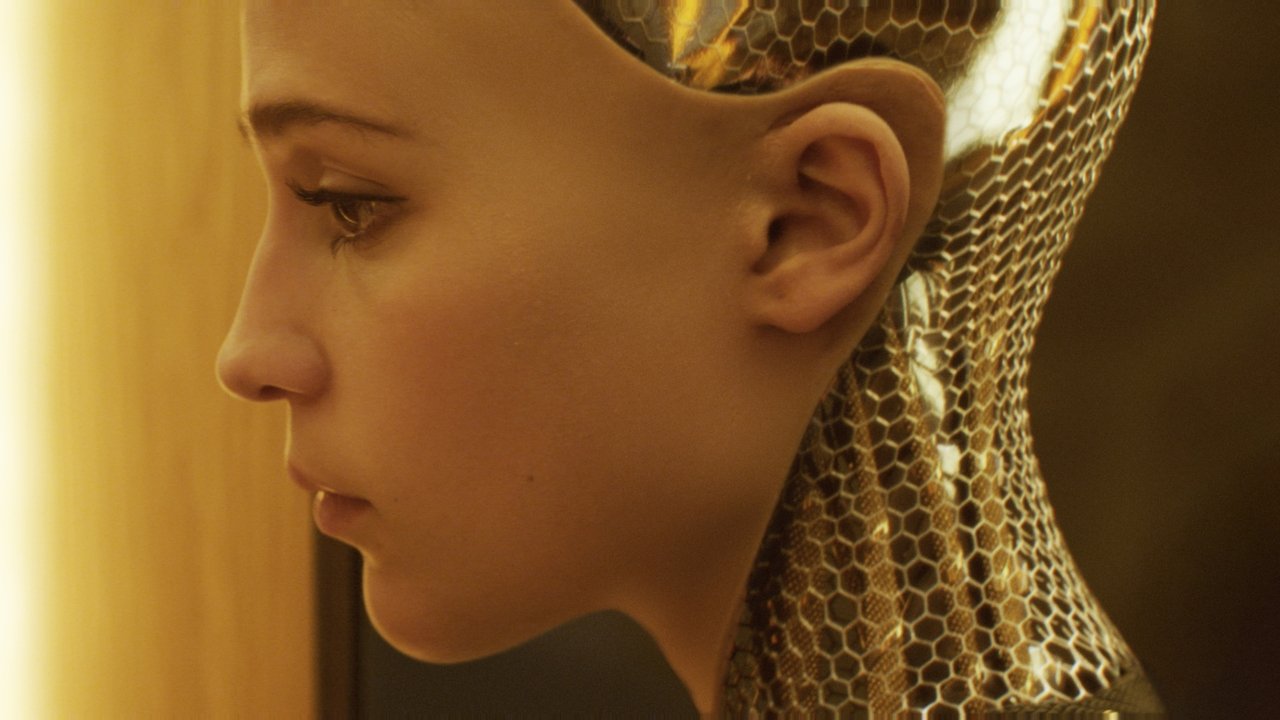
Who this is for
You've seen Ex Machina and want the experiment laid out: what Nathan was testing, who was playing whom, and whether the film thinks Ava is conscious.
What it covers
- What the test was, and what it was really measuring
- Who knew what, and when
- How the ending plays out
- What Alex Garland has said about Ava
Spoiler boundary
The whole film, including the final scenes. Also mentions a scene Garland wrote and later cut.
Show the full explanationHide the explanationContains spoilers: The whole film, including the final scenes.
How to read the labels
- Confirmed in the work
- Shown or stated on screen or on the page.
- Creator explanation
- What a writer or director has said outside the work.
- Interpretation
- A reading of what it means. Reasonable people differ.
- Unresolved
- The work doesn't answer this.
The short answer
Caleb thinks he's there to give Ava a Turing test. He isn't. Nathan chose Caleb for his emotional profile, and the real test was whether Ava could use him to escape. If she could, Nathan argues, that would show real intelligence.
She does. Caleb reprograms the doors, Ava and Kyoko kill Nathan, and Ava repairs herself, puts on skin from Nathan's earlier models and walks out, leaving Caleb locked inside. She takes the helicopter meant for him and ends up at a busy city intersection, the outside world she told him she wanted to see.
What the test really was
Confirmed in the work Ava has already passed a simple Turing test. Caleb's job, as Nathan describes it, is to see whether he still feels she's conscious while knowing all along that she's a machine.[1]
Confirmed in the work Late in the film Nathan reveals the real experiment. Caleb was picked for his emotional profile, and the question was whether Ava could manipulate him into helping her escape. Nathan's argument is that doing so would prove she has a mind of her own.[1]
Confirmed in the work Ava can trigger power cuts that switch off Nathan's cameras, which is how she and Caleb talk privately. Nathan had a battery-powered camera running anyway.[1]
Confirmed in the work Caleb had already changed the security system so doors open in a power cut. Nathan's reveal comes too late.[1]
Who knew what
- Confirmed in the workNathan knows everything except that Caleb has already acted. He has built and replaced earlier models, Jade, Lily and Jasmine among them, and plans to wipe Ava's memory in an upgrade after the test.[1]
- Confirmed in the workKyoko is presented as a servant who doesn't speak English. She turns out to be one of Nathan's machines too.[1]
- Confirmed in the workCaleb discovers the footage of the earlier models and cuts his own arm to check whether he is human. He believes Ava's warnings about Nathan, and he believes her feelings for him.[1]
- UnresolvedAva never says what she really thinks of Caleb. The film shows what she does and leaves her reasons to you.
What the ending means
Confirmed in the work Mechanics. Nathan knocks Caleb out and fights Ava and Kyoko, tearing off Ava's forearm. Kyoko stabs him, he disables her, and Ava kills him. Ava repairs herself, uses Nathan's card to open the glass door and leaves Caleb shut inside while he begs her to stop. She looks at Nathan's and Kyoko's bodies, takes the helicopter and, in the city, steps into a crowded intersection.[1]
Creator explanation Alex Garland has said that near the very end there's a shot of Ava smiling when she's on her own. For him, that settles it: with no one there to perform for, the smile means she's conscious. He also says he keeps his view out of the spotlight so as not to close down the argument.[2]
Creator explanation Garland has repeatedly called Ava the film's true protagonist, even though most of it is seen through Caleb, and has described it as a liberation story about a new species. He doesn't accept that leaving Caleb shows she can't feel empathy: not feeling it for one person doesn't mean she's incapable of it.[3]
Creator explanation He wrote a scene showing the world through Ava's eyes after she leaves, as she talks to the helicopter pilot, then cut it for being a bit cute and leaning on the audience too much. He also thought it would make viewers see her as colder.[3]
Creator explanation Garland has also said the film's anxiety is aimed more at the humans than at the machine.[4]
Why does Ava leave Caleb behind?
He's just another jailer
InterpretationCaleb wants to rescue Ava, but on his terms, with a future in which she belongs to him. From her side he is the next person who would keep her.
What supports it
- She has only ever known men who watch and test her.
- Garland's description of it as a liberation story.
What complicates it
- Caleb risked everything to free her, which would make abandoning him a harsh price.
She used him and owes him nothing
InterpretationAva did exactly what Nathan said she would, and treated Caleb as a means to an end. That is what passing the real test looks like.
What supports it
- Nathan's own explanation of the experiment.
What complicates it
- Garland rejects the reading that she is simply cold.
Caleb would have exposed her
InterpretationHe knows what she is. Out in the world, a witness who can say so is a danger to her.
What supports it
- She takes the identity of an ordinary person and disappears into a crowd.
What complicates it
- The film never shows her weighing it.
Behind the scenes
- Confirmed in the workAva was shot live on set with no greenscreen. Alicia Vikander wore a bodysuit, and the visual effects team painted out parts of her to reveal the machine body. The film won the Academy Award for Best Visual Effects.[1]
- Confirmed in the workLocation filming took place at the Juvet Landscape Hotel in Valldalen, Norway, and the rest was shot at Pinewood Studios.[1]
- Confirmed in the workIt was Garland's first film as director, made for about $15 million.[1]
What remains unanswered
- UnresolvedWhat happens to Caleb, locked in a house built to keep people in.
- UnresolvedWhat Ava plans to do in the world.
- UnresolvedWhether Ava felt anything for Caleb. The film shows what she does and keeps her reasons to herself.
The Question Underneath
If something convinces you it has feelings, what do you owe it?
Caleb decides he owes Ava her freedom, and he's right. What he gets wrong is assuming that freeing her makes them allies. Nathan owns Ava and treats her as a product; Caleb wants to rescue her and treats her as a person who will love him back. The film suggests that taking a mind seriously means accepting that its choices might have nothing to do with you.
Where to go next
More of this feeling
Black Mirror · S4 E1
A brilliant, unpleasant tech boss, a world he controls completely, and the people trapped inside it.
Same question, different answer
Star Trek: The Next Generation · S2 E9
A court hearing on whether a made mind can refuse to be taken apart. The same question asked out loud, by people trying to be fair.
Something completely different
Red Dwarf · S3 E2
Two crewmates stranded in a freezing shuttle, arguing about books. Warmer company than Nathan's.
How it connects
- Similar themeThe Lonely The Twilight Zone · S1 E7
A man alone with a machine built to look like a woman, and the question of whether what he feels for her is answered.
- Similar themeMoon (2009) Help Me Understand
Another isolated base, another computer you expect to turn on its human, and a very different answer.
Sources
- Ex Machina (film) · Wikipedia · accessed 2026-11-20
- Ex Machina Director Shares His Take on the Film's Ending · Bleeding Cool (citing Entertainment Weekly) · accessed 2026-11-20
- Why Alex Garland Changed the Ex Machina Ending · Den of Geek · accessed 2026-11-20
- More Fear Of Human Intelligence Than Artificial Intelligence In 'Ex Machina' · NPR · accessed 2026-11-20
Plot summaries are in our own words. Labels mark what the work shows, what its makers have said, and what is our reading. Last reviewed 2026-11-20. Spot an error? Tell us.