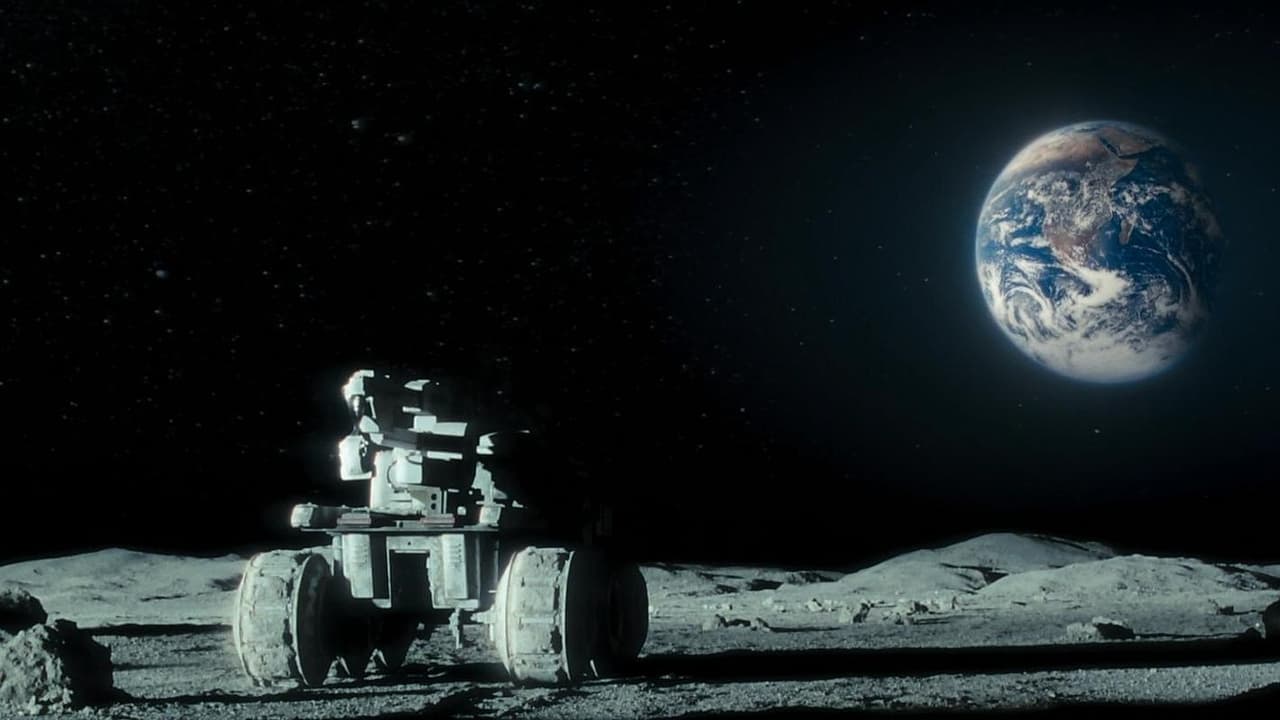
More from the film



Who this is for
You've finished Moon and want the company's set-up laid out plainly: what was hidden, how it worked, and what Sam's last decisions mean.
What it covers
- What Lunar Industries is really doing on the base
- How GERTY fits in
- The plan at the end, step by step
- A few production details worth knowing
Spoiler boundary
The whole film, including the ending. Mentions Oblivion (2013) in the spoiler section, without spoiling it beyond its premise.
Show the full explanationHide the explanationContains spoilers: The whole film, including the ending.
How to read the labels
- Confirmed in the work
- Shown or stated on screen or on the page.
- Creator explanation
- What a writer or director has said outside the work.
- Strong inference
- Not stated outright, but the evidence points one way.
- Interpretation
- A reading of what it means. Reasonable people differ.
- Unresolved
- The work doesn't answer this.
The short answer
Sam Bell isn't the original Sam Bell. He's one of many clones that Lunar Industries keeps in a hidden vault under the base, each woken with the original's memories and a three-year contract that ends in his death, not a trip home. The live link to Earth is jammed so no Sam can find out.
After a crash, the company wakes a new Sam while the old one is still alive. The two find the vault and the jammers, and learn that the original Sam's wife Tess died years ago. The dying older Sam goes back to the crashed rover so nothing looks wrong, and the newer Sam escapes to Earth on a fuel transport. His testimony brings the company down.
What Lunar Industries is really doing
Confirmed in the work Sarang Station mines helium-3 on the Moon's far side for fuel on Earth, and needs only one person to run it.[1]
Confirmed in the work Rather than train and fly up new workers, the company reuses clones of one man. Each is woken with the original Sam's memories of his wife Tess and their daughter Eve, works a three-year contract, starts to fall ill as it ends, and is killed when it's over.[1]
Confirmed in the work The "broken" live link to Earth is deliberate: a substation jams it, so the only messages Sam gets are recordings.[1]
Strong inference The recordings from Tess are years old by the time any current Sam sees them. That's why they never change much, and why the company can keep playing them.
GERTY
Confirmed in the work GERTY, the base's computer, is voiced by Kevin Spacey, whose performance was influenced by HAL from 2001: A Space Odyssey.[1]
Confirmed in the work GERTY is the one who tells the two Sams that they are both clones, helps the older Sam find the logs of the clones before him, and suggests the newer Sam reboot it to wipe its records before he leaves.[1]
Creator explanation Duncan Jones has said GERTY isn't sentient and is actually quite simple. It has one goal: keep Sam safe and looked after until he heads home. Jones designed it as the opposite of the self-aware robots he'd read about, and says everyone brings their own baggage to GERTY.[2]
Interpretation That explains the turn. The film lets you expect a HAL, and GERTY keeps doing the one thing it was built for, which is looking after the Sam in front of it. Helping him escape is just the most literal way of getting him home.
The plan at the end
Confirmed in the work The call. The older Sam drives out past the jamming range and reaches Earth. He speaks to Eve, now 15, who tells him her mother died years earlier.[1]
Confirmed in the work The rescue team. A company team is on its way. If it finds two Sams, both will be killed.[1]
Confirmed in the work The swap. The older Sam, dying, asks to be put back in the crashed rover. A fresh clone is woken so the team finds what it expects.[1]
Confirmed in the work The escape. The newer Sam wipes GERTY's records, sends a harvester to destroy the jamming antenna and launches himself to Earth in a helium-3 transport.[1]
Confirmed in the work Afterwards. The rescue team is fooled. On Earth, Sam becomes a whistleblower and Lunar Industries' stock collapses.[1]
What the ending means
Interpretation Meaning. The older Sam's choice is the heart of it. He gives up the trip home he's been promised for three years so that another man, who is in every way that matters to him also Sam, can have it. The film takes it as given that clones are people and lets the company's behaviour speak for itself.
Creator explanation Jones has said he and Rockwell deliberately steered away from the comedy Multiplicity: they wanted each clone to be a fully rounded person. The film's ending depends on you believing that both Sams are.[2]
Unresolved What the newer Sam does with a life whose memories belong to someone else, and whether he ever meets the original Sam or Eve. The film stops at the whistle being blown.
Behind the scenes
- Confirmed in the workMoon was shot in 33 days at Shepperton Studios on a budget of about $5 million, on a full 360-degree base set.[1]
- Confirmed in the workDuncan Jones preferred physical models to digital effects and worked with Bill Pearson, a supervising model maker on Alien, on the rovers and harvesters.[1]
- Creator explanationThe film began with Sam Rockwell wanting to play a blue-collar working man. Jones and Rockwell talked about the crews of Outland, Silent Running and the opening of Alien, and Jones wrote Moon for him.[3]
- Confirmed in the workSome set pieces were reused from an abandoned Red Dwarf film.[1]
- Confirmed in the workIt won the 2010 Hugo Award for Best Dramatic Presentation, and Jones won the BAFTA for Outstanding Debut.[1]
The Question Underneath
What does a company owe the people who keep it running?
Lunar Industries' answer is: as little as it can get away with. Every Sam does the same lonely job, believes the same promises and is replaced when he wears out. The film never shows anyone from the company being cruel to his face. The cruelty is in the spreadsheet, and it only falls apart because two of the Sams meet and start comparing notes.
Connections that give things away
- Similar story mechanismOblivion (2013) Help Me Understand
A worker on a long shift for a distant employer starts to doubt the company story. Critics noticed the resemblance; nobody involved has said one influenced the other.
Where to go next
More of this feeling
Help Me Understand
Another lone technician on an empty world, nearly at the end of his tour, who starts dreaming of a woman he can't place.
Same question, different answer
Star Trek: The Next Generation · S2 E9
A court has to decide whether a being made by others can own its own life.
Something completely different
Red Dwarf · S5 E6
Another small crew stuck a long way from home, this time played for laughs, from the show whose abandoned film lent Moon some of its sets.
How it connects
- Documented influence on thisSilent Running (1972) Film · Douglas Trumbull
Duncan Jones has named it as an influence: a lone caretaker in space, a small crew of robots, and an employer that doesn't care. Source
Sources
- Moon (2009 film) · Wikipedia · accessed 2026-11-20
- Duncan Jones on the Moon · Psychology Today · accessed 2026-11-20
- Duncan Jones talks Moon, Sam Rockwell, and Mute · Rotten Tomatoes · accessed 2026-11-20
Plot summaries are in our own words. Labels mark what the work shows, what its makers have said, and what is our reading. Last reviewed 2026-11-20. Spot an error? Tell us.