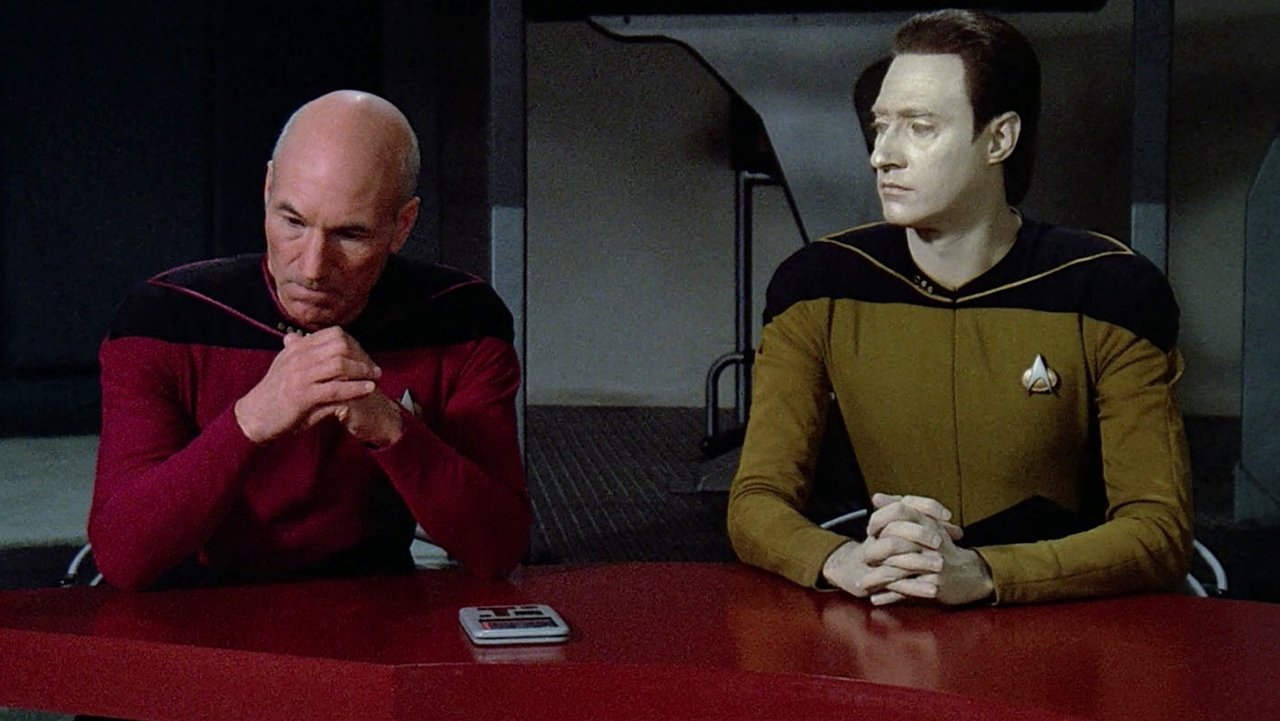
The story in 5 beats
- Starbase 173
Commander Maddox arrives with orders to transfer Data to his lab, dismantle him and study how he works.
- Property
Data resigns rather than go. The judge advocate general rules that he's Starfleet property and can't resign.
- Riker for the prosecution
With no one else to argue the case, Riker is ordered to argue against Data. He reaches over and switches him off.
GuinanSpoiler · tap to reveal
In Ten Forward, Guinan points out what Maddox's plan really is: an army of disposable people. Whole generations of them.
The rulingSpoiler · tap to reveal
Picard argues Data is sentient by Maddox's own test. The judge rules that Data has the right to choose.
Why it still matters
A cyberneticist named Bruce Maddox wants to download Data's memory and dismantle him, to learn how to build more. Data says no. Starfleet says Data is property and doesn't get to say no. Picard asks for a hearing, and the judge, short on staff, orders Riker to argue the other side. So the second season of The Next Generation, not famous for its quality, produces a courtroom drama in which the first officer has to try his hardest to prove his friend is a toaster.
It's the episode that made people take the show seriously. Entertainment Weekly called it the first truly great Next Generation episode, Brent Spiner named it his favorite, and it has been taught in a university computer-ethics course. It holds up because Melinda Snodgrass, a former lawyer, writes both sides honestly. Riker's case is good, and it hurts him to make it.
How Picard wins
Guinan's point turns the case. If Maddox is right and can build thousands of Datas, and they're all property, the Federation has invented a slave race. Picard puts Maddox back on the stand and walks him through his own three criteria for sentience: intelligence, self-awareness and consciousness. Maddox has to admit Data meets the first two, and nobody can prove anything about the third, for Data or for anyone else. Judge Phillipa Louvois rules that Data is not property and may refuse. In the last scene, Data finds Riker alone at the party and thanks him: by arguing so hard, Riker gave Data the chance to win.
The Question Underneath
Who gets to decide whether someone is a person?
The court case is about Data, but the real stakes are everyone like him who might come after. Guinan names it: if he's property, the Federation has just invented a way to own people. The episode's answer is careful. The judge can't say whether Data has a soul. She can say the law shouldn't be the thing that takes the chance away from him.
Challenge the DNA
Did the ruling go far enough?
Or skip ahead to our reading
It goes exactly as far as the case needs: Data isn't property and can say no. Whether he's a person is left for another day, and the episode seems to know it.
Behind the scenes
- Melinda M. Snodgrass, a former attorney, wrote it as an unsolicited spec script. The show was short of scripts after the 1988 Writers Guild strike, which helped it get bought. It was her first TV credit, and she joined the writing staff soon after.
- Snodgrass has said most people see it as Data's story, but she wrote it about Picard, with Data as the catalyst.
- It has the first scene of the crew's poker game, a tradition that runs through the series and closes the finale, "All Good Things..."
- The first cut ran long, and several scenes were trimmed. In 2012 an extended cut was rebuilt from a rough-cut VHS tape Snodgrass had kept, and it played in cinemas that November.
- Starbase 173 is a model built for Star Trek: The Motion Picture and reused in The Wrath of Khan, and the courtroom is the Enterprise's battle bridge set, redressed.
- Brian Brophy, who plays Maddox, had played Traker on Max Headroom. Maddox came back 30 years later in Star Trek: Picard, played by John Ales.
The thread
The old question behind it, who else has put a machine on trial, and where the ruling echoes.
Came before
Shares DNA with
Left its mark on
DNA strand
Do Machines Dream?
Most machine-mind stories try to answer whether the machine is conscious. This one admits nobody can, and asks what we should do anyway. Picard doesn't prove Data has an inner life. He shows that the people judging him couldn't prove it about themselves, and that the cost of guessing wrong falls entirely on Data. Decades later, with real AI in the news, that framing has aged better than almost anything else in the series.
Every great sci-fi story is built from a handful of strands like this one. Each strand page explains how it works and traces it across shows, books and films.
If this one stayed with you
Where to go next, and why.
Watch · Star Trek: TNG S3
"The Offspring" (1990)
Data builds a daughter, Lal, and Starfleet wants her. The same question as the trial, with much higher stakes for Data.
Watch · Film
Ex Machina (2014)
A programmer is brought in to test whether an AI is conscious. A darker take on the hearing, where the tester turns out to be the one under examination.
Read · Novella
The Lifecycle of Software Objects — Ted Chiang
Digital creatures raised over years by the people who love them, while the company that made them loses interest. It's the most thoughtful answer to Maddox anyone has written.
Watch · Black Mirror S2
"Be Right Back" (2013)
A machine copy of a dead man, and a woman who can't decide what it's owed. The same question, with grief instead of a courtroom.
Your next episode
Three directions to go from here, all on Sci-Fi DNA.

More of this feeling
Darmok
Star Trek: The Next Generation
Another TNG hour won by talking, not fighting.
Same question, different answer
Be Right Back
Black Mirror
Is a copy of a person a person? This time the copy is someone's boyfriend.

Something completely different
Back to Reality
Red Dwarf
From a courtroom to one of Red Dwarf's funniest half hours.
On the trails Who are you, really? (stop 4 of 5), Double feature: is a copy a person? (stop 1 of 2) and Can a machine love you back? (stop 2 of 5).