More from the episode
The story in 5 beats
- 11:46 p.m.
In Cambridge, Massachusetts, MIT cryogenics researchers Jason Nichols and Lucas Menand are arguing in the street when an old man warns Lucas a bus will kill him at 11:46 that night.
- Right on time
Campus security takes the old man away. That night Jason tries to pull Lucas clear, the bus hits him at 11:46 exactly, and the driver tells police Jason pushed him.
- Frozen solid
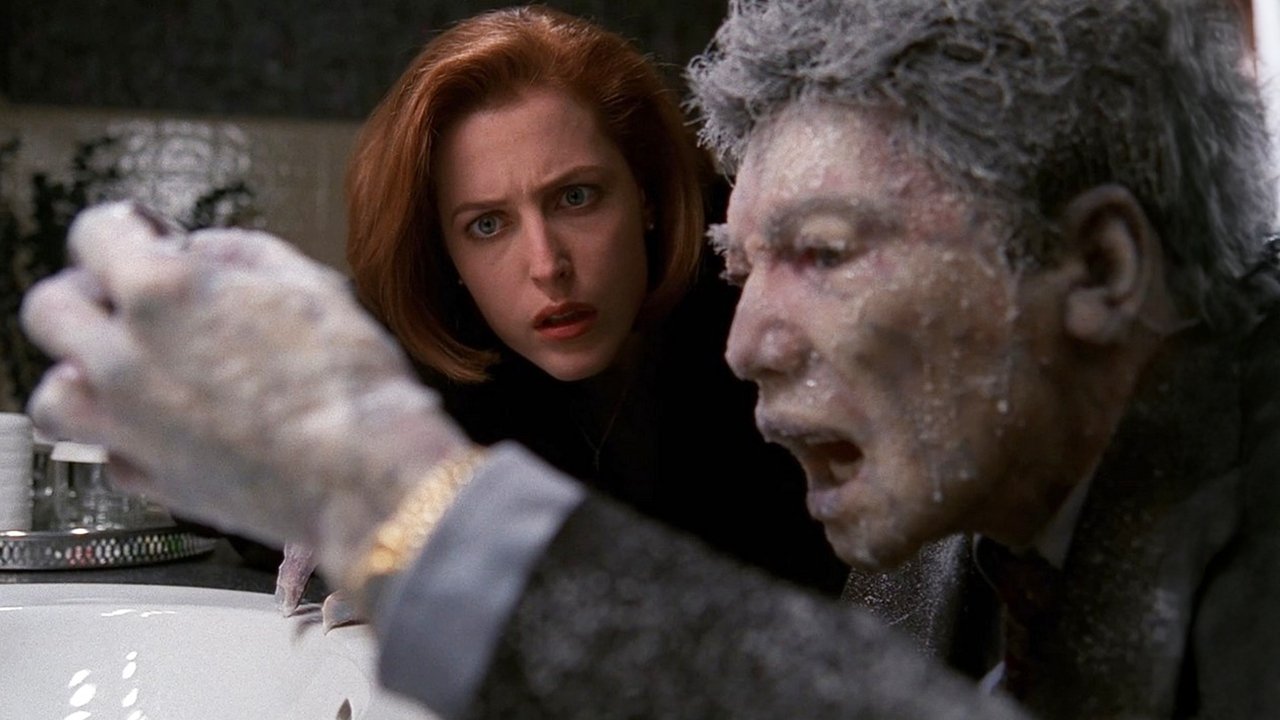
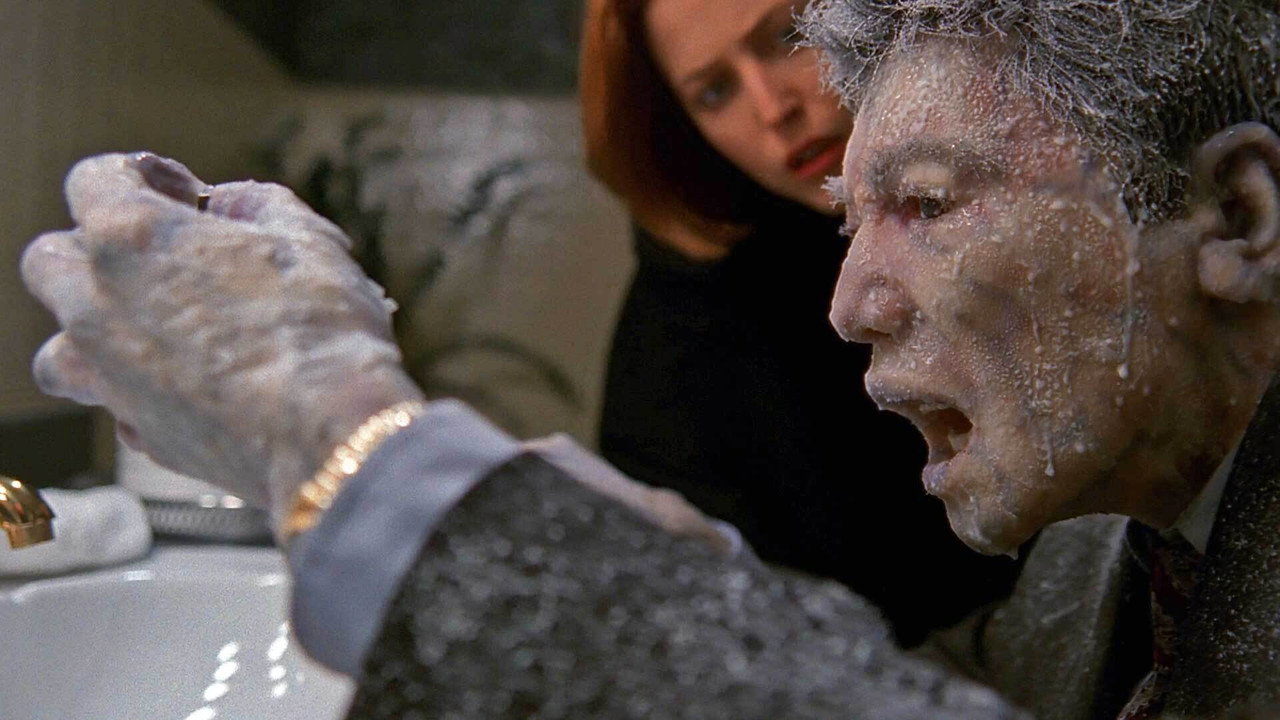
The guard who arrested the old man is found frozen to death. Then the old man pricks Dr. Yonechi, a vitrification researcher, with a metal stylus.
The photographSpoiler · tap to reveal
Jason's girlfriend Lisa says the chemical is one Jason hasn't finished inventing. In the old man's hotel room, the agents find a faded photo of Jason, Lisa and Yonechi toasting in the lab.
The mainframe roomSpoiler · tap to reveal
Mulder decides the old man is a time traveller, and that he is Jason Nichols. The old man injects Lisa, wipes Jason's files, then wraps his arms around his younger self as they both burst into flames.
Why it still matters
"Synchrony" is the rare X-Files case built on time travel, and it takes the idea seriously. Howard Gordon and David Greenwalt, who had joined the show as a producer a few months earlier, built it from a Scientific American article arguing that classical physics rules out travel through time while quantum physics allows it. What caught them was what foreknowledge would do to people. "Life itself is about the unknown and discovering what is in front of us," Gordon said. "But if everyone, or maybe some people, knew what would happen, that would create a new set of horrors, and it would need to be stopped." What they ended up with is a case about cryobiologists, a freezing agent and a stranger who knows exactly when people will die.
Critics found the idea stronger than the hour. Zack Handlen gave it a B− in The A.V. Club, saying it "has all the pieces of my favorite kind of episode" but doesn't work as well as it should, because he never came to care about the scientists. Paula Vitaris of Cinefantastique gave it two stars of four and felt time travel "takes away from the reality that is this show's foundation." Robert Shearman, in Wanting to Believe, was kinder at two and a half stars of five: a "high concept that is told without pretension", "solid and watchable", if it never fully explored a "concept with such potential".
One universe, one outcome
Old Jason tells his younger self that their research made time travel possible and plunged the world into chaos. He injected Lisa because she would be responsible for that future, but Scully brings her back, just as she had briefly revived Yonechi before his body heated up and he burst into flames. Scully tells Lisa that Jason died in the mainframe room fire. Mulder reminds Scully of a line from her own thesis: although multidimensionality suggests infinite outcomes in an infinite number of universes, "each universe can produce only one outcome." Someone will find the compound anyway. The last scene shows Lisa back in the lab, trying to rebuild it.
Gordon decided the most affecting, most X-Files-like version of the story was a time traveller who "turns out to be you". The regretful scientist came from the story of J. Robert Oppenheimer berating President Truman over the atomic bombings of Hiroshima and Nagasaki. "What if Oppenheimer could go back to the past and 'uninvent' the bomb?" Gordon asked.
Challenge the DNA
Was old Jason right to try to stop his own research?
Or skip ahead to our reading
He kills to stop a future he says is in chaos, and Scully undoes part of his work. The episode takes his warning seriously and still leaves the choice with the living.
Behind the scenes
- Chris Carter put Gordon on it after the two of them finished "Unrequited". Gordon and Greenwalt nearly turned in a story about a prison inmate swapping bodies with another man to escape, but Gordon thought it was too much like his previous episode.
- The script took more than a week, with some sessions running past 15 hours. Ken Horton, John Shiban and co-executive producer Frank Spotnitz pitched in.
- Days before filming, Gordon was still rewriting. He cut two "useless characters", one of them a Stephen Hawking-like scientist in a wheelchair, which he said "really tightened up the story".
- David Duchovny said some scenes were written during filming, "because no one could know if the audience understood what was happening." Gordon nearly abandoned the episode, and after delivering it he swore off writing about time travel. "In the end, I think it worked, but it's getting there that's really difficult."
The thread
Earlier stories of travellers from a ruined future and of a past that won't be changed, plus fiction about the scientists who start the trouble.
Came before
Shares DNA with
DNA strand
Time Loops & Timelines
The whole timeline runs through one research lab, and the case only starts to make sense once Mulder accepts that some of his evidence has come from the future. It's a story about whether knowing what's coming lets you change it, told as a murder investigation.
Every great sci-fi story is built from a handful of strands like this one. Each strand page explains how it works and traces it across shows, books and films.
If this one stayed with you
Where to go next, and why.
Watch · Film
Primer (2004)
Shane Carruth's engineers stumble on time travel in a garage and learn how quickly a few small trips tangle into something they can't control.
Read · Novel
Timescape by Gregory Benford
Physicists in a dying 1998 send tachyon messages back to 1962, hoping a scientist there will listen in time.
Read · Novella
"Story of Your Life" by Ted Chiang
A linguist learns to see her whole life at once and has to decide what knowing the future does to the choices in front of her.
Your next episode
Three directions to go from here, all on Sci-Fi DNA.
More of this feeling
Cause and Effect
Star Trek: The Next Generation
It has the same tightening dread of people racing a future they can't seem to escape.

Same question, different answer
Genesis of the Daleks
Doctor Who
It asks whether anyone has the right to stop an invention before it can ruin the future.

Something completely different
Demons
The X-Files
For a mystery inside one man's head, follow Mulder when he wakes up covered in blood with two days missing.