
More from the episode
The story in 5 beats
- Two days missing
Mulder calls Scully from a Providence hotel. She finds him in shock with a pounding headache and wants him in a hospital; he wants to find out first whether he committed a crime.
- The house in the paintings
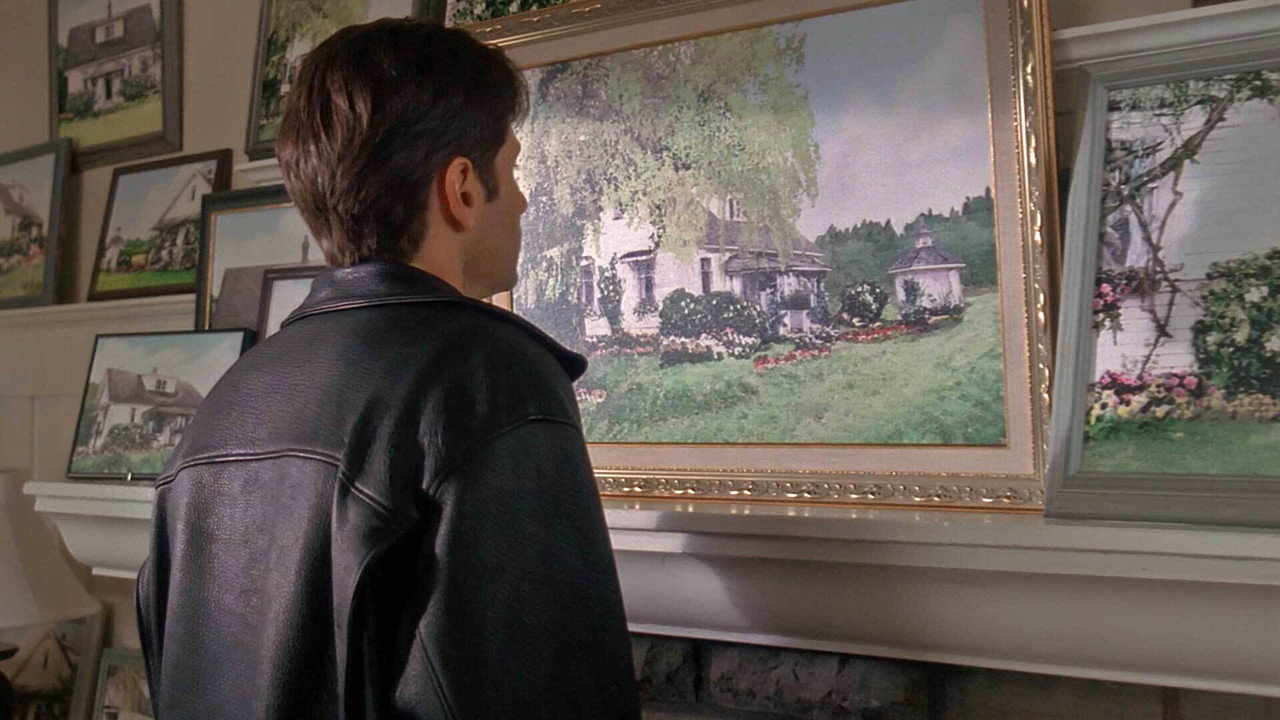
The keys lead to the Cassandras' home, where Amy's paintings keep showing one house, near Mulder's parents' summer home. The agents drive out to it and find the couple shot dead.
- The only suspect
Police find the couple's blood on Mulder's shirt. Scully finds ketamine in Amy's blood and in Mulder's, and a police officer with the same symptoms kills himself.
Dr. GoldsteinSpoiler · tap to reveal
The trail leads to a doctor in Warwick and the treatment he has been giving his patients. Mulder goes back to him by choice.
The summer houseSpoiler · tap to reveal
Scully goes looking for Mulder and finds him at the family's summer home, where she talks him down.
Why it still matters
Most X-Files cases send Mulder out into the world. "Demons" sends him into his own head. It was written by R. W. Goodwin, the co-executive producer chiefly responsible for the show's physical production, and the idea came from his reading of the neurologist Oliver Sacks. The result is a murder case in which the chief suspect is Mulder and the main evidence is whatever he can't remember.
Critics split on it. Zack Handlen of The A.V. Club gave it an A− for its look inside Mulder's mind, while admitting the story "doesn't really hold up in retrospect". Paula Vitaris of Cinefantastique gave it three and a half stars out of four and called it a character study of Mulder whose structure was "not particularly imaginative". Robert Shearman, in Wanting to Believe, gave it one and a half stars out of five and called it "the wrong episode at the wrong time": he thought the attention paid to Mulder's possible "aneurysm" sat oddly next to Scully's real, life-threatening illness. Even he called its flashback sequences "masterpieces of editing".
What Mulder wanted to remember
Dr. Goldstein has been giving Amy Cassandra and the police officer an aggressive treatment meant to recover memories of alien abduction. Scully comes to believe the Cassandras killed themselves after it, and that Mulder had been visiting them about their abduction experiences. Goldstein says he has never met Mulder. Each painful flash takes Mulder back to childhood: in the attic with his sister Samantha while their parents argue downstairs, then a younger Smoking Man in the family home, arguing with his parents and then with his mother.
Refusing the hospital, Mulder confronts his mother, Teena, demanding to know what really happened when they had to choose between him and Samantha. He believes the Smoking Man forced them to give her up, and asks who his father really is. She gets upset and won't answer. He goes back to Goldstein and talks him into another treatment to see more, and by the time Scully and the police come to arrest the doctor, Mulder is gone. He is cleared of the Cassandras' deaths, but what happened when he was a boy stays a mystery.
Challenge the DNA
Was Mulder right to risk his mind to recover his memories?
Or skip ahead to our reading
Each painful flash takes Mulder back to his childhood, and the episode never says how real those memories are. It shows how much he is willing to risk, and how little it settles.
Behind the scenes
- Goodwin found the idea in Oliver Sacks's essay collection An Anthropologist on Mars (1995), in a piece about a man who could recall every detail of his childhood. With Chris Carter's approval he spent about six weeks writing it, starting from a premise in which "Mulder wakes up in a strange place [with] no idea how he got there".
- The plot rests on the idea that Geschwind syndrome could be brought on by a mix of drugs and technology, which modern medicine doesn't support. Goodwin knew it and admitted taking big liberties; the machine that sets off Mulder's flashbacks was based on New Age equipment, including a "brain stimulator".
- The cottage is a farmhouse in South Surrey, near where "Home" and "Tunguska" were filmed. The art department rented and refurbished it, then put it back the way it was before filming.
- For the flashbacks, the camera's shutter was "continuously stopped and started", the negatives were filtered with strobe lights during processing, and producer Paul Rabwin mixed the dialogue with ambient background noise.
- Chris Owens returned as the younger Smoking Man, a part he first played earlier in the season in "Musings of a Cigarette Smoking Man". William B. Davis later said the writers built up the character's relationships with Mulder's parents and then started "backfilling with an historical connection".
The thread
The neurologist who gave Goodwin the idea, and other stories about a man who can't trust his own memory.
Came before
Shares DNA with
DNA strand
Memory & Identity
Mulder can't account for two days, and the only witness who might clear him is his own memory, which keeps failing at the worst moments. The longer the case runs, the less sure he is of anything he remembers.
Every great sci-fi story is built from a handful of strands like this one. Each strand page explains how it works and traces it across shows, books and films.
If this one stayed with you
Where to go next, and why.
Watch · Film
Jacob's Ladder (1990)
A Vietnam veteran's memories and hallucinations bleed together until he can't tell which life is real.
Watch · Film
Eternal Sunshine of the Spotless Mind (2004)
A man pays a clinic to erase his memories of a breakup, then fights the procedure from inside his own head.
Read · Book
The Man Who Mistook His Wife for a Hat by Oliver Sacks
Sacks's earlier collection of real patients whose memories and perceptions have come loose, told with great warmth.
Read · Short story
"We Can Remember It for You Wholesale" by Philip K. Dick
A clerk buys a set of fake memories and the procedure uncovers real ones somebody went to great lengths to bury.
Your next episode
Three directions to go from here, all on Sci-Fi DNA.

Same question, different answer
Conundrum
Star Trek: The Next Generation
It asks who people really are once their memories have been taken away from them.

Something completely different
Small Potatoes
The X-Files
For a much lighter case, head to a West Virginia town where five babies have been born with tails.