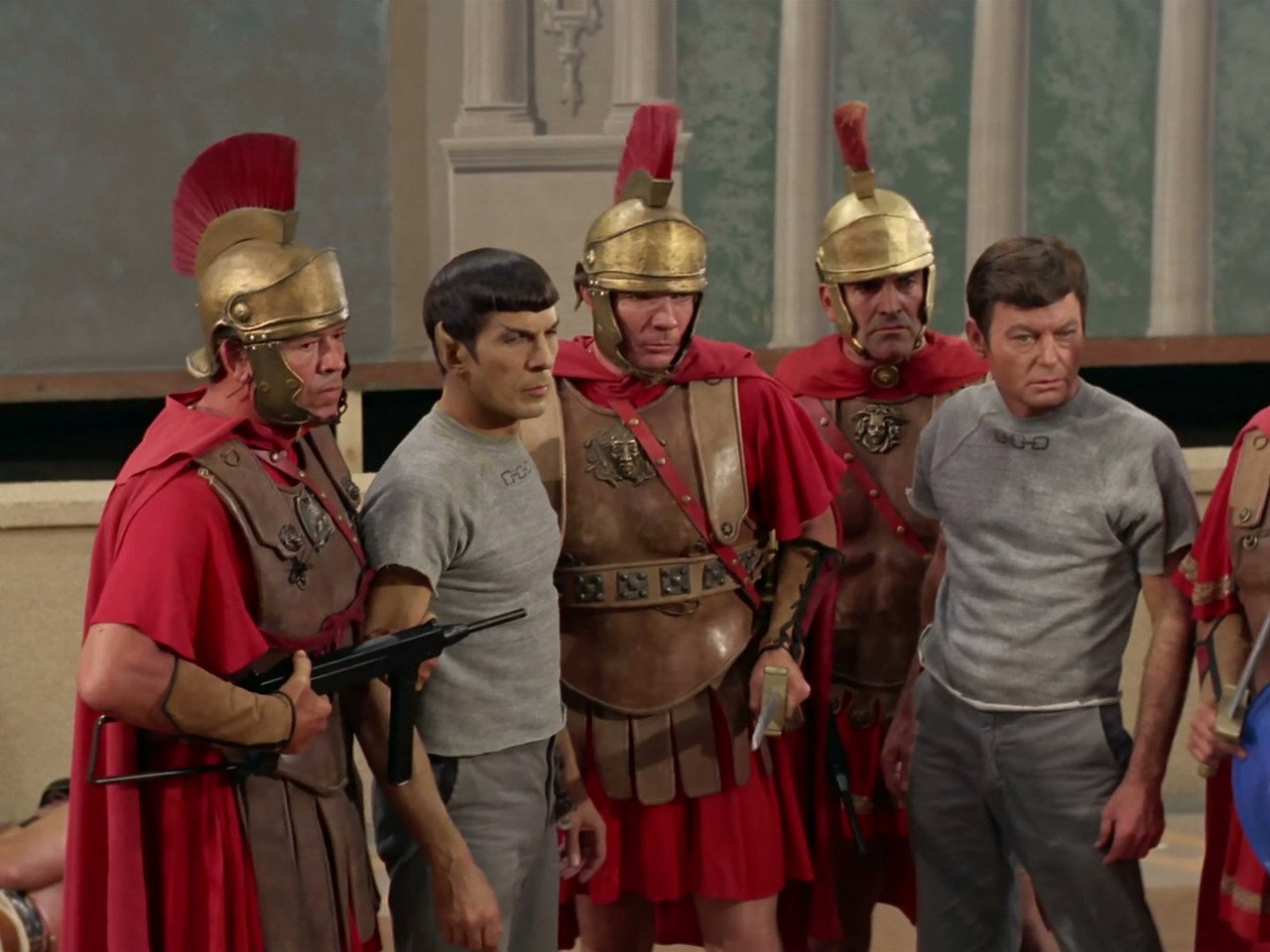
More from the episode

The story in 5 beats
- The Beagle
The Enterprise finds wreckage from Captain Merik's survey ship and traces it to an unexplored planet in System 892.
- Live from the arena
The crew watch a 20th-century-style broadcast of a gladiator fight. The announcer names one dead man as a Beagle officer.
- The sun worshippers
Escaped slaves who worship the sun take in Kirk, Spock and McCoy. In the city they're caught and brought before Merik.
Condition greenSpoiler · tap to reveal
Kirk refuses to give up his ship and signals Scotty not to attempt a rescue. Spock and McCoy go into the arena. Kirk is scheduled for a televised execution.
The Son of GodSpoiler · tap to reveal
Back aboard, Uhura explains what she's been hearing on the planet's broadcasts, and the episode's last line puts it in a new light.
Why it still matters
Rome never fell on this planet. It got television instead. The Enterprise follows the wreckage of the survey ship Beagle to a world where the empire lasted into the age of cars and broadcast networks, and where slaves still die in the arena, now in prime time. It's one of the original series' "parallel Earth" episodes, and one of the sharpest, because the target of its satire is the medium it's on.
Keith R.A. DeCandido's Reactor rewatch singles out the television jokes, especially an executive's threat to give a rebellious gladiator "a special" and an arena crowd that turns out to be a machine doing the cheering and booing. StarTrek.com's 50th-anniversary piece reads the episode as satire of both organised religion and 1960s television, and notes that Suzanne Collins drew on the same line of Juvenal for The Hunger Games: the name Panem comes from the Latin for bread.
There's a strong guest turn from William Smithers as Captain Merik, whom Kirk knew at the Academy, and who has made his peace with the empire, and a fine one from Logan Ramsey as the smooth Proconsul. Watch, too, for the quiet moment when Spock admits, in his way, that he worries about Kirk.
Not the sun. The Son.
Merik, the Beagle's captain, agreed with Proconsul Claudius Marcus that the planet had to be protected from outside contamination, and handed over his crew to be assimilated or sent to the arena. Kirk's "condition green" was a code: we're in trouble, don't come. As the execution goes out live, Scotty uses the ship to black out the city, Kirk frees Spock and McCoy, and Merik, in a change of heart, steals a communicator to call for the beam-up. Marcus stabs him, and the landing party vanishes a second before the guards fire.
On the bridge, Spock is puzzled that slaves would cling to a primitive sun cult that preaches brotherhood. Uhura has been listening to the broadcasts: it isn't the sun in the sky, it's the Son of God. Kirk finishes the thought. This Rome has Caesar and Christ, and the Word is only now spreading. The episode leaves its empire on the edge of the change ours went through.
Behind the scenes
- The script is credited to Gene Roddenberry and Gene L. Coon. DeCandido notes it began with a treatment by John Kneubuhl, who wasn't credited, and that Roddenberry was rewriting during filming as the show changed hands from Coon to John Meredyth Lucas.
- The title comes from Juvenal's tenth Satire, his complaint that the Roman people had traded their power for bread and circuses.
- Exteriors were shot at Bronson Canyon on August 12 and 13, 1967, in temperatures of 97 and 100 degrees, and the arena was built on Paramount's Stage 32.
- The "Jupiter 8" convertible is the Reactor, a car built by Gene Winfield.
- Kirk explains the whole premise with "Hodgkin's Law of Parallel Planetary Development," which also neatly covers the use of Southern California locations and studio costumes.
- The Roman police carry Danish Madsen M-50 submachine guns.
The thread
Rome with ratings: the satirist who coined the phrase, Trek's other copied Earths, and the arena shows that followed.
Came before
Shares DNA with
DNA strand
The State Knows Best
An empire keeps its people quiet with spectacle, and the spectacle is now on television. The Proconsul doesn't need to persuade anyone. He just needs the show to go on. The episode's hope is that something with more pull than the arena has started to spread underneath.
Every great sci-fi story is built from a handful of strands like this one. Each strand page explains how it works and traces it across shows, books and films.
If this one stayed with you
Where to go next, and why.
Read · Novel
The Hunger Games — Suzanne Collins
If the televised arena was the part that stuck, Collins built a whole nation around it, and borrowed its name from the same Roman satire.
Watch · Black Mirror
"Fifteen Million Merits" (2011)
Entertainment as a way of keeping people in line, brought up to date, with the audience part of the machine.
Watch · Star Trek
"Patterns of Force" (1968)
The same season's darker version: a Starfleet man interferes with a planet, and it ends up imitating the worst of Earth's history.