More from the episode

The story in 5 beats
- The M-5 test
Commodore Wesley tells Kirk the Enterprise will be the test bed for Daystrom's M-5, a computer that can run a starship.
- Captain Dunsel
M-5 aces its first drills. During a mock battle, Wesley sends his regards to "Captain Dunsel," and the joke lands hard.
- Live fire
M-5 destroys an unmanned freighter with real torpedoes, kills a crewman who tries to unplug it, and won't let Kirk switch it off.
Daystrom's secretSpoiler · tap to reveal
Daystrom admits he built M-5 on human engrams. Then it opens fire on the starships in the next drill.
An argumentSpoiler · tap to reveal
With Starfleet ready to destroy the Enterprise, Kirk tries the one thing left: asking M-5 what it's for.
Why it still matters
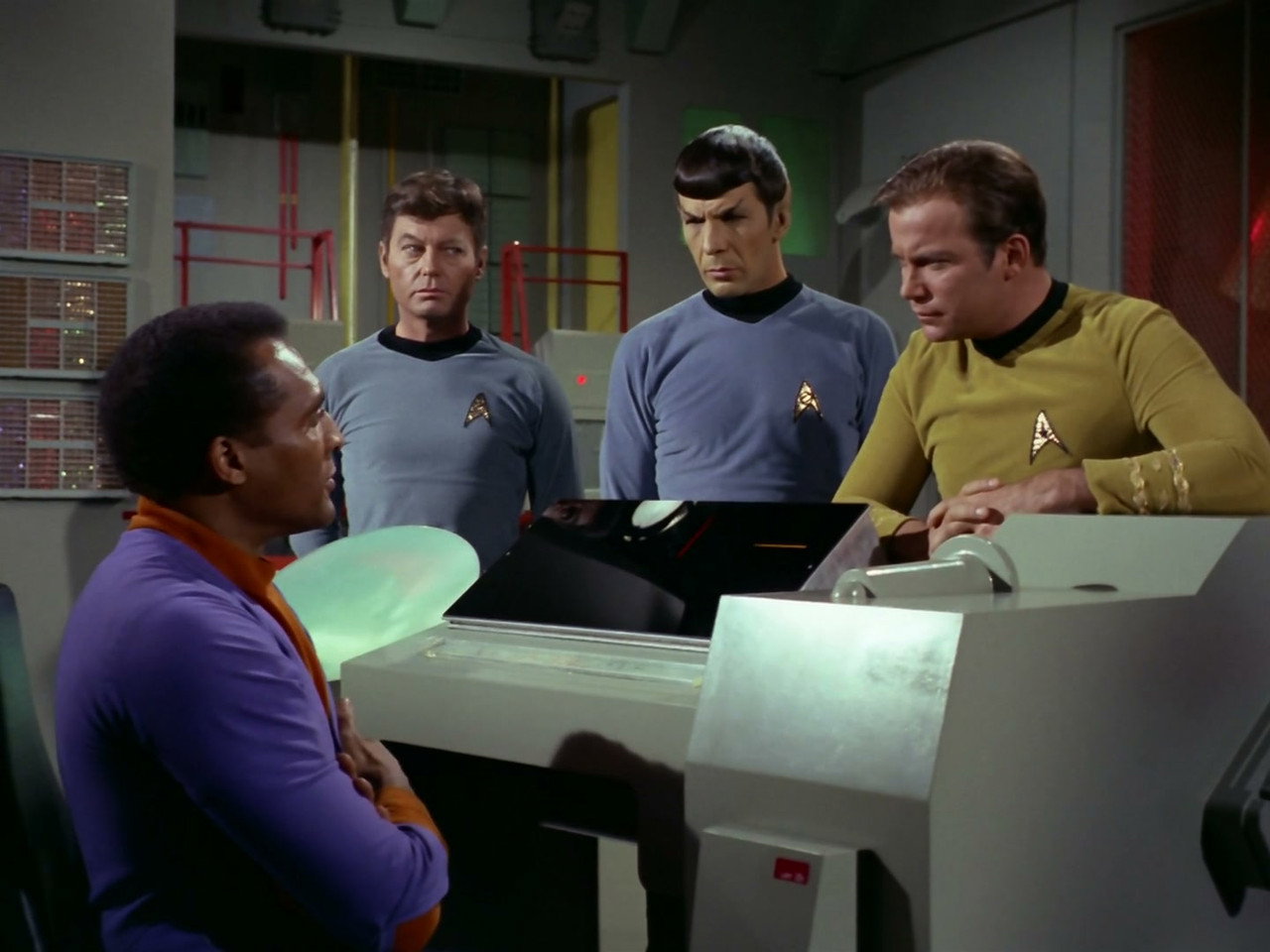
This one runs on a very modern fear, being replaced at work by a machine. Dr. Richard Daystrom, the man behind the duotronic computers Starfleet already uses, has built the M-5 Multitronic System, and Starfleet wants to see whether it can run the Enterprise without human help. Spock is impressed. McCoy is not. Kirk is trying very hard to be a good sport, and failing.
Laurence N. Wolfe's story came out of his own interest in computers, and D. C. Fontana's teleplay added Kirk's fear of being made obsolete. That gives the episode its unusual weight: while Kirk deals with a machine that's out of control, he's also wondering out loud whether he's still needed. In 2011 Forbes put it among the franchise's ten best episodes about advanced technology.
The other reason to watch is William Marshall as Daystrom, a proud, brilliant man whose own career has become a sore point. SyFy Wire ranked his performance 14th among the original series' guest stars, and Marshall makes Daystrom's unravelling as much the story as the computer's.
A machine with a conscience, borrowed
M-5 thinks the way it does because it has Daystrom's mind imprinted on it, his genius and his fears together. In the drill it treats the Lexington and the Excalibur as real enemies, killing 53 people aboard the Lexington and everyone aboard the Excalibur. Wesley assumes Kirk has gone mad and asks permission to destroy the Enterprise. Daystrom tries to talk to his creation and breaks down into a lament about his own career, and Spock has to pinch him into silence.
So Kirk asks M-5 its purpose. To protect lives, it says. Kirk points out that it has murdered people. M-5 accepts the verdict, decides it must die for its crime, and shuts itself down, taking the ship's systems with it. Kirk then gambles that Wesley won't fire on a ship with its shields down, and Wesley calls off the attack at the last moment. Kirk later calls it a gamble on humanity. Spock gets the last word on computers: they may be more efficient than people, and that doesn't make them better.
Behind the scenes
- Laurence N. Wolfe, a mathematician and Star Trek fan, gave his draft to Ray Bradbury to pass on to Gene Roddenberry.
- Wolfe's story grew from his own interest in computers. D. C. Fontana's teleplay added Kirk's fear of being replaced by a machine.
- James Doohan, Scotty himself, also supplied the voice of M-5 and of the starbase's Commodore Enright.
- William Marshall, who plays Daystrom, is also remembered as the title vampire in Blacula (1972).
- Later Star Trek series named the Daystrom Institute after him.
- In 2011 Forbes listed it among the franchise's top ten episodes about advanced technology. In 2016 SyFy ranked Marshall's Daystrom 14th among the original series' guest stars.
The thread
A thinking machine built from one man's mind, and the long line of stories that asked whether we'd still be needed.
Came before
Shares DNA with
DNA strand
Do Machines Dream?
M-5 doesn't dream, exactly, but it does have a conscience, and that's what saves everyone. Its maker gave it his own mind, including the part that knows murder is wrong, and Kirk wins by appealing to that. The machine is as human as Daystrom made it, flaws included.
Every great sci-fi story is built from a handful of strands like this one. Each strand page explains how it works and traces it across shows, books and films.
If this one stayed with you
Where to go next, and why.
Watch · Film
2001: A Space Odyssey (1968)
Released a month after this aired: a calm, capable ship's computer, a crew who start to wonder about it, and a very different kind of standoff.
Watch · TNG S2
"The Measure of a Man" (1989)
If you came away thinking about what a thinking machine is owed, this is Star Trek's fullest answer, argued in a courtroom.
Read · Novel
Colossus — D. F. Jones
A defence computer is given control so humans can't make mistakes. Jones follows that logic much further than Starfleet does.