
More from the episode

The story in 5 beats
- The silent observer
The Enterprise looks for John Gill on Ekos. A nuclear-armed rocket, far beyond Ekosian technology, attacks the ship in orbit.
- The newsreel
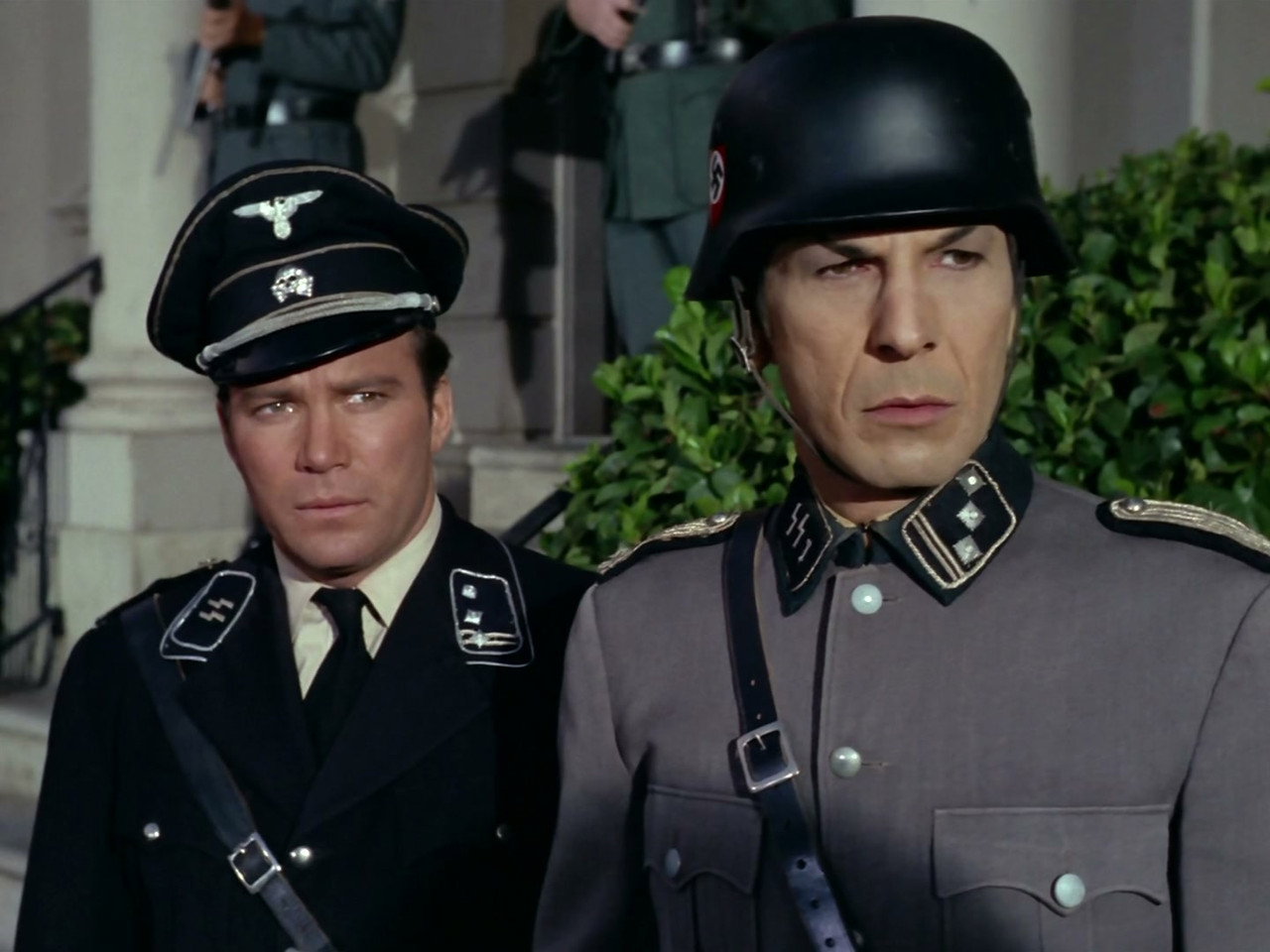
Kirk and Spock watch a broadcast of rallies, swastikas and a coming "Final Solution" for the Zeons. The Führer on screen is Gill.
- In uniform
In stolen uniforms they get inside headquarters, until Spock's ears give them away. They break out of a cell using crystals from their implanted transponders.
The broadcast boothSpoiler · tap to reveal
Posing as a film crew, they reach Gill and find him drugged, a figurehead. His deputy Melakon has been running Ekos.
The last speechSpoiler · tap to reveal
Gill goes on air to call off the invasion of Zeon and name Melakon a traitor. Melakon shoots him. The resistance takes it from there.
Why it still matters
John Gill taught Kirk history at Starfleet Academy. He was sent to the planet Ekos as a cultural observer, with orders to watch and not interfere, and then he went quiet. When the Enterprise arrives, a rocket with a thermonuclear warhead comes up to meet it, and on the surface Kirk and Spock find a society copied, uniform for uniform, from Nazi Germany, with its hatred aimed at the people of the neighbouring planet Zeon.
It's the show's most direct look at an observer who breaks the rule against meddling, and does it with good intentions. Gill thought he could keep the efficiency and leave out the cruelty. The episode's answer is that the cruelty was the system, and that whoever climbs to the top of it will use it however they like. The uniforms and swastikas are there to make that case, and the episode handles them plainly.
It's also a lean, quick adventure: Kirk and Spock in borrowed uniforms, a jailbreak with lasers improvised from their own implants, and an underground resistance that may or may not be what it seems. Keith R.A. DeCandido's Reactor rewatch gives it a 4 out of 10, and argues that the premise is wrong on its own terms: Nazi Germany wasn't an efficient state at all.
A figurehead with good intentions
Spock's mind meld confirms that Melakon has been drugging Gill and ruling through him. Gill explains that he imposed National Socialism because he believed it was the most efficient system ever devised, and that he meant it to run without the hatred. Melakon took the machine and pointed it at Zeon. Kirk makes Gill see what his planet has become, and the old man uses his last broadcast to renounce the Final Solution and denounce his deputy. Melakon cuts him down with a submachine gun, and Isak, the Zeon prisoner who escaped with Kirk and Spock, kills Melakon.
The ending gives the planet back to its own people. Eneg, the party chairman who turns out to be part of the resistance, and Daras agree to stop the bloodshed and announce the end of the regime. Eneg thanks Starfleet and asks the Enterprise to go, because Ekos and Zeon have to rebuild for themselves, and Kirk leaves without the old teacher he came to find.
Behind the scenes
- The rocket launches are real V-2 footage, and the shots of Hitler in a car are taken from Leni Riefenstahl's Triumph of the Will (1935).
- The Ekosian offices were real offices on the Paramount lot, which is why the chancellery windows stay shuttered. StarTrek.com identifies the building as the Schulberg building.
- Chairman Eneg is named after Gene Roddenberry. DeCandido calls it "probably an affectionate dig."
- Because of the uniforms and insignia, the episode was left out of both original German runs, on ZDF in the 1970s and on Sat.1 later. It was dubbed in 1995, went out on pay TV in 1996 and reached free-to-air German TV on ZDFneo on November 4, 2011.
- Skip Homeier, who plays Melakon, came back in the third season as Dr. Sevrin in "The Way to Eden."
- John Gill gets a mention in Star Trek: Enterprise's "In a Mirror, Darkly, Part II."
The thread
A planet remade from a history book, and other stories about people who thought they could steer a society from above.
Came before
Shares DNA with
Left its mark on
DNA strand
The State Knows Best
Gill is the well-meaning planner who decides he knows how a people should be run, and the episode follows that thought to its worst destination. The state he builds is efficient at one thing, sorting people into us and them, and it outlives his good intentions. The resistance ends it, and Kirk's job is mostly to get out of their way.
Every great sci-fi story is built from a handful of strands like this one. Each strand page explains how it works and traces it across shows, books and films.
If this one stayed with you
Where to go next, and why.
Watch · Star Trek S1
"The Return of the Archons" (1967)
If the idea of one mind shaping a whole planet stayed with you, this is the first-season version: a town where everyone is serene, and nobody knows why.
Watch · Star Trek
"Bread and Circuses" (1968)
Another lost Starfleet officer, another planet that took the wrong page of Earth's history. This time it's Rome, with television.
Read · Novel
It Can't Happen Here — Sinclair Lewis
Lewis watched fascism rise in Europe and imagined it winning an American election. Like Ekos, it's about how ordinary people go along.
Read · Novel
The Man in the High Castle — Philip K. Dick
Dick imagines a 1960s America living under the regime Ekos was copied from, and the quiet ways people resist it.