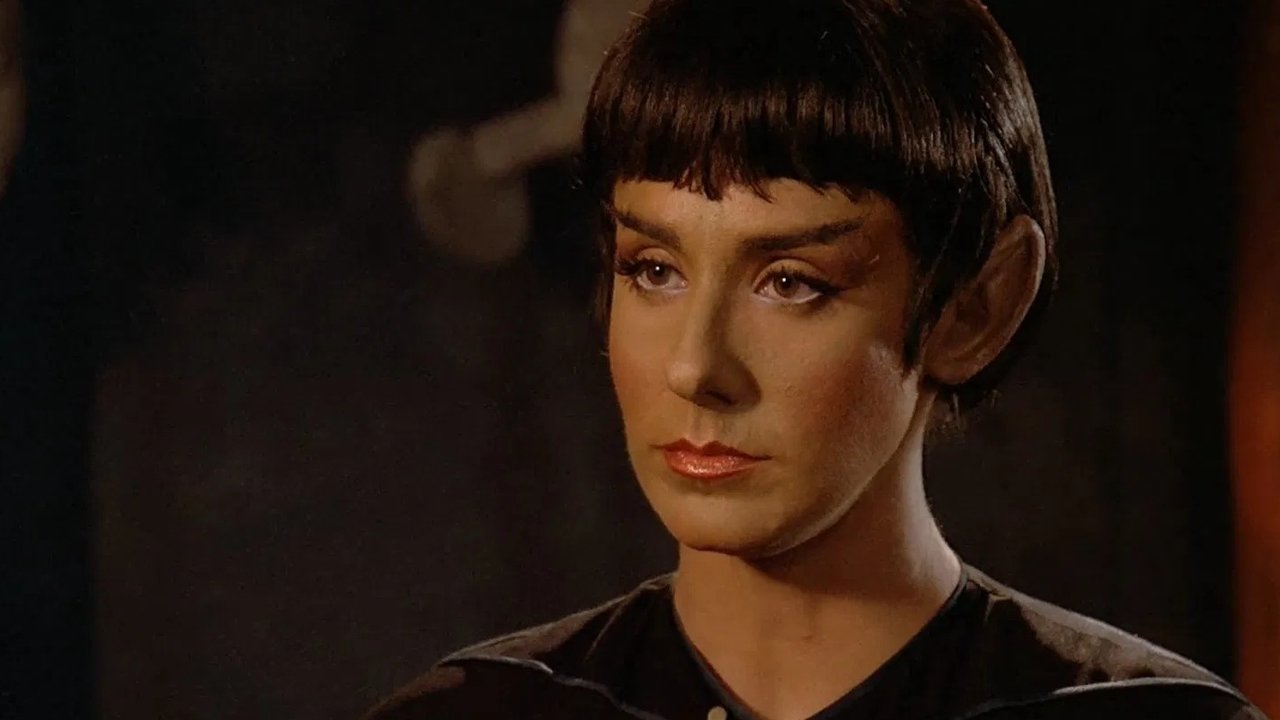
The story in 5 beats
- House call
Graves's assistant, Kareen, calls for medical help without telling him. With the Enterprise needed elsewhere, Data leads an away team down with Worf, Troi and Dr. Selar.
- Grandpa
Selar finds Darnay's disease, which is incurable. Graves recognizes Data as Soong's work and spends his last days talking with him, including about a way to put a mind into a computer.
- The eulogy
Data reports that Graves died in his arms, then delivers a eulogy so warm and so long that Picard has to cut him off.
Two in oneSpoiler · tap to reveal
Data whistles Graves's tune and snaps at Picard. Troi finds two personalities in him, and the stranger one, Graves, is winning.
Knowledge without the manSpoiler · tap to reveal
Graves breaks Kareen's hand and knocks Picard out without meaning to. Then Data is found in his quarters, himself again.
Why it still matters
Dr. Ira Graves is a brilliant, rude old cyberneticist living on a remote planet with his assistant, and he's dying. He's also the man who taught Noonien Soong, which makes him something like Data's grandfather, and he says so. He also tells Data he has no aesthetic value whatsoever. Data, trusting him anyway, mentions that he has an off switch.
Brent Spiner carries this one. W. Morgan Sheppard plays Graves in only a few scenes, and that's enough to give Spiner a set of habits to pick up: the sneer, the impatience, the whistled tune from The Wizard of Oz. Keith DeCandido, who gave it 8 out of 10, called Spiner's performance both obvious and subtle, and the whole thing a morality play that recalls The Wizard of Oz, The Prisoner and Frankenstein.
Critics split hard. The A.V. Club gave it a C−; Wired named it one of the series' worst in 2012. It's also where TNG first raises a question it would take on properly a few weeks later: whether it matters if Data can be overwritten.
Where Graves went
Graves had found a way to transfer his consciousness, and he'd learned about Data's off switch. He moved into Data's body and left his own to die. The odd eulogy, the whistling, the sudden jealousy when Picard gives Kareen a tour of the bridge: it's Graves, in Data's body, slowly forgetting to act. Troi's tests show two personalities, the foreign one getting stronger, and Picard works out whose it is.
Graves tells Kareen everything and offers her an android body of her own, a thousand years together. She refuses, and he grips her hand hard enough to break two bones without meaning to. When Picard confronts him in engineering and argues that Data is a unique life form who shouldn't be sacrificed, Graves lashes out and knocks the captain cold. That, it seems, is what convinces him he can't control what he's taken.
Picard and Geordi find Data lying in his quarters, himself again. Graves has moved into the ship's computer, but only his knowledge made it; the man himself is gone. DeCandido liked that there's no technobabble fix, just Graves choosing to go.
Behind the scenes
- The title comes from an episode of The Prisoner, and the producers originally wanted that show's star, Patrick McGoohan, to play Graves.
- Suzie Plakson's Dr. Selar never appears on screen again, though she's mentioned often and shows up in the novels. Plakson went on to three more Trek roles, starting with K'Ehleyr.
- Graves whistles a song from The Wizard of Oz, the clue that gives him away once Data starts doing it.
- Data tries on a beard at one point, a joke at the expense of Jonathan Frakes's new one.
- Picard's argument that Data is a unique life form whose existence matters comes back, at full length, in "The Measure of a Man."
- Tor.com rated it 8 out of 10. The A.V. Club gave it a C−, and Wired named it one of the worst episodes of the series in 2012.
The thread
A borrowed title, a borrowed song and a borrowed body, and the question of Data's rights that the show was about to take on.
Came before
Shares DNA with
Left its mark on
DNA strand
Memory & Identity
Data looks like Data the whole time, so the episode has to show the takeover through habits: a tune, a sneer, a flash of jealousy. It's a neat way to ask what a self is made of when the body stays the same and only the behavior changes.
Every great sci-fi story is built from a handful of strands like this one. Each strand page explains how it works and traces it across shows, books and films.
If this one stayed with you
Where to go next, and why.
Watch · Star Trek: TNG
"The Measure of a Man"
Picard's last argument with Graves, that Data is a life form whose existence matters, gets an entire episode a few weeks later, and it's one of the series' best.
Watch · TV series
The Prisoner
The show this episode took its title from, whose star the producers hoped would play Graves. If identity games are your thing, this is the deep end.
Read · Novel
Frankenstein, Mary Shelley
A brilliant, prickly scientist and the life he makes. If Graves struck you as a man who thought making something gave him rights over it, Shelley's novel is the classic version of that story.