The story in 5 beats
- Dead of old age
The Enterprise finds the Lantree adrift, its crew dead of what looks like natural causes. The only illness on record was a harmless flu.
- Darwin Station
The Lantree's last stop was a genetics lab on Gagarin IV. Dr. Kingsley is 35 and looks decades older. She begs Picard to take the children, who have no symptoms.
- The boy in the box
One child is beamed aboard sealed in styrolite. Supposedly twelve, he looks fully grown, and Troi can sense him even in stasis.
Pulaski's gambleSpoiler · tap to reveal
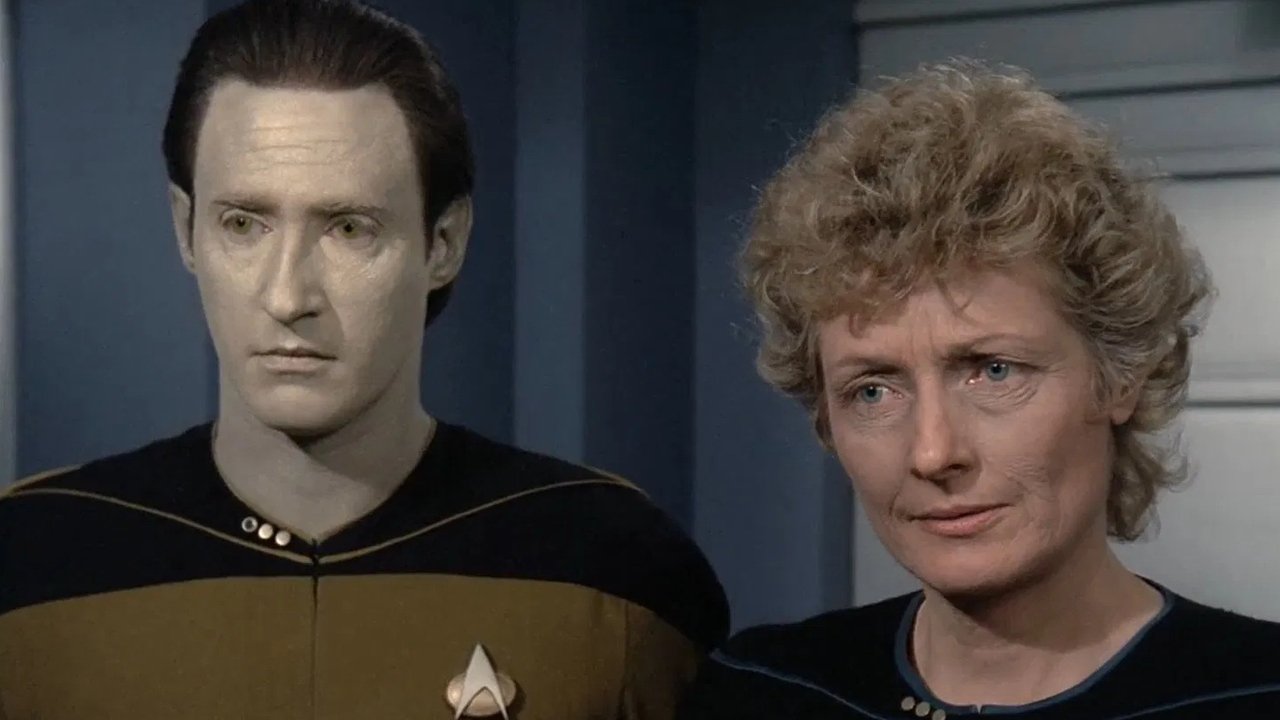
Pulaski takes the boy to a shuttle with Data and frees him to examine him. Twenty minutes later her joints ache, because the children are the carriers.
The hairbrushSpoiler · tap to reveal
Picard runs the transporter himself, rebuilding Pulaski from a pattern taken from a hair in her brush.
Why it still matters
The opening is one of the creepiest of the early seasons. The USS Lantree calls for help, its captain saying the crew is dying, and by the time the Enterprise arrives there are no life signs. A remote look at the bridge shows old, withered bodies at their stations. Riker notes that he and the Lantree's captain were the same age.
From there it's a mystery with a genetics lab at the end of it, a subject that StarTrek.com later pointed out still seemed like outlandish science fiction in 1989. The scientists at Darwin Station have been designing children. Diana Muldaur gets to play Pulaski's slow transformation in progressive aging makeup, and the episode earned an Emmy nomination for hair styling.
Critics are divided. The A.V. Club gave it a B+; Keith DeCandido gave it 3 out of 10 and called it a warmed-over rehash of the original series' "The Deadly Years," though even he liked the dignified send-off the crew gives the Lantree. It's also the episode where Colm Meaney's transporter chief finally gets a name: O'Brien.
What the children did
Darwin Station's engineered children have immune systems that produce airborne antibodies, and those antibodies alter the DNA of the humanoids around them, which is what's aging the adults so quickly. The children themselves never get sick; they just make everyone else old.
Pulaski proves it the hard way. She insists on examining the boy outside stasis, on a shuttle with Data at the controls, and within twenty minutes she has an arthritic cramp, the first symptom. The fix is the transporter: run her through it using her original genetic pattern as a filter. The catch is that Pulaski has always avoided transporters, so there's no stored pattern. It comes from a hair in her hairbrush, and Picard sends O'Brien aside and runs the transporter himself.
It works, and the same trick restores the station's adults. Then the Enterprise scuttles the Lantree, with honors. The episode never wonders what else the trick could do. StarTrek.com did, years later, asking why anyone in the Federation would need to die of old age once word got out.
Behind the scenes
- The Lantree was the USS Reliant model from Star Trek II: The Wrath of Khan, redressed. Special effects were by Image G.
- Richard Sabre's hair styling was nominated for an Emmy in 1989.
- Colm Meaney's transporter chief is named O'Brien here for the first time, and gets his biggest role yet. He'd go on to Deep Space Nine.
- It's the only time Trek shows humans doing legal genetic engineering, which later canon says is banned in the Federation.
- StarTrek.com's Jon Sung noted in 2014 that the original series cured its own rapid-aging plague in "The Deadly Years" with adrenaline, and doubted anyone ever studied that further.
The thread
Star Trek's earlier rapid-aging scare, its first engineered supermen, and the rule against making more.
Came before
Shares DNA with
DNA strand
Technology Outpaces Ethics
The Darwin scientists set out to build better children and succeeded. Nobody checked what better children would do to everyone else, and the station's own adults pay for it first.
Every great sci-fi story is built from a handful of strands like this one. Each strand page explains how it works and traces it across shows, books and films.
If this one stayed with you
Where to go next, and why.
Watch · Star Trek
"The Deadly Years"
The original crew's version of the same nightmare, where the senior officers start aging and a commodore eyes Kirk's chair. Fun to compare the cures.
Watch · Star Trek
"Space Seed"
If Darwin Station made you uneasy, meet the engineered man the Federation never forgot. As StarTrek.com put it, the scientists here seemed to be trying to make their very own Khans.
Read · Novel
Brave New World, Aldous Huxley
The classic novel about a society that designs its people before birth. Darwin Station is one small lab; Huxley imagines a whole world run that way.