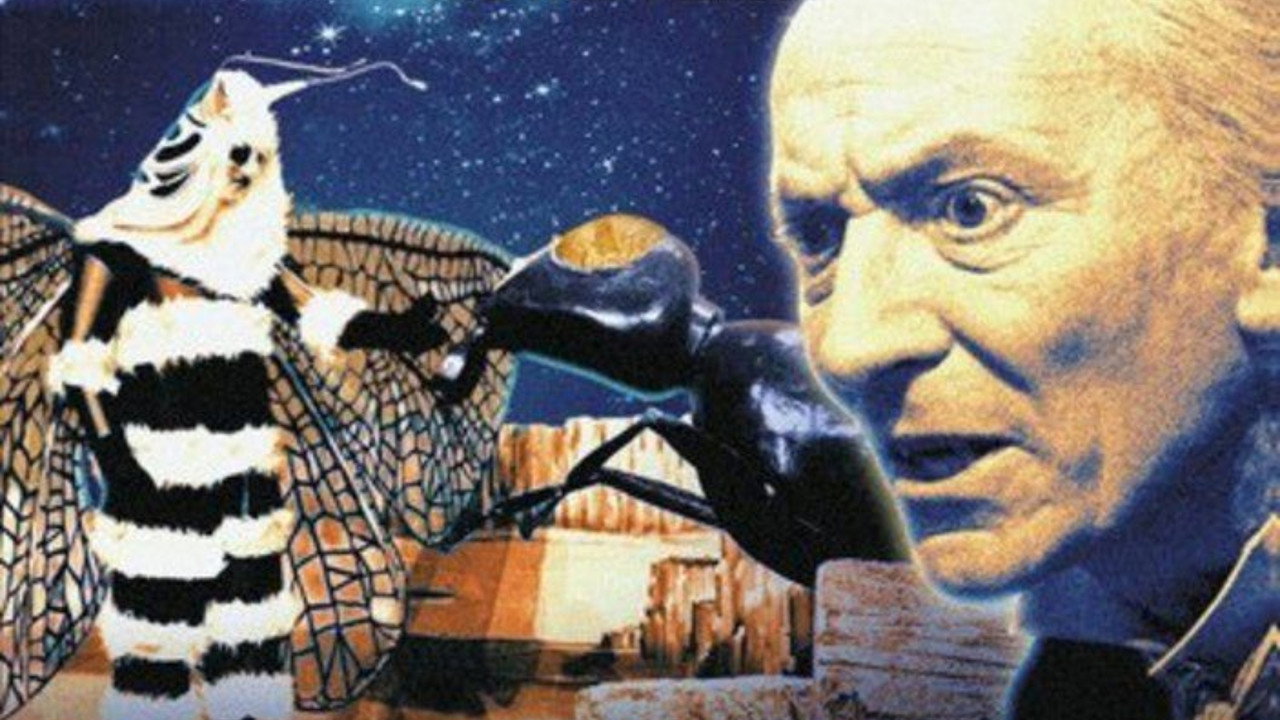
More from the episode

The story in 5 beats
- Pulled down to Vortis
Something forces the TARDIS to land. The Doctor recognises the planet as Vortis, but it now has moons it never used to have.
- Barbara's bracelet
A force working through Barbara's gold bracelet draws her out of the ship in a trance, and an unseen power drags the TARDIS across the surface.
- The Zarbi and the Menoptra
The ant-like Zarbi take the Doctor and Ian to their stronghold, the Carsenome. Ian escapes and learns that the moth-like Menoptra plan to retake their planet.
The Crater of NeedlesSpoiler · tap to reveal
The Doctor lets slip where the Menoptra will land, and Barbara can't warn them in time. Ian finds help underground.
The CentreSpoiler · tap to reveal
The travellers and their allies close in on the Animus from above and below, carrying a weapon the Menoptra built to destroy it.
Why it still matters
The Web Planet is one of the oddest things Doctor Who has ever tried. No guest character is human. There are eight-foot fibreglass ants called the Zarbi, moth people called the Menoptra whose hand gestures were worked out by the Australian mime artist Roslyn de Winter, and burrowing grubs called the Optera. Director Richard Martin skipped a composed score and used recordings made for Les Structures Sonores, music played on glass rods and steel, because it sounded properly alien and the props and costumes had cost so much.
Viewers turned up in numbers. The first part drew 13.5 million viewers, the show's highest yet, and the serial stayed in the weekly top 20 all six weeks. The audience's own scores went the other way: by the final part the BBC's Appreciation Index had sunk to 42, a record low, and viewers complained about the costumes, the smeared lens Martin used to suggest a thin atmosphere, and a story they found hard to follow. The Daily Mail's Peter Black called the regulars "the dullest quartet in fiction".
Later critics have mostly split the difference. The Discontinuity Guide praised its imagination and ambition but called it "slow and silly looking" now, and David J. Howe and Stephen James Walker wrote that its ambition "may be seen as its great strength or its great weakness, depending on the spirit in which it is approached". Peter Capaldi put it more kindly in 2015: "the ambition and imagination was great but they just didn't have the resources to deliver".
The spider at the centre
The Menoptra spearhead is massacred at the Crater of Needles, but the Doctor works out that the Animus channels its control through gold and turns that against it, taking over a Zarbi to escape with Vicki. Ian and Vrestin persuade the Optera, descendants of Menoptra who fled underground, to dig up beneath the Carsenome. When the Doctor and Vicki are brought before the Animus, a great spider-like creature, Barbara and the Menoptra attack from outside while Ian's party comes up from below, and they destroy it with the Isoptope, the Menoptra's cell-destroying weapon.
With the Animus gone, the Zarbi go back to being docile and Vortis returns to its purer state, and the creatures promise to tell stories about the visitors who saved them. Verity Lambert edited the last part herself because Martin had gone on holiday, and she cut a shot of the web dissolving. "I thought nobody would know what on earth was happening," she explained in a memo.
Challenge the DNA
Is The Web Planet ambitious or just strange?
Or skip ahead to our reading
Both, and we'd rather have the ambition. It's slow, and the costumes ask a lot of you. But a 1965 teatime serial that tried to build an entire alien ecosystem in a TV studio deserves credit for trying.
Behind the scenes
- Bill Strutton, an Australian writer with no background in science fiction, watched the show in 1964 and wanted to write for it. Lambert and story editor David Whitaker asked him to avoid robot monsters, given how big the Daleks had become. He thought back to watching two bull ants fight in an empty kerosene can as a toddler, and to his own two sons fighting. The story was commissioned on September 28, 1964, as Doctor Who and the Webbed Planet.
- The names came from Strutton's household and an encyclopedia. His wife named the Zarbi; Lepidoptera gave the Menoptra and Optera, and carcinoma gave the Carsenome. Dennis Spooner, the new script editor, read the Menoptra as free enterprise and the Zarbi as communism.
- Designer John Wood drew the Zarbi from Strutton's descriptions. Shawcraft Models built four costumes in fibreglass, modelled on Dalek operator Robert Jewell, and each took around 30 minutes to put on. The main Zarbi were the three regular Dalek operators, Jewell, Kevin Manser and Gerald Taylor, with John Scott Martin in his first job on the show.
- Martin wanted a greased filter over the lens to suggest Vortis's thin air, but optical glass cost too much, so he used a cheaper fix. Two special lenses were fitted, and both broke during production.
- Peter Purves auditioned to play a Menoptra. Martin thought the part would waste his talent and kept him in mind, casting him as Morton Dill in The Chase a few months later.
- Recording was rough. Part two overran by 16 minutes after seven retakes; part three ran 37 minutes over, so late that studio management turned off the dressing-room lights and the crew left in the dark. Part four's set dressing, fifteen bags of seaweed, smelled overpowering under the hot studio lights.
- Jacqueline Hill was on holiday for part three, which was written without Barbara. She kept her Radio Times credit but not the on-screen one, and complained on March 1, 1965, without success.
The thread
Insect worlds, a planet taken over by a single mind, and a crew trying to tell monsters from people.
Came before
Shares DNA with
Left its mark on
DNA strand
First Contact & Invaders
Vortis has already been invaded when the TARDIS arrives: one mind has taken over its creatures and pulled moons into its sky. The travellers have to learn, with no humans to ask, which of the giant insects are enemies and which are the planet's rightful owners.
Every great sci-fi story is built from a handful of strands like this one. Each strand page explains how it works and traces it across shows, books and films.
If this one stayed with you
Where to go next, and why.
Watch · The Outer Limits S1
"The Zanti Misfits"
Another early attempt to put insect aliens on a TV budget, with ant-bodied creatures and more nerve than money.
Watch · Star Trek S1
"The Devil in the Dark"
A non-humanoid alien and a crew that has to decide what it is before deciding what to do about it.
Watch · Doctor Who
"The Romans"
The story just before, a comedy in Nero's Rome. It explains the bracelet, and the contrast in a single month of 1965 is quite something.
Read · Novelisation
Doctor Who and the Zarbi — Bill Strutton
Strutton's own retelling, written in three weeks and published in 1965 with John Wood's illustrations. On the page the insects cost nothing.
Your next episode
Three directions to go from here, all on Sci-Fi DNA.
More of this feeling
The Zanti Misfits
The Outer Limits
More giant insects in 1960s black and white, played completely straight.

Same question, different answer
Darmok
Star Trek: The Next Generation
How do you talk to a people who think nothing like you? Picard tries the hard way.

Something completely different
The Crusade
Doctor Who
From an alien planet with no humans in it to the Third Crusade and real kings.