More from the episode

The story in 5 beats
- The evidence is rigged
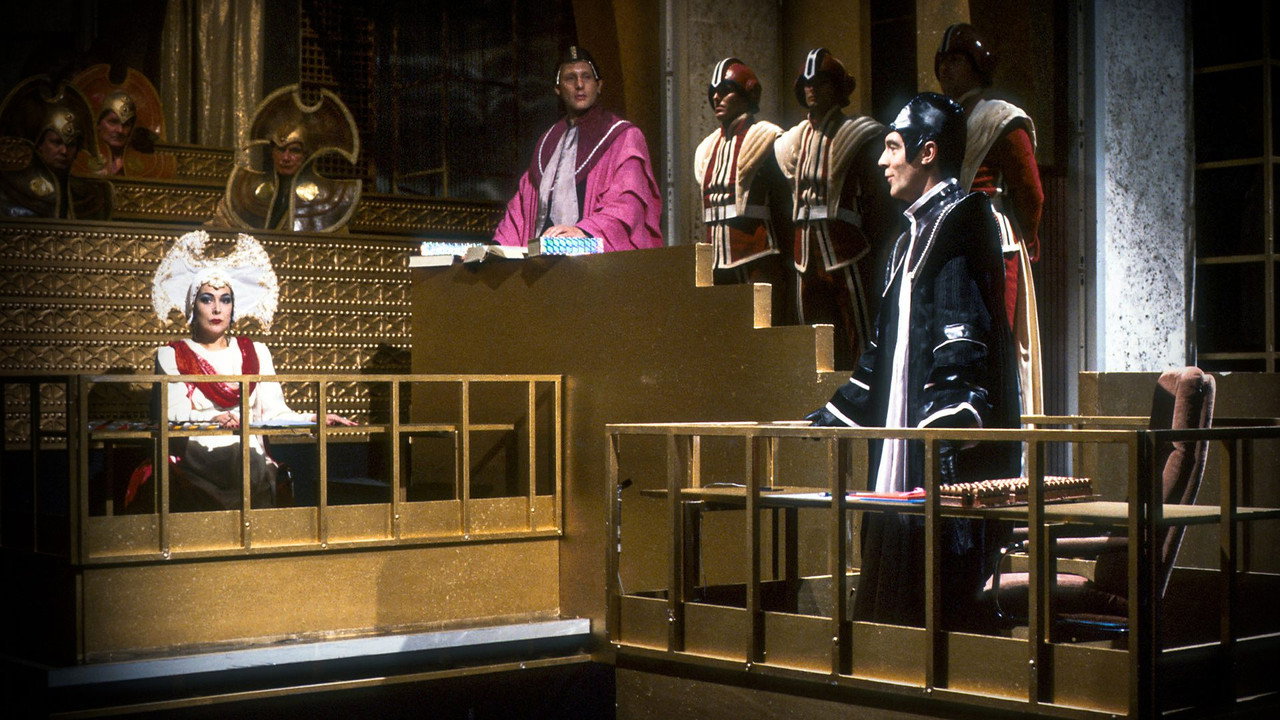
The Doctor tells the court the Matrix has been tampered with. Glitz and Mel arrive as witnesses, and the Master appears on the Matrix screen to prove it can be broken into.
- What Glitz was after
Glitz explains what he was really trying to steal on Ravolox, and the Doctor doesn't like what it says about the Time Lords. He tells them they're decadent and corrupt, to their faces.
- Into the Matrix
The trial collapses and the Valeyard escapes into the Matrix. The Doctor follows with Glitz, into a world of nerve gas, a cottage that isn't one and a clerk called Popplewick.
GuiltySpoiler · tap to reveal
The Doctor is found guilty and led off to die, but the courtroom is a fake. Popplewick peels off his face: he's the Valeyard, and he has a weapon pointed at the real court.
Case dismissedSpoiler · tap to reveal
The Doctor wrecks the weapon. The Inquisitor drops the charges and says Peri is alive, queen to Yrcanos. Then the Keeper of the Matrix looks up with the Valeyard's face.
Why it still matters
Season 23 put the Doctor on trial for fourteen weeks, and these two episodes are where the case finally breaks open. They're worth knowing about for how they got made as much as for what's on screen. Veteran writer Robert Holmes was commissioned to write the finale and died in May 1986 having got no further than the first part. Script editor Eric Saward reworked that episode and wrote a last one, then fell out with producer John Nathan-Turner over the ending and withdrew his script. Pip and Jane Baker wrote a replacement without being allowed to know what was in Saward's version.
The season itself was a response to trouble. BBC1 controller Michael Grade wanted less violence and more humour, and Nathan-Turner and Saward built the year around one long trial, with the evidence arranged like A Christmas Carol: the past, the present and the future. In The Telegraph, Tom Fordy has read the whole arc as a nod to the show's own position: Doctor Who itself was on trial.
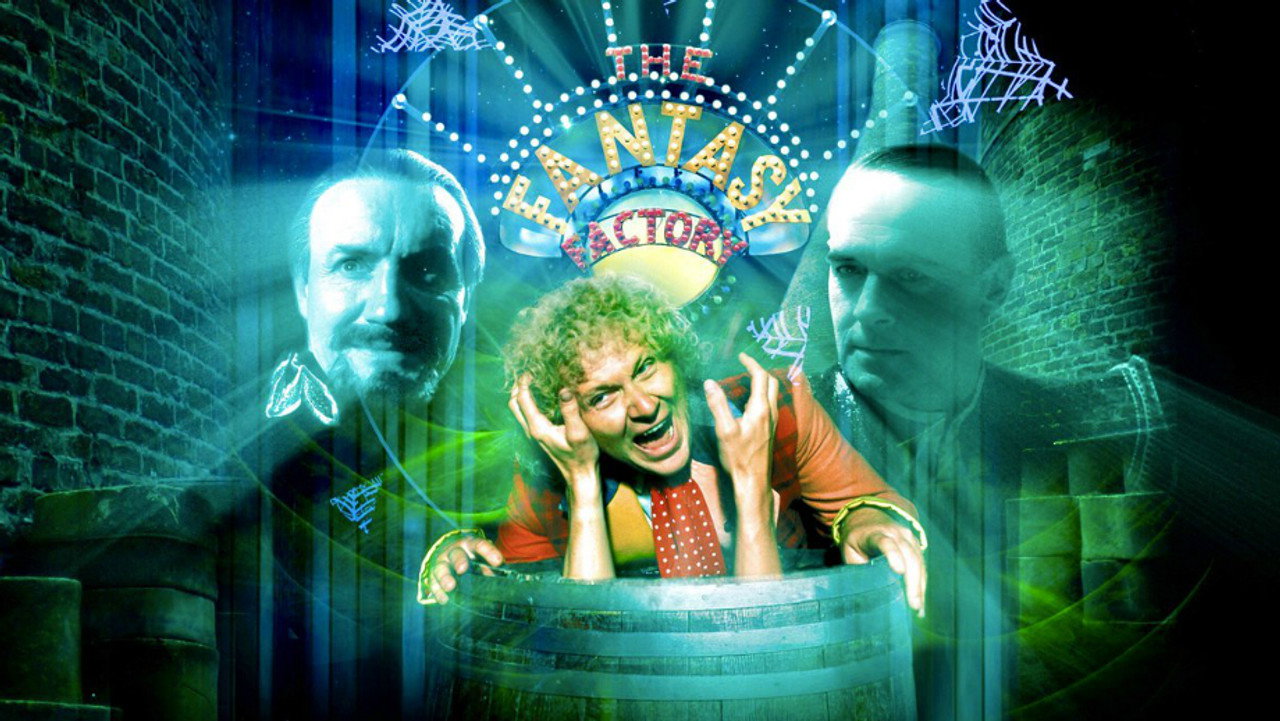
What survives the chaos is an odd, appealing pair of episodes. The Doctor accuses his own people of corruption in open court, chases his prosecutor into the Matrix, and finds a world where a cottage won't stay put and the most frightening character might be a fussy clerk named Popplewick.
The prosecutor is the Doctor
The Master explains it in court: the Valeyard is the Doctor's own darker side, from somewhere between his twelfth and final incarnations, and the High Council offered him the Doctor's remaining regenerations in return for faking the evidence. Ravolox was Earth, dragged across space by the Time Lords to get at thieves who had stolen secrets from the Matrix, and the Doctor made a handy scapegoat. The Doctor wins in the end, turns down the Inquisitor's suggestion that he stand for Lord President, telling her to stand herself, learns that Peri's death in Mindwarp never happened and leaves with Mel. As the court empties, the Keeper of the Matrix turns out to be the Valeyard, still at large.
It wasn't meant to end that way. The Holmes and Saward version closed on the Doctor and the Valeyard falling into a void, both apparently dead, which Nathan-Turner thought too downbeat for a show under threat of cancellation. He asked Pip and Jane Baker to let the Valeyard escape so he could return. Peri's fate was rewritten too, and Nicola Bryant was disappointed when she heard. It was Colin Baker's last story. Michael Grade and Jonathan Powell read the season's ratings as proof he didn't appeal to viewers, and Nathan-Turner phoned him on October 29, 1986, to say he'd be replaced. Powell offered one four-part story ending in a regeneration. Baker asked for a full season instead, and didn't come back.
Challenge the DNA
Does the trial's ending make sense?
Or skip ahead to our reading
It mostly works as a finale, and the reveal is a strong idea. The troubled writing shows in places. It's an ending that does more than it explains.
Behind the scenes
- The story was commissioned from Robert Holmes on February 4, 1986, under the title Time Inc. Holmes died on May 24, 1986, and couldn't work on it past the first part.
- Holmes's draft included a reenactment of one of the Whitechapel murders attributed to Jack the Ripper, which was felt to be unsuitable. James Cooray Smith's The Black Archive #14: The Ultimate Foe (2017) credits most of the Matrix scenes in Part Thirteen to Eric Saward.
- Saward was annoyed by what he saw as Nathan-Turner going back on an ending he and Holmes had long agreed, and withdrew his version of the final episode. Pip and Jane Baker, who had written Terror of the Vervoids, wrote the replacement.
- For copyright reasons the Bakers couldn't be told anything about Saward's script.
- Nathan-Turner and Saward created the Valeyard for the season, along with several other new characters.
- The two parts drew 4.4 and 5.6 million viewers.
- On BBC listings the episodes are simply The Trial of a Time Lord Parts 13 and 14; Part 13 went out on BBC One at 5:20 pm on Saturday, November 29, 1986.
The thread
A courtroom where the evidence lies, and a hero who has to prove it from inside the machine.
Came before
Shares DNA with
Left its mark on
DNA strand
Is Any of This Real?
For fourteen weeks the court has been watching the Doctor's life on a screen, and here the Doctor argues the footage is lying. Then he walks into the archive itself, where a house, a clerk and even the courtroom can be faked. By the end you're checking every face.
Every great sci-fi story is built from a handful of strands like this one. Each strand page explains how it works and traces it across shows, books and films.
If this one stayed with you
Where to go next, and why.
Watch · Doctor Who
"The Deadly Assassin" (1976)
Holmes's first trip into the Matrix, with the Doctor framed for murder on his own planet.
Watch · Star Trek: TNG
"All Good Things..."
Another hero hauled back before a judge who holds all the cards, and made to prove himself across time.
Watch · Red Dwarf
"Justice"
The comic version: a trial run by a machine, with the crew's worst coward as the defendant.
Read · Novel
The Trial — Franz Kafka
The original nightmare of a court that won't say what you're charged with or who's running it.
Read · Novella
A Christmas Carol — Charles Dickens
The past, present and future the season borrowed for its evidence, with ghosts doing the Valeyard's job.
Your next episode
Three directions to go from here, all on Sci-Fi DNA.

More of this feeling
The Deadly Assassin
Doctor Who
Another trip into the Matrix, where nothing can be trusted.
Same question, different answer
Mirror, Mirror
Star Trek
How far can you trust a version of yourself?

Something completely different
Time and the Rani
Doctor Who
A new planet, a new era and the Rani again.