
More from the episode
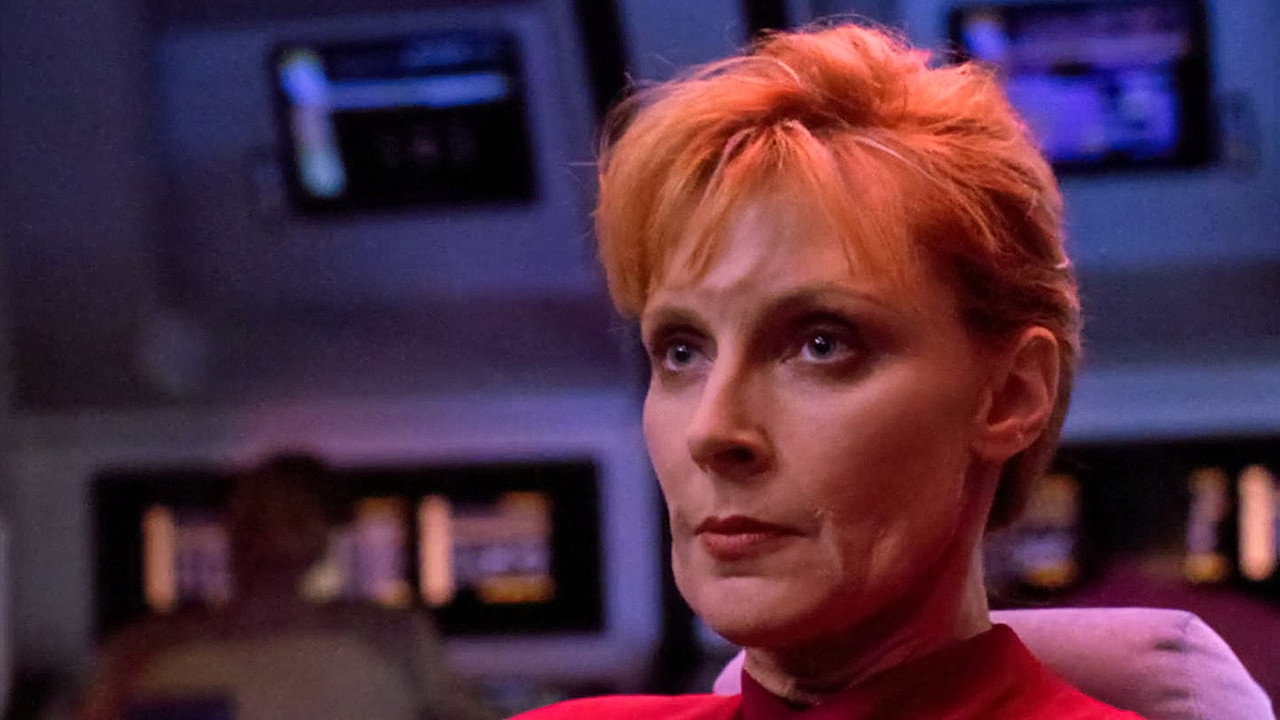
The story in 5 beats
- Unstuck in time
Picard shifts without warning between the present, the day before Farpoint and a future where he's retired to his family's vineyard.
- Back to day one
In the past, Picard overrides the cancellation of the Farpoint mission to keep his appointment with Q, baffling a crew he has only just met.
- The trial resumes
Q tells Picard humanity is still on trial, admits he is the one moving him through time, and warns that Picard will destroy humanity.
Anti-timeSpoiler · tap to reveal
The anomaly is bigger in the past and gone in the future. Q shows Picard a lifeless Earth, billions of years ago, where life never began.
Picard deals inSpoiler · tap to reveal
Three Enterprises collapse the rift. Back in the present, Picard joins the senior staff's poker game for the first time.
Why it still matters
The series ends where it started, with Q. Picard keeps jumping, without warning, between three times. In the present, the Enterprise is sent to investigate a strange anomaly near the Romulan Neutral Zone. Seven years earlier, he is about to take command for the first time, with Tasha Yar still aboard and the Farpoint mission ahead. More than twenty-five years on, he is retired to his vineyard in France and talks Beverly into taking him back out to the same patch of space.
Then Q puts him back in the courtroom from the pilot. The trial of humanity never ended, Q says, and the verdict is due. Ronald D. Moore and Brannon Braga built the finale as a deliberate bookend to "Encounter at Farpoint," and much of the fun is watching the cast play their characters at three ages, from the stiff first-season versions to future selves who have drifted apart in ways that hurt a little to see.
Patrick Stewart carries it, playing three Picards who each know a different amount about what's going on. There are small rewards all the way through for anyone who watched all seven seasons, down to the senior staff's poker game, a fixture since season two.
What the trial was really testing
The anomaly is a rift in anti-time, and Picard made it. In each era his ships scan it with an inverse tachyon pulse on his orders, and the three pulses together sustain it, so it grows backward through time until, 3.5 billion years ago, it stops life on Earth from forming at all. That's the sense in which Picard destroys humanity. Data and Geordi work out the fix: in all three eras, an Enterprise flies into the rift and generates a static warp shell. All three ships are badly damaged, and the future Enterprise, commanded by Admiral Riker, explodes as Q remarks that all good things must come to an end.
Then Q lets Picard in on the joke. The test was whether Picard could think across several timelines at once. He could, which suggests humanity can still grow. Q restores the past and present, signs off with "See you... out there," and Picard is back in the present for good.
He tells the senior staff about the future he saw, and they resolve not to drift apart. Then he sits down at their poker game for the first time in seven years. He says he should have done it long ago, they tell him he was always welcome, and he deals: "The sky's the limit."
Behind the scenes
- Moore and Braga had expected Michael Piller or Jeri Taylor to write the finale. Instead they wrote it alongside the film Star Trek Generations, sometimes mixing up elements of the two, and it took a month.
- Early drafts had a Locutus of Borg segment, which Piller cut to keep the number of timelines down. Hugh the Borg was also planned to appear, and a sequence of the crew stealing the Enterprise from a museum was dropped.
- The poker scene was the last one shot for the series, with support staff and crew gathered on set to watch the final day of filming.
- The image of past Riker is reused from "The Arsenal of Freedom," which spared Jonathan Frakes from shaving off his beard.
- It drew a 17.4 Nielsen rating, the highest of the series, beating the pilot's 15.7.
- It won the 1995 Hugo Award for Best Dramatic Presentation.
- Damon Lindelof cited it as an inspiration for the Lost episode "The Constant," and Kevin Feige has said it inspired how Avengers: Endgame handled its characters' growth.
The thread
A finale that circles back to the pilot, and keeps getting borrowed by other finales.
Came before
Shares DNA with
Left its mark on
DNA strand
Time Loops & Timelines
Picard lives three stretches of his life at once, and they keep bleeding into each other. The structure doubles as a farewell, showing the crew as they were, as they are and as they might end up, and Picard has to keep all three straight to make sense of what's happening to him.
Every great sci-fi story is built from a handful of strands like this one. Each strand page explains how it works and traces it across shows, books and films.
If this one stayed with you
Where to go next, and why.
Watch · TNG S6
"Tapestry" (1993)
If Picard and Q sparring over the meaning of his life was the best part, this is their other great episode together.
Read · Novel
Slaughterhouse-Five by Kurt Vonnegut
Billy Pilgrim is the original man unstuck in time, bouncing between the war, his old age and somewhere much stranger. His story is darker and funnier than Picard's.
Watch · Lost
"The Constant" (2008)
Another man whose mind slips between two points in his life and has to find something to hold on to. Damon Lindelof has named this finale as its inspiration.
Sources
- “All Good Things... (Star Trek: The Next Generation),” Wikipedia
- “Star Trek: The Next Generation season 7,” Wikipedia
- Keith R.A. DeCandido, “Star Trek: The Next Generation Rewatch: "All Good Things…",” Reactor (Tor.com), 2013
- Zack Handlen, “Star Trek: The Next Generation: "All Good Things…",” The A.V. Club, 2011
- Ryan Britt, “Star Trek: The Next Generation's Finale Remains Perfect,” Inverse, 2024
- Witney Seibold, “The Star Trek: Picard Season 3 Finale Opens And Closes With Two Of Its Best Easter Eggs,” /Film, 2023