More from the episode
The story in 5 beats
- A cargo of tribute
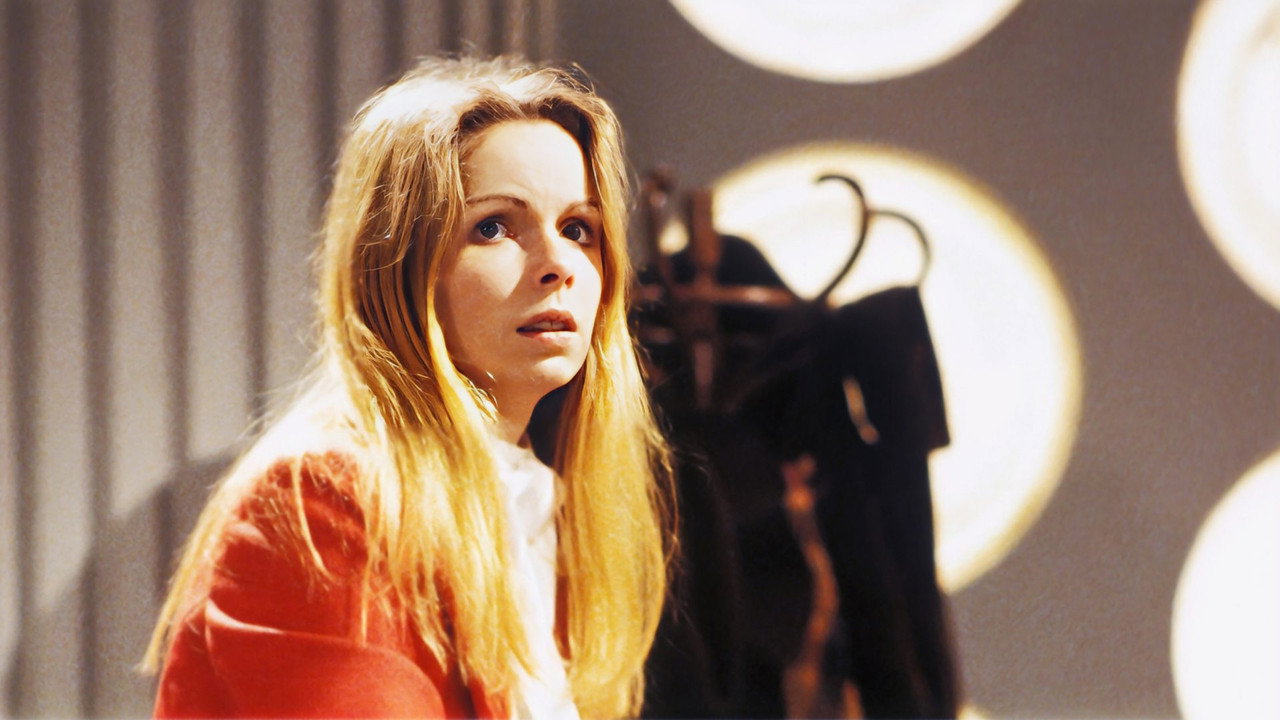
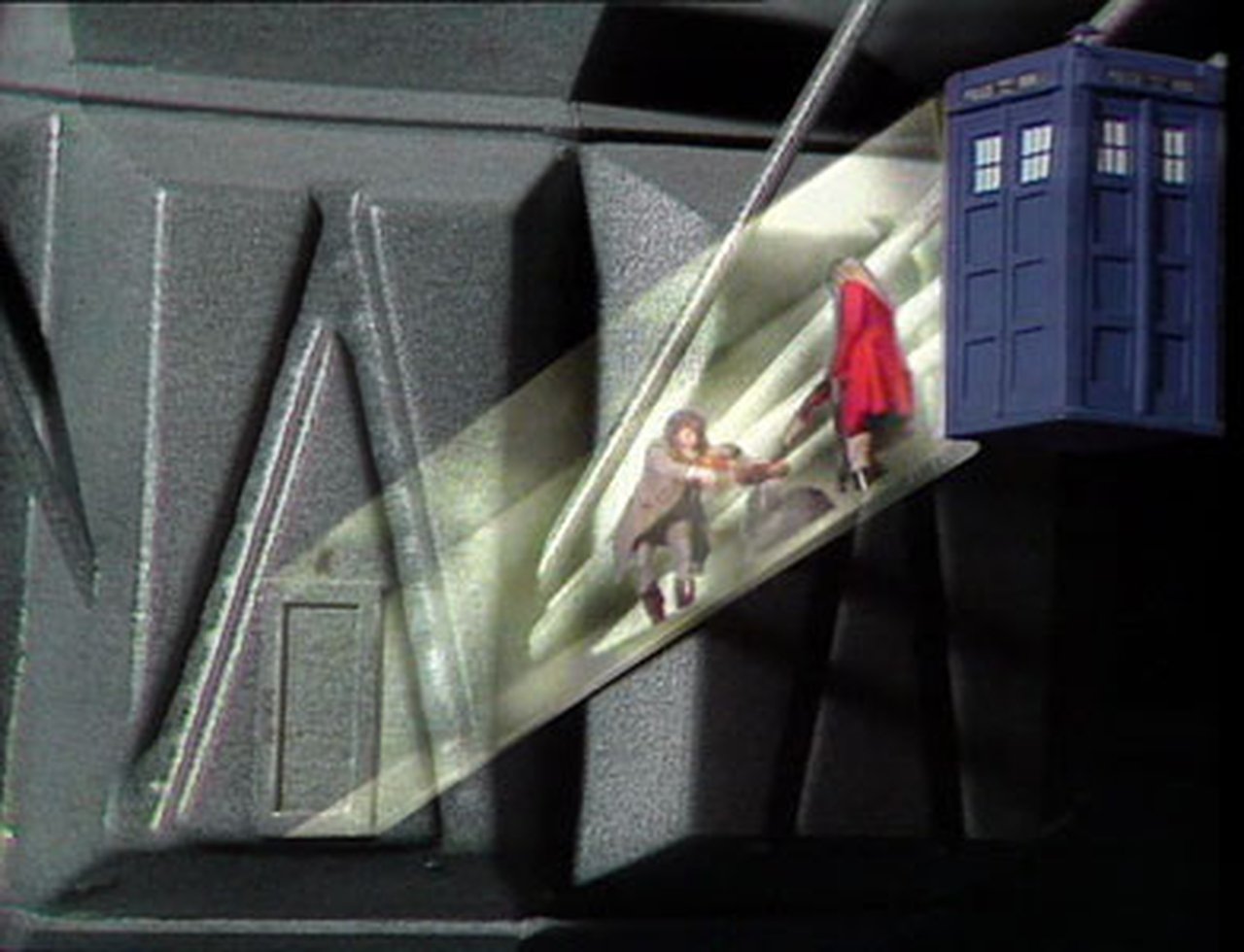
A Skonnan ship carrying young Anethans and hymetusite crystals breaks down near a black hole. The TARDIS arrives beside it, and the co-pilot makes the Doctor fix the engines at gunpoint.
- Soldeed and his god
On Skonnos, Soldeed serves the Nimon, a horned being in a vast Power Complex who has promised the weapons to rebuild the Skonnan Empire. It is not pleased the tribute is late.
- Into the labyrinth
Romana, Seth and Teka are forced to carry the crystals into the complex, where shifting walls push them toward the Nimon. The Doctor follows them in.
A tunnel between black holesSpoiler · tap to reveal
At the centre, the Nimon opens a passage through a pair of black holes, and more Nimon start to arrive.
CrinothSpoiler · tap to reveal
Romana is carried through to Crinoth, a world the Nimon have already used up, where an old man named Sezom offers her a way to fight back.
Why it still matters
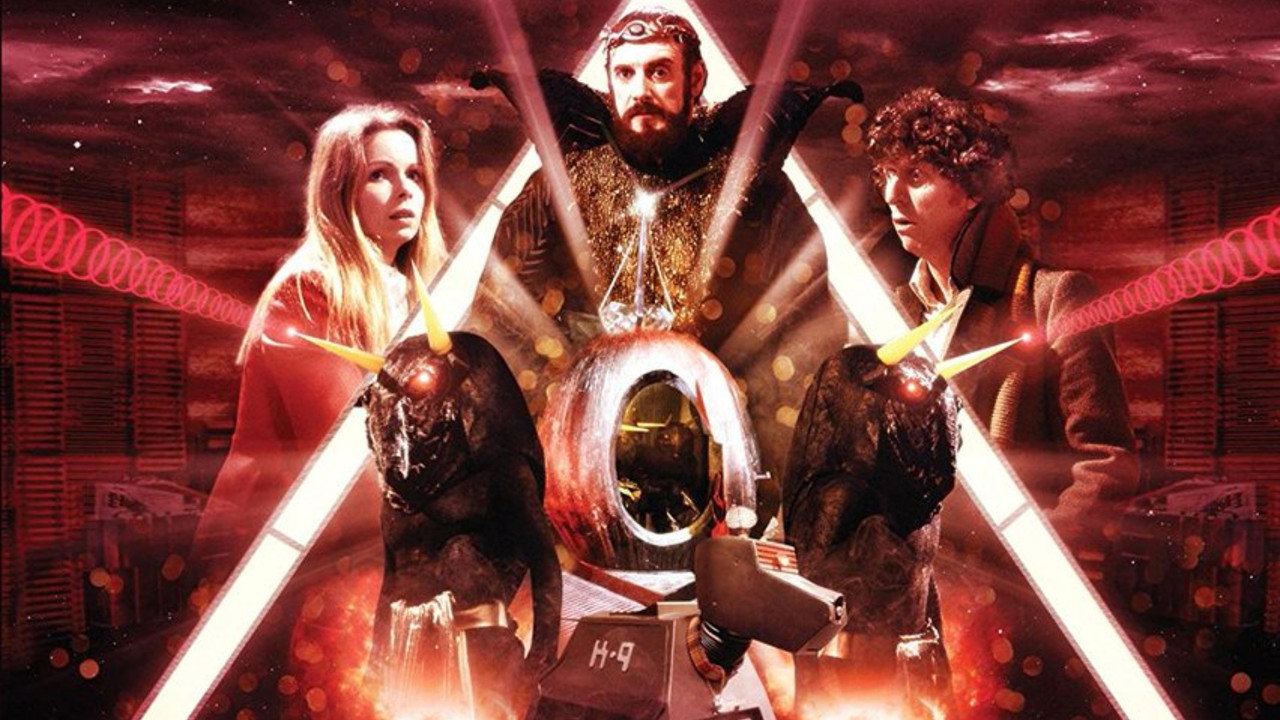
Anthony Read rebuilt the Greek myth of Theseus and the Minotaur almost name for name. The planet Skonnos stands in for Knossos, the people of Aneth for the Athenians sent to die in the Labyrinth, Soldeed for Daedalus, the young hero Seth for Theseus, and the bull-headed Nimon for the Minotaur. It went out the Saturday before Christmas 1979, and John Kenneth Muir has pointed out that the slot fell in panto season, which he argues obliged the script to carry in-jokes. Graham Crowden plays Soldeed, the Skonnan leader who reveres the Nimon as a god.
Douglas Adams's Shada was meant to end the season, but strike action at the BBC hit its studio recording, the studio time then went to Christmas programmes, and it was never finished. So The Horns of Nimon became the season's last broadcast story. It was also Read's final contribution to the show, as his Guardian obituary records.
Opinion on it is still split. Radio Times's Patrick Mulkern called it a "tatty, embarrassing production" and "lowest-calibre Doctor Who," sparing only Tom Baker and Lalla Ward. David J. Howe and Stephen James Walker, in Doctor Who: The Television Companion, thought its low reputation undeserved, found the story "ingenious and fun," and said Baker plays it more seriously and intensely than in most stories of the period.
A god that brings relatives
The Nimon is one of a parasitic race that travels between planets through artificial black holes, draining each world before moving on, and they are leaving Crinoth for Skonnos. On Crinoth, Sezom admits that he once helped them in, trusting their promises, and saw too late that the small tributes were the start of his people's destruction. He gives Romana jacenite, a mineral that can be used against them, before she is pulled back to Skonnos.
Seth fits the jacenite to Soldeed's ceremonial staff and stuns the Nimons. Soldeed, shot, sets off the Power Complex's self-destruct, and K9 guides everyone out before it explodes, while Crinoth breaks apart with the Nimon still on it. Seth and Teka head home to Aneth, and the Doctor reminds Seth to paint his ship white and hints that he once caused "quite a hoohah" at Knossos himself. It was also the last time David Brierley's voice was heard as K9 on air; John Leeson came back to the part the next season.
Challenge the DNA
Is The Horns of Nimon too silly?
Or skip ahead to our reading
It's silly, and it knows. The myth underneath still works, and the Doctor's cheerfulness carries it through. It's a good example of the season's lighter style, and a fair place for the era's broadcasts to end.
Behind the scenes
- Shada, written by script editor Douglas Adams, was planned as the season's six-part finale. Location filming in Cambridge and the first of three studio sessions went ahead, but the second block ran into a long-running technicians' dispute at the BBC. The strike was over by the third session, but the studio time was given to higher-priority Christmas programmes instead. An estimated half of the story was filmed, so The Horns of Nimon closed the broadcast season.
- Anthony Read had joined Doctor Who in 1977 as script editor under producer Graham Williams, and argued for Douglas Adams to replace him in the job. This was his final contribution to the series.
- John Kenneth Muir, in A Critical History of Doctor Who on Television, sets out the myth mapping: Skonnos for Knossos, Anethans for Athenians, Soldeed for Daedalus, Seth for Theseus and the Nimon for the Minotaur.
- Janet Ellis played Teka in 1979, the same year she became a presenter of the children's programme Jigsaw. She joined Blue Peter in 1983.
- Part one, on December 22, 1979, drew 6.0 million viewers; the audience climbed every week to 10.4 million for part four on January 12, 1980.
- Kenny McBain directed, Douglas Adams was script editor and Dudley Simpson wrote the music. On DVD it first came out in the 2010 Myths and Legends box set, alongside The Time Monster and Underworld.
The thread
Greek myth moved to outer space, a god in a maze taking tribute, and a season cut short.
Came before
Shares DNA with
DNA strand
Be Careful What You Wish For
Soldeed wants his empire back and the Nimon promises it, for a modest price in young lives and crystals. The story is about what that kind of bargain costs once the god in the maze starts collecting.
Every great sci-fi story is built from a handful of strands like this one. Each strand page explains how it works and traces it across shows, books and films.
If this one stayed with you
Where to go next, and why.
Watch · Doctor Who
"Underworld"
The Fourth Doctor's other Greek myth in space, this time Jason and the Golden Fleece.
Watch · Doctor Who
"The Time Monster"
An earlier Doctor and an earlier Minotaur, in a story that goes all the way to Atlantis.
Watch · Star Trek
"Who Mourns for Adonais?"
Another show turning a Greek god loose on its heroes and asking what worship is worth.
Read · Novel
The King Must Die — Mary Renault
The Theseus story told straight, labyrinth and bull dancers included, for when you want the original myth with the costumes off.
Read · Novelisation
Doctor Who and the Horns of Nimon — Terrance Dicks
Dicks opens the 1980 Target book with a history of the Skonnan Empire and Soldeed that the serial never had time for.
Your next episode
Three directions to go from here, all on Sci-Fi DNA.
More of this feeling
Underworld
Doctor Who
Another Greek myth retold in space, a season earlier.

Same question, different answer
The Squire of Gothos
Star Trek
A godlike creature, and people forced to play its game.

Something completely different
Gunmen of the Apocalypse
Red Dwarf
Something completely different, and played for laughs.