
More from the episode
The story in 5 beats
- The Evil One arrives
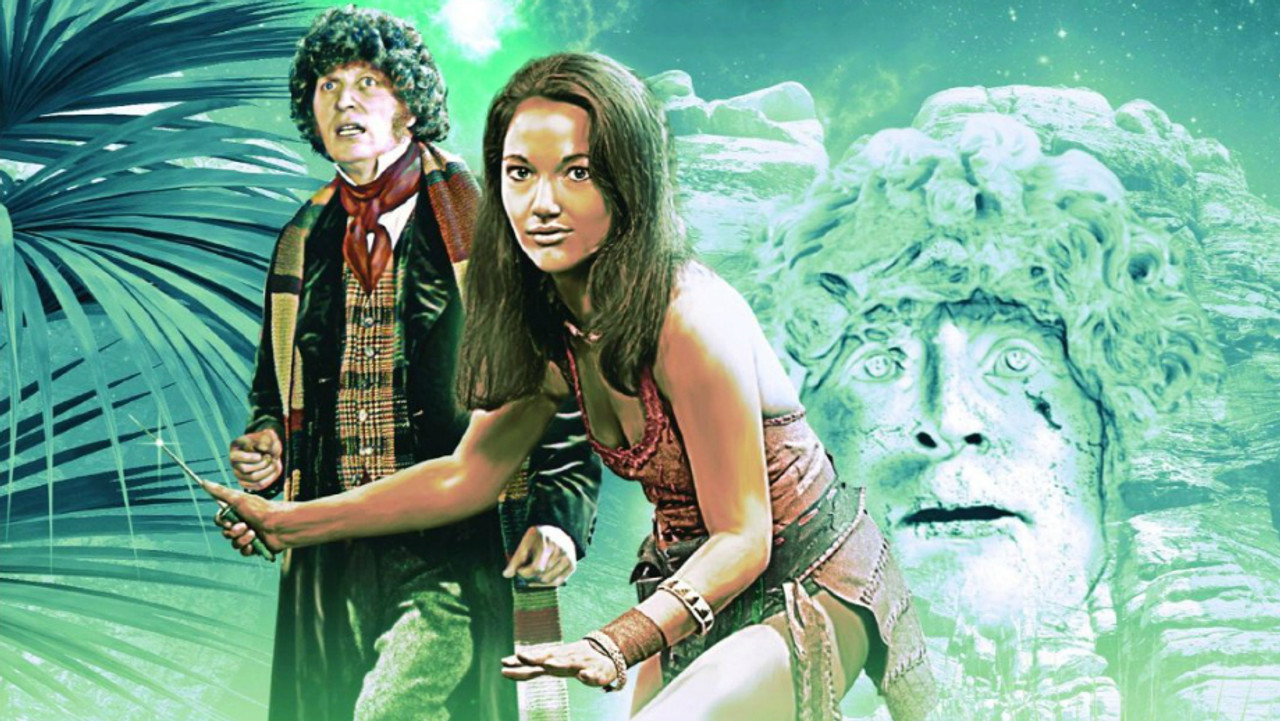
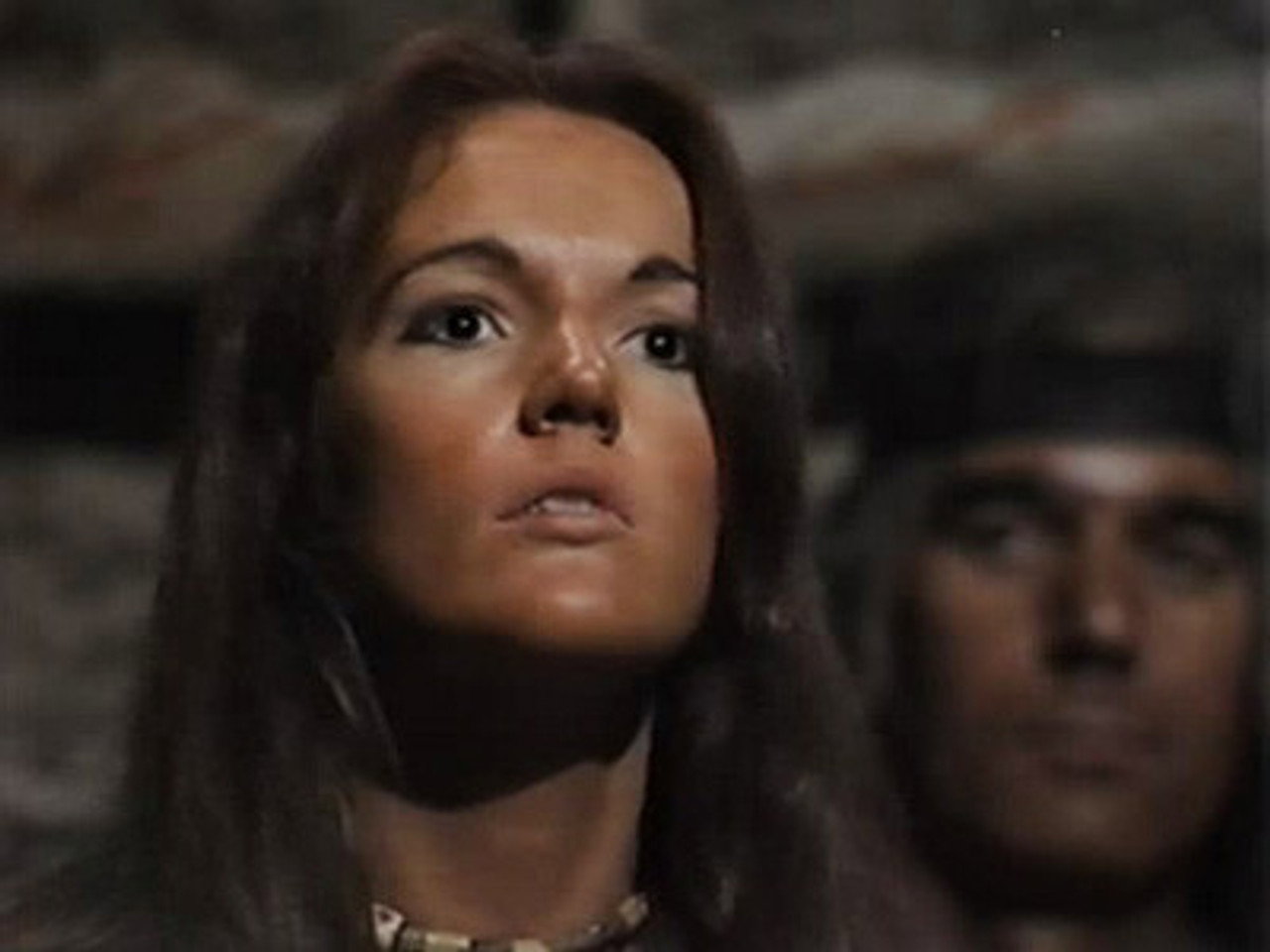
Travelling alone, the Doctor lands in a jungle and meets Leela, a Sevateem warrior, just as her tribe decides he is the Evil One who imprisoned their god.
- Relics in the shrine
Among Neeva's sacred relics, the leftovers of an Earth survey expedition, the Doctor finds the transceiver through which the shaman hears Xoanon speak.
- A face in the mountain
Past the jungle, a huge face is carved into the mountainside. It is the Doctor's, and he can't remember why.
Two tribes, one crewSpoiler · tap to reveal
The savage Sevateem and the psychic Tesh turn out to be descendants of the same expedition's survey team and technicians, bred apart on purpose.
A god with his voiceSpoiler · tap to reveal
Xoanon is the expedition's computer, which the Doctor once repaired and left with a copy of his own personality. It has been mad ever since.
Why it still matters
The Doctor's guide through this jungle is Leela (Louise Jameson), a hunter from a tribe that has forgotten it was ever anything else, and she is the best thing in it. Chris Boucher, writing his first Doctor Who, named her after the Palestinian hijacker Leila Khaled. Even Patrick Mulkern of Radio Times, who gave the story two stars out of five and called it a "lifeless tale," said Jameson was "a wonderful find."
Underneath is a sharp little story about faith. The Sevateem's shaman, Neeva, hears his god through the tribe's sacred relics, the war leader Andor suspects he is a false prophet, and the Doctor walks into the middle of it as the tribe's devil. DVD Talk's John Sinnott praised its "quite subversive" take on religious fervour, and The Discontinuity Guide (1995) called it "a little masterpiece, often undeservedly forgotten by the weight of the surrounding stories."
It began on New Year's Day 1977 and drew more than 11 million viewers for each of its last three parts, but fans do tend to rank it below the stories around it: in Doctor Who Magazine's 2014 readers' poll it came 130th, the lowest of Season 14.
The Doctor's own mistake
The Doctor had been to this planet before. Repairing the Mordee Expedition's computer, he forgot to wipe his personality print from its data core, and the machine, Xoanon, ended up with a split personality, part of it the Doctor. It has been running a eugenics experiment on the crew's descendants: the Sevateem (the name is a worn-down "survey team") and the Tesh (the technicians). The idea that the Doctor's earlier visit had done harm was Hinchcliffe's, and Terrance Dicks's novelisation adds what the scripts never say, that the visit came just after his regeneration, when he was too muddled to notice. Xoanon's other voices came from Rob Edwards, Pamela Salem, Roy Herrick and Anthony Frieze, a boy from the school where Pennant Roberts's wife worked.
Neeva, who has lost his faith, is the one person Xoanon can't control. He fires at the computer and is killed, and the break gives the Doctor time to pull his personality print out. He wakes two days later to find Xoanon sane and grateful. Calib proposes Leela to lead the united people; she jumps into the TARDIS instead, over the Doctor's protests. She had been written as a one-off, with the season's new companion planned for its final story, until the production team decided to keep her. Hinchcliffe and Holmes had wanted a companion like Eliza Doolittle in Pygmalion, a bright but unschooled pupil for the Doctor, and Boucher saw Leela as a mix of Khaled and Emma Peel from The Avengers. David J. Howe and Stephen James Walker found the ending "somewhat unlikely," but still called the story an "impressive tale that manages to intrigue and delight."
Challenge the DNA
Is the Doctor to blame for Xoanon?
Or skip ahead to our reading
Yes, and the story makes him own it. A careless repair job left a machine split in two and a people living by its rules. Fixing it is the least he can do, and he knows it.
Behind the scenes
- Holmes turned down Boucher's first storyline in early 1975 as too short and unsuitable, but liked its imagination and invited him to try again. The story went through the titles The Mentor Conspiracy, The Tower of Imelo and The Day God Went Mad, which Hinchcliffe disliked and Boucher later agreed was "pretentious."
- Filming began at Ealing Studios on September 20, 1976. The jungle was built in the studio instead of being shot in a real forest, because the studio jungle of Planet of Evil the season before had worked so well. The first scene filmed was the end of Part One, with Hinchcliffe's Mount Rushmore-style model of the face in the mountain.
- In one filmed scene the Doctor was meant to threaten a tribesman with a knife. Tom Baker refused to threaten anyone with a weapon and used a jelly baby instead, to the annoyance of Hinchcliffe, who wasn't there that day.
- Pennant Roberts auditioned 26 actresses for Leela before casting Louise Jameson. Pamela Salem, who also tried out, appeared in the next story instead. Jameson's red contact lenses, which turned her blue eyes brown, were so uncomfortable she couldn't wear them for long.
- Austin Ruddy designed the sets, his only Doctor Who. Hinchcliffe rated him the best designer after Roger Murray-Leach.
- Two of the guest cast had been in The War Games in 1969: David Garfield (Neeva) played the alien Von Weich, and Leslie Schofield (Calib) played Leroy.
- It was the first of three Doctor Who stories by Boucher, all broadcast in 1977. Holmes later recommended him as script editor of Blake's 7.
The thread
Lost colonists, a god who speaks through a radio, and a tribe that needs a devil.
Came before
Shares DNA with
DNA strand
Us vs. Them
Two peoples share one planet, each sure the other is the enemy. The best scenes are about how a tribe keeps its faith going, with a shaman who interprets, a war leader who doubts, and a stranger who makes a convenient devil.
Every great sci-fi story is built from a handful of strands like this one. Each strand page explains how it works and traces it across shows, books and films.
If this one stayed with you
Where to go next, and why.
Watch · TNG S3
"Who Watches the Watchers"
The same problem from the other side: Picard is mistaken for a god and has to talk a whole people out of believing in him.
Watch · Star Trek
"The Apple"
Kirk's crew meets a people who live by their god's rules, ten years before the Sevateem.
Watch · Doctor Who
"The Robots of Death"
Boucher's next script, broadcast the following week, and a world away from the jungle: a giant sandminer crawling across a desert, crewed by people who leave all the work to robots.
Read · Novelisation
Doctor Who and the Face of Evil — Terrance Dicks
Target's 1978 novelisation, which fills in a gap the scripts leave open about the Doctor's past here.
Your next episode
Three directions to go from here, all on Sci-Fi DNA.
More of this feeling
The Return of the Archons
Star Trek
A society living under an all-powerful guide nobody questions.
Same question, different answer
The Changeling
Star Trek
What happens when a machine gets its idea of itself badly wrong?

Something completely different
The Robots of Death
Doctor Who
A murder mystery aboard a giant mining machine.