More from the film


Who this is for
You've seen Timecrimes and want the afternoon laid out in order, with every path kept straight, plus a clear answer on whether anything in it could have gone differently.
What it covers
- The afternoon, step by step
- The one rule the film never breaks
- Who causes what
- What the last shot is really telling you
Spoiler boundary
The whole film, including the last scene. Mentions Triangle (2009) and Primer (2004) only by premise, outside the spoiler section.
Show the full explanationHide the explanationContains spoilers: The whole film, including the last scene.
How to read the labels
- Confirmed in the work
- Shown or stated on screen or on the page.
- Strong inference
- Not stated outright, but the evidence points one way.
- Interpretation
- A reading of what it means. Reasonable people differ.
- Fan theory
- A popular idea the work doesn't confirm.
- Unresolved
- The work doesn't answer this.
The short answer
Nothing in Timecrimes changes. It's a single closed loop: every event in the afternoon was always going to happen, and the man causing the trouble is Héctor himself, at three different points in the same day.
Héctor 1 is stabbed by a bandaged man and hides in a time machine. He comes out about an hour earlier as Héctor 2, who becomes the bandaged man. Héctor 2 thinks he has caused his wife's death and goes back again as Héctor 3. Héctor 3 can't stop anything he has already seen, so he works in the gaps: he gets his wife Clara out of the way and dresses the young woman from the woods to look like her. The woman dies in Clara's place, and the loop closes.
The afternoon, Héctor by Héctor
The film shows you these in the order Héctor lives them. Here they are in that order, so you can follow one man at a time.
Héctor 1
Confirmed in the work Settling into a new country house with his wife Clara, he looks through binoculars and sees a young woman undressing in the woods. He walks over, finds her unconscious, and is stabbed in the arm by a man with a bandaged face.
Héctor 1
Confirmed in the work He runs to a nearby research building. A scientist on a walkie-talkie guides him in and hides him in a large tank. Héctor climbs out about an hour earlier.
Héctor 2
Confirmed in the work The scientist explains what happened and tells him the safest thing is to let events run their course. Héctor 2 drives after the woman instead, is forced off the road, cuts his head, and wraps it with the bandage from his arm.
Héctor 2
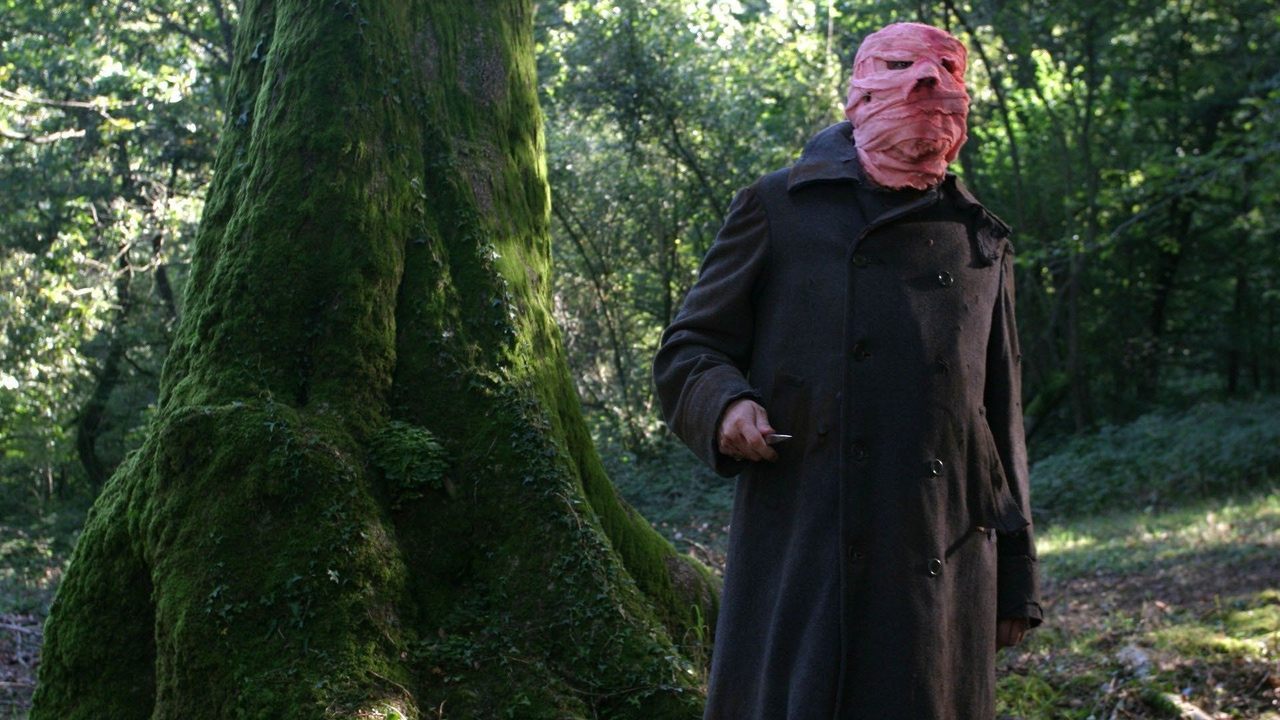
Confirmed in the work Now he is the bandaged man. Believing he has to make the afternoon happen as he saw it, he forces the woman to undress where Héctor 1 will see her, stabs Héctor 1 and lets her get away.
Héctor 2
Confirmed in the work Back at the house he chases a woman with short hair onto the roof. She falls and dies. He believes it was Clara. He goes back to the lab and goes through the machine again.
Héctor 3
Confirmed in the work Arriving earlier still, he tries to stop Héctor 2 and crashes into his car. That crash is the one that cut Héctor 2's head and made the bandages necessary.
Héctor 3
Confirmed in the work He finds the woman from the woods, gets Clara somewhere safe, cuts the woman's ponytail and sends her upstairs in a way that makes her look like Clara from behind.
Héctor 3
Confirmed in the work He sits with Clara on the lawn while Héctor 2 chases the woman onto the roof and she falls. Sirens approach as the film ends.
The one rule: nothing changes
Confirmed in the work The film never shows a second version of any event. Every scene Héctor 1 witnessed happens again, exactly, from another angle. That's the only rule the film needs, and it never breaks it.
Strong inference The scientist's advice to keep things as they were isn't superstition. He's the only one who understands that the afternoon is already finished. Héctor's only choices are about what he does inside the parts he didn't see.
Fan theory A rule fans often attribute to Vigalondo: you can change anything you haven't seen happen, but not what you have. We couldn't find him saying it, so treat it as a fan reading. It does fit the film exactly.
Unresolved In a closed loop like this there is no first time round, so there was never an "original" bandaged man. The film doesn't try to explain that, and doesn't need to.
Clues you may have missed
- Confirmed in the workHéctor causes his own injuries. Héctor 2 stabs Héctor 1. Héctor 3 crashes into Héctor 2 and gives him the head wound that turns him into the bandaged man.
- Confirmed in the workThe scientist is the only character who knows about more than one Héctor. Everyone else, Clara included, only ever meets one of him at a time.
- Strong inferenceThe woman on the roof has short hair. That detail is set up by Héctor 3 cutting her ponytail. Héctor 2 sees short hair from behind and assumes it's Clara, which is exactly the mistake Héctor 3 is counting on.
What the ending means
Confirmed in the work Mechanics. Clara lives. The young woman from the woods dies in the fall. Héctor 3, the one who remains, is sitting with his wife as the emergency vehicles arrive. The other two Héctors have each gone into the machine, so only one is left in the world.
Interpretation Meaning. Héctor got what he wanted, and the price was a stranger's life that he arranged himself. The ending is quiet because he has to stay quiet about it for good.
Interpretation A darker reading is that Héctor's very first look through the binoculars set all of this going. A man watching a stranger undress is where the whole machine of harm starts, and she is the one who pays for it.
What remains unanswered
- UnresolvedWho the young woman is. The film never names her or gives her a life outside Héctor's afternoon, which is part of its point.
- UnresolvedWhat the scientist will do now that he knows what the machine can do, and what he does about the death.
- UnresolvedWhat Héctor tells Clara, and what she'll believe.
The Question Underneath
If you could undo a mistake, how much damage would you do trying?
Héctor never sets out to hurt anyone. Every terrible thing he does is a repair, or a cover for a repair, or a way to make sure an earlier repair still happens. By the end he has saved his wife by arranging for a stranger to die in her place, and he gets to sit on the lawn and call that a fix. The film is a tidy machine, but what it's really about is how far a person will go to avoid facing that he caused the harm in the first place.
Where to go next
More of this feeling
Help Me Understand
Another closed circle of bad decisions, this time on a ship at sea, with more dread and fewer laughs.
Same question, different answer
Star Trek: The Next Generation · S5 E18
A starship crew keeps living the same few hours. Their way out takes patience instead of panic.
Something completely different
Star Trek · S2 E15
A break from consequences: Kirk, a space station and a growing pile of purring fur.
How it connects
- Documented influence on thisThe fiction of Philip K. Dick Book · Philip K. Dick
Vigalondo has said his inspiration for Timecrimes came from Philip K. Dick's books, and from his love of twisted, hard sci-fi rather than space opera. Source
- Similar story mechanismPrimer (2004) Film · Shane Carruth
Another low-budget story about a box that sends people back a short way, and the trouble of sharing a day with yourself.
- Editor's pairingTriangle (2009) Help Me Understand
Released two years apart and often watched together. Triangle's director has said he had the idea years before Timecrimes came out.
On the trail: Time loops that do more than repeat the day (stop 2 of 6)
Sources
- Timecrimes · Wikipedia · accessed 2026-11-20
- Timecrimes (review) · Cineuropa · accessed 2026-11-20
- Timecrimes (Los Cronocrímenes) · PopMatters · accessed 2026-11-20
- Timecrimes (2007) movie plot and ending explained · This is Barry · accessed 2026-11-20
- Nacho Vigalondo on Timecrimes, and How To Land A Car On A UFO · Gizmodo · accessed 2026-11-20
Plot summaries are in our own words. Labels mark what the work shows, what its makers have said, and what is our reading. Last reviewed 2026-11-20. Spot an error? Tell us.