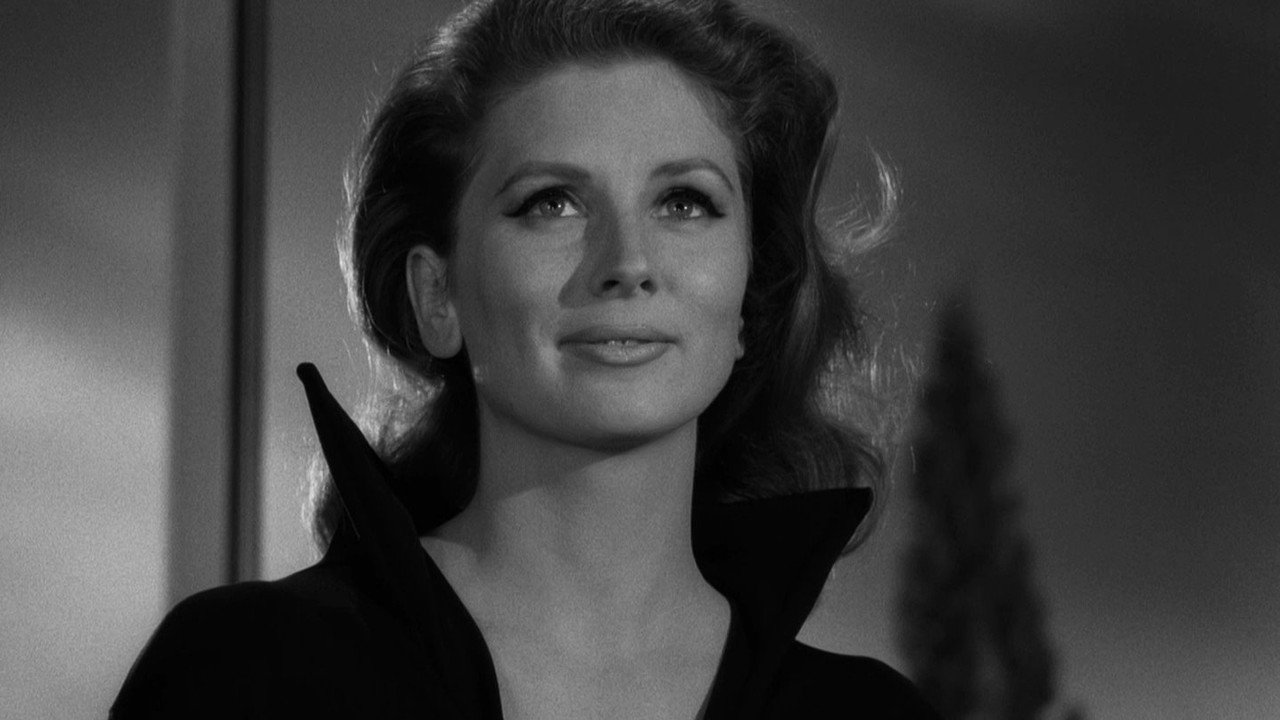
More from the episode

The story in 5 beats
- The year 2000
Teenagers undergo the Transformation and come out as numbered models. Marilyn says she doesn't want to.
- Her father's books
Her late father regretted his own Transformation. He left her the habit of reading and asking questions.
- Professor Sigmund Friend
Her mother takes her to Dr. Rex, who sends her to Professor Friend. He says the procedure ended war and hate.
The hospitalSpoiler · tap to reveal
Marilyn is kept in for tests. Her transformed friend Valerie watches her cry and feels nothing.
The mirrorSpoiler · tap to reveal
She runs, and the door she picks opens onto the operating room.
Why it still matters
Marilyn Cuberle is eighteen, and next year she's due for the Transformation: surgery that turns you into one of a handful of numbered, beautiful models, slows your aging and keeps you free of disease. Women mostly choose Number 12 and men Number 17, so grown-ups wear name badges to tell each other apart. Marilyn's late father had her reading banned books, and she has started to ask what else the operation takes away.
Suzy Parker plays Marilyn's mother and most of the other women, and Richard Long plays every man. That's funny for about ten minutes. Watch the faces around Marilyn repeat as the episode goes on; it's the cheapest special effect on the show and one of the most unsettling.
It's often paired with "Eye of the Beholder" from Season 2, and the two make a good double bill: one about a world that punishes a face, one about a world that hands you a better one and asks only for everything else.
Who walks out of the operating room
Marilyn realizes the Transformation isn't really optional, and that the people who've had it can no longer feel what she's feeling. She tries to escape, gets lost in the hospital corridors and ends up in the operating room. The next time we see her, she looks exactly like Valerie, thinks exactly like Valerie, and admires her new face in the mirror, delighted to look just like her friend. Whatever Marilyn was worried about losing, she no longer remembers having it.
Beaumont is after more than vanity. The Transformation is sold as a kindness, it really does end disease, and its costs are invisible to everyone who has paid them, so there's no villain to blame. Her father, the one adult who saw the price, couldn't live with it and took his own life. By the last shot Marilyn has paid the same price and is smiling about it, and the episode leaves you to decide which of them got the worse deal.
Behind the scenes
- It's adapted from Charles Beaumont's 1952 story "The Beautiful People," first published in If magazine and later collected in Yonder (1958).
- John Tomerlin wrote the teleplay and consulted Beaumont by phone. The two had already written a novel together, Run From the Hunter (1957), under the shared pen name Keith Grantland.
- In Tomerlin's first draft, Val was Marilyn's boyfriend; the second draft made her a girlfriend and added Uncle Rick.
- The first ending had Serling deliver his closing words in the mirror. It was dropped for a shot of Pam Austin smiling straight at the camera.
- TV Guide ran a multi-page spread on Suzy Parker to promote the episode.
- The music is stock, including cues from Bernard Herrmann's score for the CBS Radio Workshop's adaptation of Brave New World.
- Charlie Brooker has said the episode influenced "Fifteen Million Merits," his second Black Mirror.
The thread
Perfect faces, managed feelings and the people who say no, from the pulp magazines to *Black Mirror*.
Came before
Shares DNA with
Left its mark on
DNA strand
The State Knows Best
Nobody in this future is cruel. Doctors are patient, the mother is worried, the professor has statistics on his side. The state doesn't need to force anyone because it has made conformity feel like health, and the only person who notices is the one who hasn't had it yet.
Every great sci-fi story is built from a handful of strands like this one. Each strand page explains how it works and traces it across shows, books and films.
If this one stayed with you
Where to go next, and why.
Watch · Twilight Zone S2
"Eye of the Beholder" (1960)
The obvious next step: another young woman, another hospital, another society very sure of what a face should look like.
Watch · Black Mirror
"Fifteen Million Merits" (2011)
Brooker has said this episode fed into his own: a cleaner, brighter system, and another young person who won't go along with it.
Read · Novel
Uglies — Scott Westerfeld
Critics have paired the two for years. A girl counting down to the operation that will make her pretty starts asking Marilyn's questions.
Read · Short story
"The Beautiful People" — Charles Beaumont
The original, a short, sharp pulp story. It's in Beaumont's collection Yonder.
Sources
- “Number 12 Looks Just Like You,” Wikipedia
- “The Twilight Zone (1959 TV series) season 5,” Wikipedia
- Brian Durant, “Number 12 Looks Just Like You,” The Twilight Zone Vortex, 2025
- “The Twilight Zone, Season 5, Episode 17: Number 12 Looks Just Like You,” Great Books Guy, 2022
- Oktay Ege Kozak, “Every Episode of The Twilight Zone, Ranked from Worst to Best,” Paste, 2023