
More from the episode
The story in 5 beats
- Treatment eleven
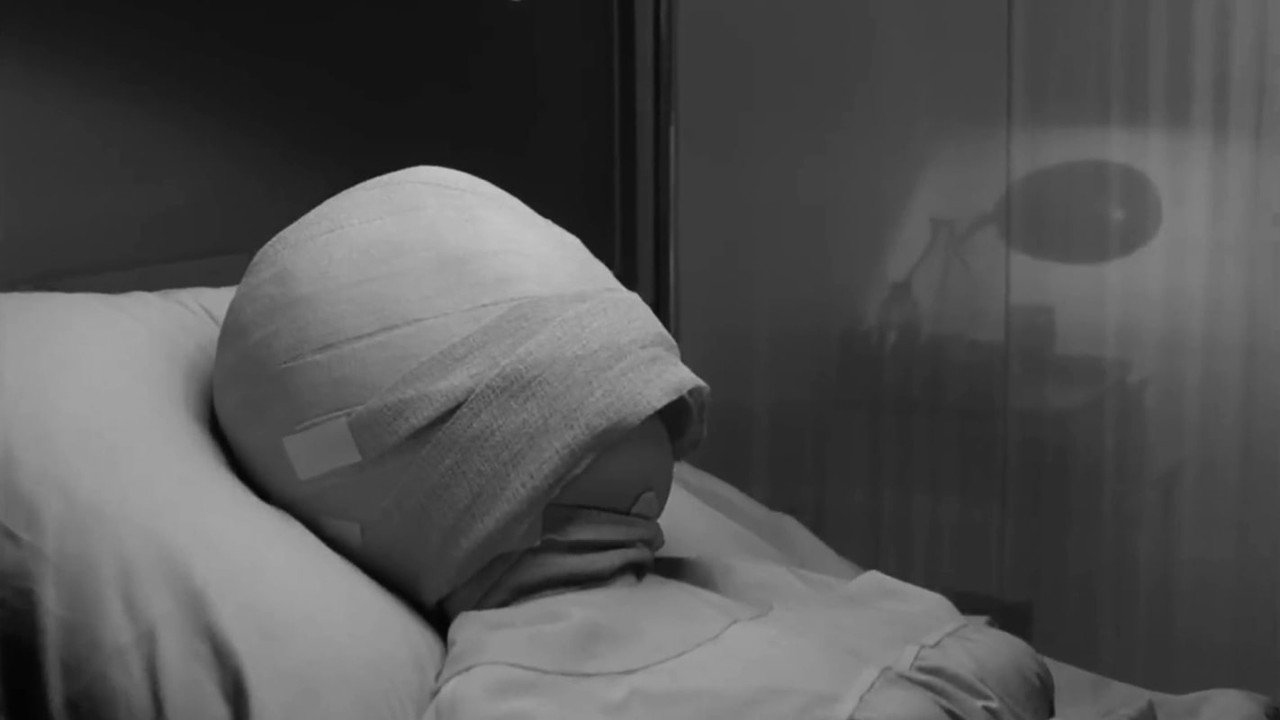
Janet lies in a hospital bed, face wrapped. If this last treatment fails, the State will send her away.
- Faces in shadow
Doctors and nurses come and go, kind voices with no faces. The camera never lets you see them.
- On the screens
Wall screens carry a leader's speech about conformity. A nurse warns the doctor that his doubts sound like treason.
The bandages come offSpoiler · tap to reveal
The treatment has failed. Janet is beautiful by our standards. The doctors and nurses have pig-like faces.
Her own kindSpoiler · tap to reveal
Walter Smith, who looks like her, arrives to take her to a village for people like them.
Why it still matters
Janet Tyler has had eleven treatments, the most the State allows, to make her look normal. Her head is wrapped in bandages, and for almost the whole episode so is the world around her: the doctors and nurses are kept in shadow, behind lamps, at the edge of the frame. You spend 20 minutes wondering what Janet looks like, and the episode is counting on that. The question it really wants you to ask is about everyone else.
It's one of the most-imitated twists in television, and it works on a second viewing because the craft is so careful. Director Douglas Heyes staged every hospital scene so the staff's faces never quite turn to the camera. He explained that the audience couldn't know what they looked like because Janet didn't.
The reveal
When the bandages come off, the doctor tells Janet the treatment didn't work. She looks like a 1960 movie star (she's played by Donna Douglas). Then the camera finally shows the staff: heavy brows, twisted lips, snouts for noses. To them, she is the one who's deformed. She runs through the hospital, past more screens carrying the leader's speech, until Walter Smith, a handsome man by our standards and an outcast by theirs, takes her to a settlement where people like them can live without bothering the State. Serling's narration says what the episode was about: beauty is in the eye of the beholder.
The Question Underneath
Who decides what counts as normal?
For most of the episode we share the doctors' assumption that Janet's face must be terrible. The reveal turns that assumption inside out. Beauty here is whatever the majority says it is, and the state enforces it. The episode is less about faces than about the pressure to match, and how quickly a society calls difference a disease.
Challenge the DNA
Is the episode about beauty, or about conformity?
Or skip ahead to our reading
Both, but the screens give it away: the leader's speech about one norm runs through the whole hospital. The face is just where the state shows up first.
Behind the scenes
- Two actresses play Janet. Maxine Stuart plays her under the bandages; Heyes chose her because her voice didn't suggest a beautiful woman. Donna Douglas plays her unmasked. Stuart was supposed to dub Douglas's lines, but Douglas matched Stuart's voice so well that she spoke them herself.
- Heyes cast the doctors and nurses by voice alone, with his back to them, so the audience would trust them and not suspect a thing.
- To keep the staff's faces hidden, Heyes used complicated camera moves: people pass each other or step behind a pillar just as they turn toward the lens, and the set is kept in shadow.
- William Tuttle, head of MGM's makeup department, designed the faces. He said the goal was pigs, with big nostrils and a pig-like nose. He had recently done the Morlocks for MGM's The Time Machine (1960), and the two designs are related.
- A TV producer named Stuart Reynolds, who was selling an educational film of the same name to schools, threatened to sue over the title. The summer 1962 rerun went out as "The Private World of Darkness."
The thread
Where the idea came from, what shares it, and where Serling and others came back to it.
Came before
Shares DNA with
Left its mark on
DNA strand
The Cruel Twist
The best twists don't add a fact; they change who you've been rooting for. This one works because the episode controls exactly what you see. Every shot that hides a face is a clue, and every kind voice is a trap. When the camera finally turns, nothing new has happened, but you've been looking at the story from the wrong side.
Every great sci-fi story is built from a handful of strands like this one. Each strand page explains how it works and traces it across shows, books and films.
If this one stayed with you
Where to go next, and why.
Watch · Twilight Zone S5
"Number 12 Looks Just Like You" (1964)
The same worry from the other direction. A young woman in a world where everyone gets a standard beautiful face doesn't want one.
Watch · Black Mirror S3
"Nosedive" (2016)
Janet's State uses hospitals. This one uses a five-star rating app. The pressure to look acceptable is the same.
Read · Novel
Uglies — Scott Westerfeld
A young-adult novel about a world where everyone gets surgery at 16 to become "pretty." The State's speech, stretched into a whole trilogy.
Watch · Twilight Zone S1
"Time Enough at Last" (1959)
Another ending that changes everything in one image, from a season earlier.
Your next episode
Three directions to go from here, all on Sci-Fi DNA.

More of this feeling
The Monsters Are Due on Maple Street
The Twilight Zone
Serling again, showing how fast people turn on whoever doesn't fit.

Same question, different answer
Nosedive
Black Mirror
Who decides what counts as acceptable? Fifty-six years later, the answer is an app.

Something completely different
Dimension Jump
Red Dwarf
From hidden faces to Ace Rimmer's square jaw: a comedy about the man you could have been.