The story in 5 beats
- A colony of philosophers
Answering a distress call, Kirk, Spock and McCoy meet the Platonians, who modelled their society on ancient Greece and the teachings of Plato.
- A doctor's visit
Their leader Parmen has an infected leg wound. McCoy treats him, but Parmen's delirium sends his telekinetic power lashing out, all the way up to the Enterprise.
- Puppets
Recovered, Parmen wants McCoy to stay. To persuade him, the Platonians turn Kirk and Spock into entertainment. Spock is made to laugh, then weep.
The kissSpoiler · tap to reveal
Parmen brings Uhura and Chapel down and forces Kirk to kiss Uhura and Spock to kiss Chapel, for the Platonians' amusement.
Alexander's choiceSpoiler · tap to reveal
Given the chance to kill Parmen, Alexander listens to Kirk instead, and leaves with the Enterprise.
Why it still matters
This is the episode with the kiss. Under telekinetic control, Kirk is forced to kiss Uhura, and it's often described as the first kiss between a Black character and a white character on American television. MeTV's history of it notes some earlier, smaller moments on TV, and StarTrek.com's own 50th-anniversary piece calls the "first" claim "perhaps a bit inflated." Either way, it went out in prime time on NBC in November 1968, and people remember it.
It's worth knowing what you're in for, though. The kiss is forced on both of them, and it's one of many humiliations in an hour built around them: the Platonians make Kirk and Spock perform for them against their will. Zack Handlen at The A.V. Club found the torment "unsettling and sad" and still gave the episode a B+, while Keith R.A. DeCandido at Reactor called it the single worst episode of any Star Trek series.
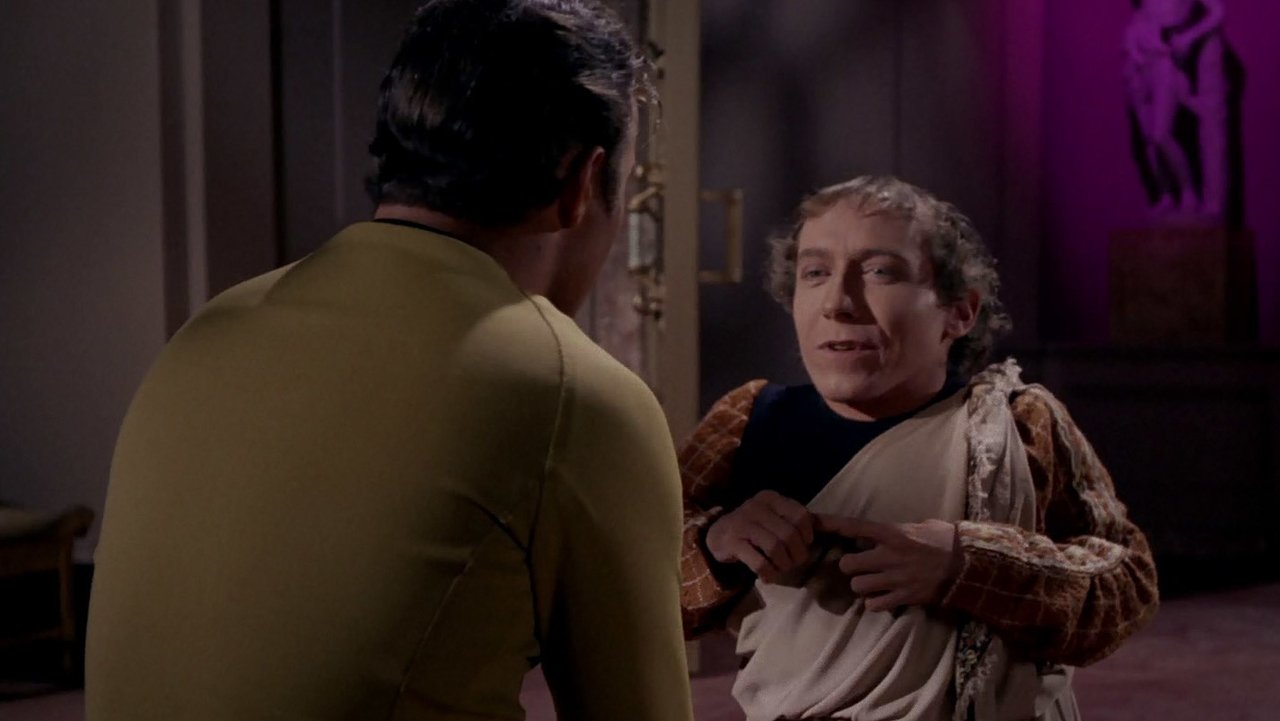
The hour belongs to Michael Dunn as Alexander, the one Platonian without powers, kept as the colony's jester. He gets a character with real dignity, and the episode's kindest speech is aimed at him.
It was in the food
McCoy works out that the Platonians' power comes from kironide, an element in the local food. He makes an injection of it, and once it takes hold, Kirk turns the Platonians' own power back on Parmen and the humiliations are over.
Alexander thinks about stabbing Parmen, and Kirk talks him out of it, telling him not to become like them. Earlier, when Alexander asked how many of Kirk's people have the power, Kirk told him that where he comes from, size, shape and color don't matter, and nobody has the power. Alexander leaves with the Enterprise, and Kirk lets Parmen off with a warning. As The A.V. Club pointed out, you have to wonder how long the Platonians' good behaviour lasts after the ship goes.
Behind the scenes
- NBC wanted an alternate take of the scene without the kiss. William Shatner said their lips never actually touched, the camera angle hiding the gap, and the actors made sure the alternate take couldn't be used, so NBC aired the kiss.
- It's Meyer Dolinsky's only Star Trek script. His working title was "Sons of Socrates."
- Michael Dunn had been a finalist for Balok in "The Corbomite Maneuver" before Clint Howard got the part, and Gene Roddenberry said he had once considered Dunn for Spock.
- Barbara Babcock, who plays Philana, had been Mea 3 in "A Taste of Armageddon." Liam Sullivan plays Parmen.
- The BBC thought the episode too sadistic to show and withheld it, with "The Empath," "Whom Gods Destroy" and "Miri." It finally aired in Britain on December 22, 1993.
- Sulu and Chekov don't appear.
The thread
Powerful beings who treat the crew as toys, and a small man who refuses to become one of them.
Came before
Shares DNA with
DNA strand
Us vs. Them
The Platonians divide the world into those with power and those without, and they treat the second group as furniture. Kirk's answer to Alexander, that where he comes from size, shape and color don't matter, is the episode's whole argument. It is corny, and on NBC in 1968 it still needed saying.
Every great sci-fi story is built from a handful of strands like this one. Each strand page explains how it works and traces it across shows, books and films.
If this one stayed with you
Where to go next, and why.
Watch · Star Trek S1
"The Squire of Gothos" (1967)
If the Platonians made your skin crawl, Trelane is the earlier, funnier version: an all-powerful host who treats the crew as playthings.
Watch · Star Trek S2
"The Gamesters of Triskelion" (1968)
Another hour about being made to perform for masters who can't be reached, with Uhura and Chekov caught up too.
Watch · Star Trek S1
"Charlie X" (1966)
Same telekinetic powers, in the hands of a lonely teenager instead of a bored aristocracy.
Sources
- “The Tholian Web,” Wikipedia
- “Wink of an Eye,” Wikipedia
- Keith R.A. DeCandido, “Star Trek The Original Series Rewatch: “Plato's Stepchildren”,” Reactor
- “7 things you never noticed in the historic Star Trek episode "Plato's Stepchildren",” MeTV
- Amy Imhoff, “50 Years Later: Plato's Stepchildren,” StarTrek.com, 2018
- Zack Handlen, “Star Trek: “The Tholian Web”/“Plato's Stepchildren”,” The A.V. Club, 2010