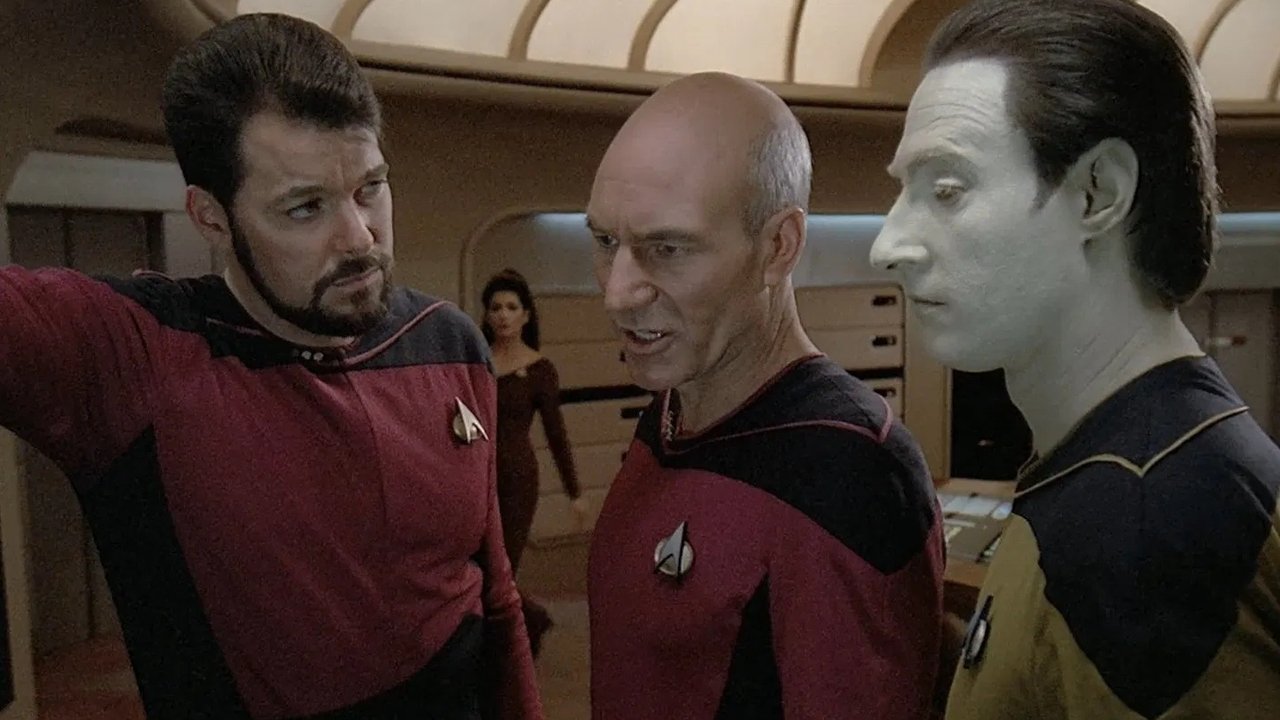
The story in 5 beats
- Riker cooks
Riker cooks for the senior staff, to mixed reviews, and then the shuttle turns up.
- The other Picard
Inside the shuttlepod is a nearly dead double of Picard. Data and La Forge work out that it came from six hours in the future.
- A captain's doubts
Pulaski revives the double, but he can't say anything useful. Picard is shaken that his future self abandoned the ship.
The vortexSpoiler · tap to reveal
The Enterprise is pulled into the vortex. It seems to be searching for Picard, and when it hits him with a beam, he's sure it wants him.
Breaking the loopSpoiler · tap to reveal
The double tries to leave in the shuttle again. Picard stops him with a phaser, then flies the Enterprise into the vortex's center.
Why it still matters
A powerless shuttlepod turns up in space carrying the name and registry of one of the Enterprise's own. Inside is a second Jean-Luc Picard, half dead. The shuttle's clock runs six hours ahead of the ship's, and its damaged log shows the Enterprise being destroyed in an energy vortex soon after the shuttle left. So in six hours, the ship dies and its captain is the only one who gets away.
Maurice Hurley, who wrote the teleplay, wanted a time-travel story that covered just six hours instead of centuries, and that small scale is what makes it work. Nobody needs to go back and save history. The crew has an afternoon, a captain who can't stop staring at himself, and a question Picard can't stand: why would he ever leave his ship?
Critics split hard. Tor.com's rewatch gave it 2 out of 10. Zack Handlen of The A.V. Club gave it an A− and said the final scenes between the two Picards rank among his favorites of anything the show had done so far. Patrick Stewart, playing a man who is disgusted with himself, is the reason to watch.
Picard against Picard
Once the vortex has the Enterprise, Picard works it out. Something is controlling it, it's interested in him in particular, and his future self left in the shuttle to draw it away from the ship. That was the wrong answer, and the logs prove it: the ship died anyway. The double recovers and heads for the shuttlepod to do it all again. Picard follows him, insists there has to be another choice, and as the double climbs aboard, says the cycle will be broken and kills him with a phaser.
Then he does what his double didn't and orders the Enterprise straight into the center of the vortex. The ship comes out into normal space, the double and his shuttle are gone, and nobody ever learns who or what was behind it. As Picard puts it, a lot of questions, damn few answers.
Behind the scenes
- The intelligence in the vortex was originally meant to be Q, but Gene Roddenberry vetoed it.
- Peter David's novel Q-Squared later supplied an answer of its own: Trelane, from the original series' "The Squire of Gothos."
- The shuttlepod was a lower-budget alternative to a full shuttlecraft, and was named after NASA scientist Farouk El-Baz.
- Riker mentions being raised by his father and never knowing his mother. The next episode, "The Icarus Factor," picks that thread up.
- The opening track of Orbital's 1991 debut album samples Worf's line "There is the theory of the Möbius, a twist in the fabric of space where time becomes a loop," along with other dialogue from the episode.
The thread
Earlier Star Trek time trips, another ship that keeps dying, and where Worf's line about the Möbius ended up.
Came before
Shares DNA with
Left its mark on
DNA strand
Time Loops & Timelines
Most time-travel stories go big. This one has six hours and a single bad decision, and the loop exists because Picard's instinct in a crisis was wrong. Breaking it means doing the opposite of what he did last time, and getting the other version of himself out of the way first.
Every great sci-fi story is built from a handful of strands like this one. Each strand page explains how it works and traces it across shows, books and films.
If this one stayed with you
Where to go next, and why.
Watch · Star Trek: TNG S5
"Cause and Effect" (1992)
The Enterprise caught in a loop that ends with the ship destroyed. The show's later, sharper take on what this episode tried.
Watch · Film
Primer (2004)
Two engineers build a machine that sends them back a few hours, and things get complicated fast. Small scale, like this one, and much harder to follow.
Read · Short story
"By His Bootstraps", Robert A. Heinlein
A man keeps meeting versions of himself and doing exactly what they told him he'd do. If the two Picards stayed with you, start here.
Watch · Star Trek S1
"Tomorrow Is Yesterday" (1967)
Kirk's crew stuck in the wrong time, using the slingshot method Picard and Riker bring up here. Lighter than this one.
Sources
- “Time Squared (Star Trek: The Next Generation),” Wikipedia
- Keith R.A. DeCandido, “Star Trek: The Next Generation Rewatch: "Time Squared",” Tor.com, 2011
- Zack Handlen, “Star Trek: The Next Generation: "Time Squared"/"The Icarus Factor"/"Pen Pals",” The A.V. Club, 2010
- James Hunt, “Revisiting Star Trek TNG: Time Squared,” Den of Geek, 2013