The story in 5 beats
- En garde
Picard is fencing with Lieutenant Dean when the same exchange happens twice. Other ships in the sector feel it too.
- An old name
Dr. Paul Manheim calls for help and is soon in convulsions. His wife, Jenice, is the one person Picard didn't want to see again.
- Ourselves, earlier
The distortions grow. Picard, Riker and Data see their own past selves outside a turbolift.
Data goes aloneSpoiler · tap to reveal
Manheim's experiment is out of control, and Data, less affected by the distortions, beams down to shut it off.
One more eveningSpoiler · tap to reveal
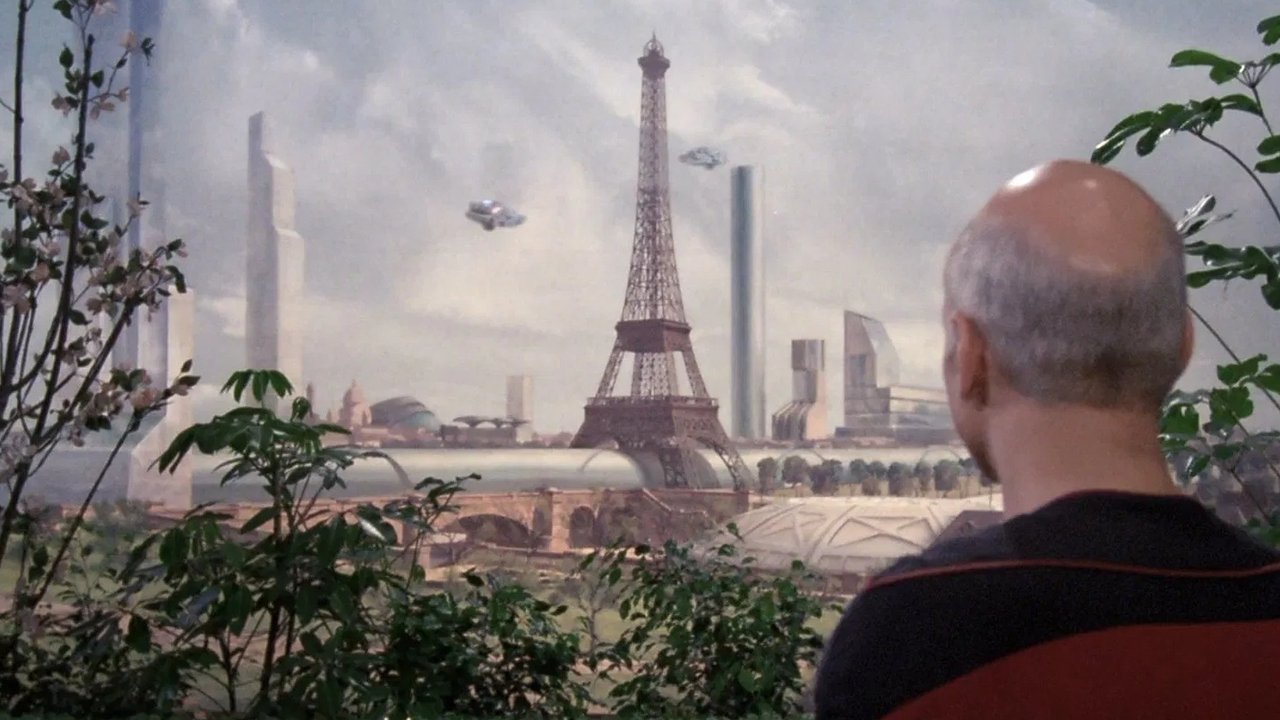
Manheim recovers. Picard takes Jenice to a holodeck Paris for the café meeting he once skipped.
Why it still matters
Picard is fencing with a lieutenant when a moment of time repeats itself, then a distress call comes in from Dr. Paul Manheim, a scientist thrown out of the Federation Science Institute for experiments nobody approved. Picard knows the name, and he knows Manheim's wife, Jenice, much better. She's the woman he was supposed to meet at a Paris café before he got cold feet and left to become a starship captain.
The title and the love triangle come straight from Casablanca, and the episode doesn't hide it; the Blue Parrot Café gets a mention. Michelle Phillips, formerly of The Mamas & the Papas, plays Jenice. The romance hasn't won many fans, Shearer included. The time effects are the fun part: little loops that make the crew live the same seconds twice, and one scene by a turbolift that's worth waiting for.
It was written in a hurry with the 1988 writers' strike bearing down, and part of the finished episode was worked out over the phone after the writers had put their pens down.
Shutting the door
Manheim explains that his work touched time, gravity and tunnels to other universes, and that his last experiment opened something he couldn't close. He's caught between two dimensions, which is why he keeps convulsing. Data works out that the thing has to be shut down during one of its fluctuations, or it will keep growing.
Data beams down alone, gets through the lab's security and finds a column of energy coming out of a dimensional matrix. Time folds around him, so for a moment there are several Datas, and one of them gets the antimatter into the matrix. That stabilizes it, the distortions stop and Manheim comes back to himself. Jamahl Epsicokhan's summary is fair: Data takes a canister into a hall of mirrors, and that's that.
The last scene is the one that counts. Picard rebuilds the café on the holodeck so he and Jenice can finally have the goodbye they skipped, and then she leaves with her husband. It's Casablanca's ending with the roles shuffled, since this time he's the one who walked away, years earlier.
Behind the scenes
- Shearer and Dean Davis pitched the story, combining their idea about a professor whose work wasn't appreciated with Maurice Hurley's wish for a time-anomaly episode. They finished the script in five days.
- An earlier draft differs from what was shot: Jenice is called Laura, and Riker, Worf and Data split the job of shutting down the experiment differently.
- Filming started before the script was finished, and the scene of Data fixing the distortions hadn't been written. Robert Legato and Rick Berman spent forty minutes on the phone with Shearer, who wouldn't write new lines during the strike but gave her opinions while Legato took notes.
- Legato got the three Datas with a whip pan instead of an effects shot.
- Shearer was unhappy with the result: "we were writing the most romantic episode in the world," she said, and it was "toned down 75%."
- The matte painting of 24th-century Paris turned up again in Star Trek VI: The Undiscovered Country, outside the Federation president's office window.
The thread
An old romance, an open door in time, and a captain who chose the stars once and has to live with it.
Came before
Shares DNA with
Left its mark on
DNA strand
Time Loops & Timelines
The time loops are small and strange: a fencing move twice, three officers meeting their own selves at a turbolift. They work as a rhyme for Picard's problem, a man being made to replay a moment he left unfinished.
Every great sci-fi story is built from a handful of strands like this one. Each strand page explains how it works and traces it across shows, books and films.
If this one stayed with you
Where to go next, and why.
Watch · Film
Casablanca
The episode reads better once you've seen the café and the goodbye it's borrowing.
Watch · Star Trek: TNG
"Cause and Effect"
If the turbolift scene was your favorite part, this is TNG doing a time loop at full length.
Watch · Star Trek: TNG
"Lessons"
Picard in love again, years later, and a much fuller answer to the question of what the job costs him.
Read · Star Trek novel
The Entropy Effect — Vonda N. McIntyre
Reactor's rewatch notes how much this episode's plot has in common with McIntyre's novel.