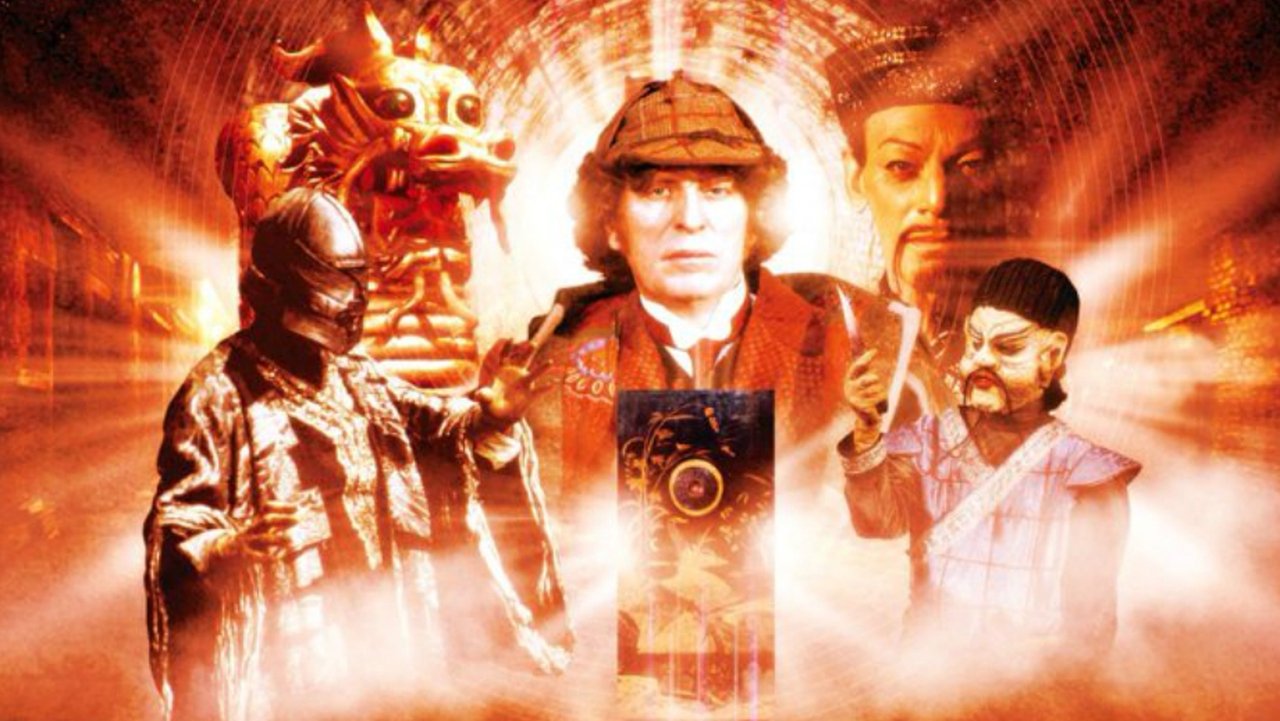
More from the episode
The story in 5 beats
- A foggy night
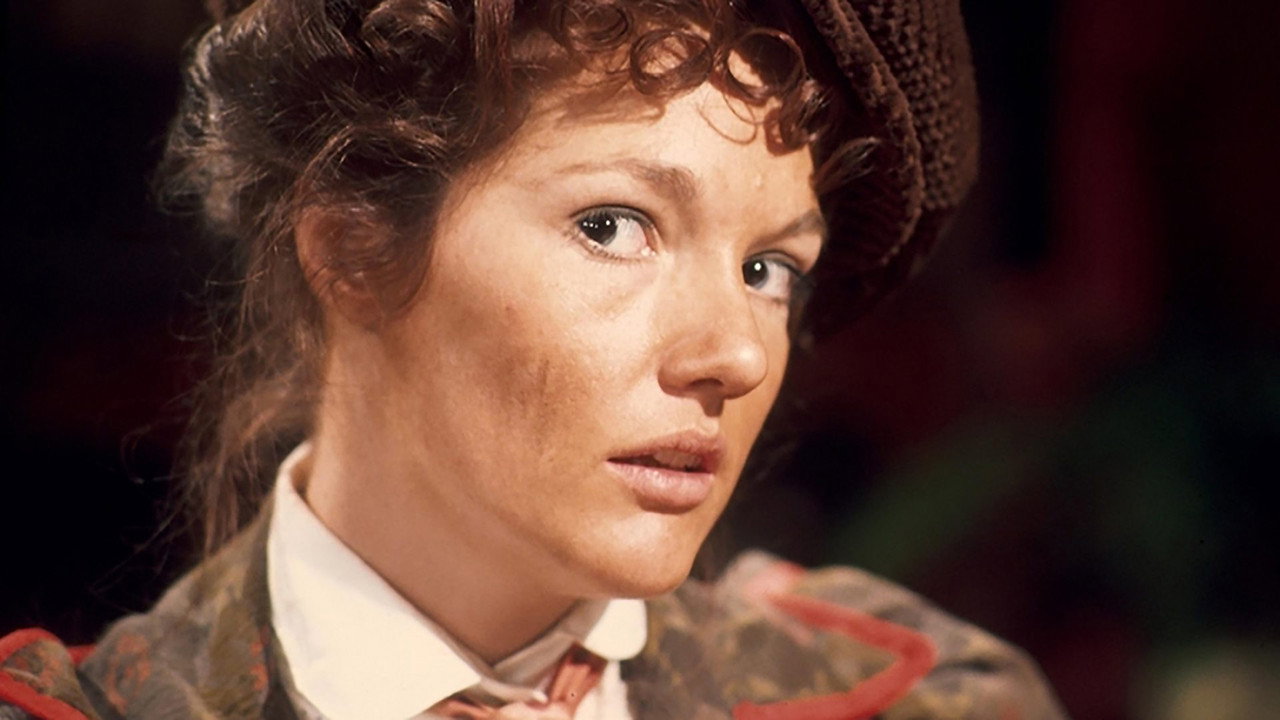
The Doctor and Leela, on their way to the theatre, run into a gang of Chinese men who have just killed a cab driver searching for his missing wife.
- The Palace Theatre
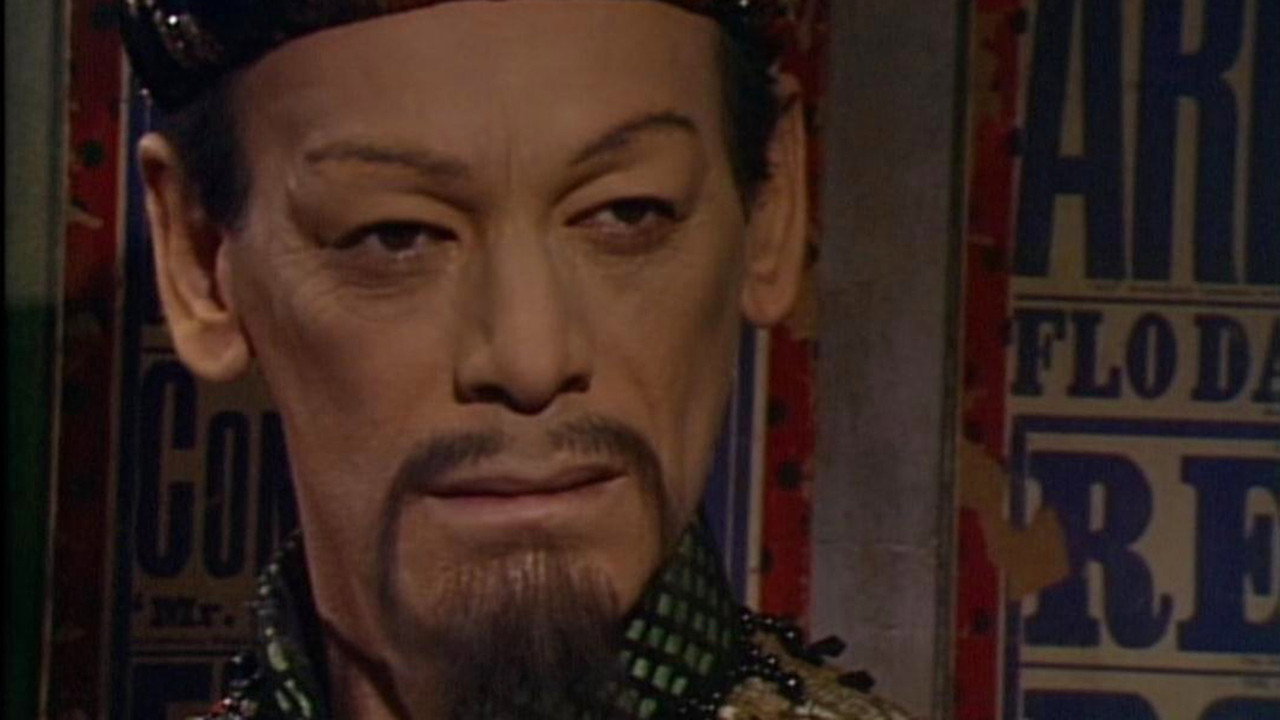
Stage magician Li H'sen Chang is performing at Henry Gordon Jago's Palace Theatre, with a ventriloquist's dummy called Mr Sin.
- Rats in the sewers
A body pulled from the Thames bears the bite marks of a giant rat, and the Doctor heads into the sewers beneath the theatre.
Weng-Chiang unmaskedSpoiler · tap to reveal
The masked 'god' Chang serves is Magnus Greel, a 51st-century despot, disfigured by his time cabinet and draining young women to stay alive.
The House of the DragonSpoiler · tap to reveal
Mr Sin turns on its master, and the Doctor pushes Greel into his own machine.
Why it still matters
Fans and critics have voted this one of the best Doctor Who stories ever made, again and again. The Daily Telegraph put it top of its ten greatest in 2008, an Outpost Gallifrey poll for the 40th anniversary in 2003 named it the best of all, narrowly ahead of The Caves of Androzani, and readers of Doctor Who Magazine placed it fourth in 2009. Robert Holmes, the show's script editor, drew on The Phantom of the Opera, on Sherlock Holmes (the Doctor even dresses the part) and on Sax Rohmer's Fu Manchu novels. Russell T Davies later said the first episode had "the best dialogue ever written. It's up there with Dennis Potter."
It also introduced Henry Gordon Jago, the theatre's owner, and Professor George Litefoot, played by Christopher Benjamin and Trevor Baxter. The Discontinuity Guide singled out their double act for praise, and the production team briefly thought about giving the pair a series of their own, though it never happened.
The story has two well-known weak spots, and critics name both. One is the giant rat, which the historian Dominic Sandbrook called "one of the worst-realised monsters not merely in the show's history, but in the history of human entertainment." The other is serious. Li H'sen Chang, the Chinese magician at the centre of the plot, is played by a white actor, John Bennett, in yellowface make-up; the Chinese characters around him are all coolies or members of a Tong gang; and English characters' racist remarks go unchallenged by the Doctor. Critics have called the depiction racist, and The A.V. Club's Christopher Bahn wrote that "if it wasn't for the uncomfortably racist aspects of the story, it'd be close to perfection."
The Butcher of Brisbane
Weng-Chiang is no god. He is Magnus Greel, a tyrant from the 51st century known as the Butcher of Brisbane, responsible for the deaths of hundreds of thousands of people, who fled the authorities in an unstable time cabinet. The journey ruined his body, and he keeps himself alive by draining the life essence from young women. The cabinet has ended up with Professor Litefoot, and the whole plot is Greel's hunt to get it back. Mr Sin is no dummy either: it's the Peking Homunculus, a cyborg toy with the brain of a pig, which Greel brought with him from the future.
Greel abandons Chang, who is mauled by one of the rats and dies in an opium den. In the House of the Dragon the Doctor, Jago and Litefoot rescue Leela before Greel can drain her. The Doctor convinces Mr Sin that Greel's escape in the cabinet would cause a catastrophic implosion, Mr Sin turns on Greel, and the Doctor pushes him into his own extraction machine, which overloads. Then he switches Mr Sin off and leaves with Leela.
Challenge the DNA
Can you enjoy The Talons of Weng-Chiang today?
Or skip ahead to our reading
Both answers are fair, and we think the story should be watched with eyes open. Its Victorian pastiche is some of the best-written Doctor Who of the decade. Its casting and its Chinese characters are hard to defend, and the page says so plainly.
Behind the scenes
- It was the last story made by producer Philip Hinchcliffe, who had run the show for three seasons. His successor, Graham Williams, asked Louise Jameson during the location filming to stay on as Leela; she had been contracted for only three stories, and agreed on condition she could stop wearing the contact lenses that turned her blue eyes brown.
- The story had two blocks of location work. The film exteriors were shot around London, mostly around Wapping, in mid-December 1976; Hinchcliffe then swapped a studio session for an outside-broadcast crew and spent a week in Northampton in January 1977, mostly at the Royal Theatre.
- On one street a modern car couldn't be moved off the road before filming, so the crew hid it under a pile of straw.
- Dudley Simpson, who composed the music for this and many other stories, appears on screen as the conductor of Jago's theatre orchestra.
- When the BBC first submitted it for a home video release in 1985, the British Board of Film Classification objected to the murders, gore and the use of nunchaku, then illegal weapons in the UK, and one examiner thought the portrayal of the Chinese characters racist. The UK tape finally came out in November 1988, rated PG with eleven seconds cut.
- In 1980 the Chinese Canadian National Council for Equality complained to TVOntario that the serial was "dangerous, offensive, racist stereotyping," and the channel chose not to broadcast all six episodes. In 2020 BritBox added content warnings when viewers questioned whether it should host the serial at all.
- Michael Spice, who plays Weng-Chiang, had voiced Morbius in The Brain of Morbius the year before. Christopher Benjamin had played Sir Keith Gold in Inferno (1970).
The thread
Victorian melodrama, a detective in a deerstalker, and a visitor from the far future hiding under a theatre.
Came before
Shares DNA with
DNA strand
Funny and Creepy at Once
Jago and Litefoot's comic double act runs right alongside giant rats, vanished women and a dummy nobody would want to sit next to. Patrick Mulkern of Radio Times called it Doctor Who at its most blatantly Grand Guignol, and the jokes are what make the horror bearable.
Every great sci-fi story is built from a handful of strands like this one. Each strand page explains how it works and traces it across shows, books and films.
If this one stayed with you
Where to go next, and why.
Watch · Doctor Who
"Pyramids of Mars"
The same Hinchcliffe and Holmes partnership a season earlier, borrowing from horror with an Edwardian setting and an ancient 'god'.
Watch · TNG S2
"Elementary, Dear Data"
Holmes pastiche in a gaslit London, with a villain built to outthink the detective.
Watch · Doctor Who
"The Brain of Morbius"
Michael Spice's earlier work as the voice of Morbius, in another Hinchcliffe story full of horror-film borrowings.
Read · Novel
The Phantom of the Opera — Gaston Leroux
The masked man beneath the theatre, which the BBC's own guide names among Robert Holmes's inspirations.
Your next episode
Three directions to go from here, all on Sci-Fi DNA.

More of this feeling
Pyramids of Mars
Doctor Who
More Gothic horror from Holmes and Hinchcliffe, a season earlier.
Same question, different answer
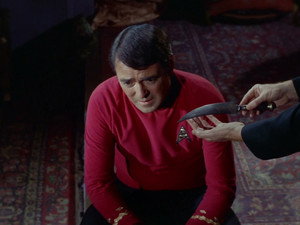
Wolf in the Fold
Star Trek
A killer stalking the streets of a city that won't look too closely.

Something completely different
Horror of Fang Rock
Doctor Who
A lighthouse, a fog and a very long night.