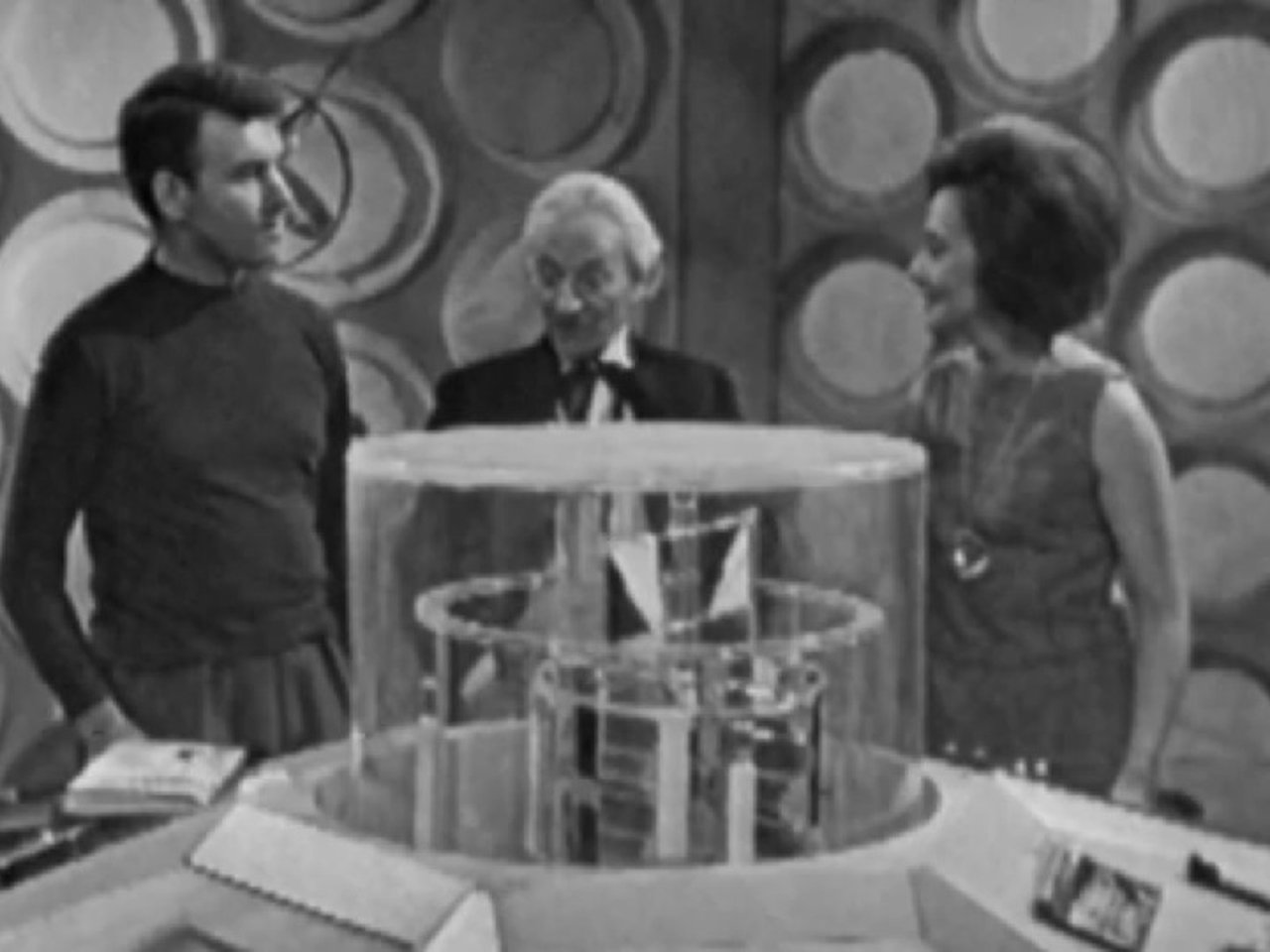
More from the episode

The story in 5 beats
- A farmhouse outside Paris
The travellers walk into a safe house on an escape route for enemies of the Revolution, just as soldiers surround it.
- Bound for the guillotine
Ian, Barbara and Susan are marched to the Conciergerie and sentenced. The Doctor, left behind in a burning house, sets off on foot.
- Citizen Doctor
In Paris the Doctor swaps clothes for a regional officer's uniform and is taken to report to Robespierre in person.
The spy in the governmentSpoiler · tap to reveal
Citizen Lemaitre has been watching the Doctor closely, and he knows more about the English spy James Stirling than he lets on.
An inn on the Calais roadSpoiler · tap to reveal
Ian and Barbara overhear Barras plotting with a young general, Napoleon Bonaparte, to bring down Robespierre.
Why it still matters
This is where Dennis Spooner arrived on Doctor Who. He would go on to write more stories and spend six months as its script editor. He wanted to write science fiction; script editor David Whitaker wanted another history story after Marco Polo and The Aztecs, and gave him four periods to choose from. Spooner took the French Revolution, an idea William Russell had suggested, and added a comic jailer to lighten a heavy plot. His next serial, The Romans, was planned from the start as the show's first comedy.
It is also an early run at things the show kept doing. The Doctor bluffs his way in as a provincial officer and ends up face to face with Robespierre. It was the first serial with outdoor filming, a double walking for William Hartnell along tree-lined lanes near Denham that passed for France. John Kenneth Muir later noted that the historical stories after it borrowed from its template, though he wished they had borrowed from The Aztecs instead.
It did not please everyone. The secretary of the Napoleon I Society wrote to say the BBC had a duty "not to misinform children" after the young Napoleon turned up in a plot that never happened, and the Daily Worker called it a "half-baked royalist adventure." Christopher Bahn of The A.V. Club thought it stretched "too little story over too many episodes." Two of its six parts are missing from the BBC archive, but off-air recordings of their sound survive, and the 2013 DVD filled the gap with animation.
The spy was the man in charge
Lemaitre, the official who has been crossing names off lists and keeping the Doctor in Paris, unmasks the Doctor as an impostor and then unmasks himself: he is James Stirling, the English agent everyone has been looking for. Ian passes on the dying Webster's message, which points them to the meeting at an inn on the Calais road where Barras and Napoleon agree to bring Robespierre down.
Stirling gets Susan out of prison, the coup against Robespierre begins, and Stirling heads for England while Jules and Jean lie low to see what the new France will be. The Doctor and his friends walk back to the TARDIS, and history goes on as it did. The meeting between Barras and Napoleon is Spooner's invention, which is exactly what the Napoleon I Society complained about.
Challenge the DNA
Should the travellers have tried to stop the Terror?
Or skip ahead to our reading
They couldn't, and the story doesn't pretend otherwise. The Doctor talks his way around Paris, Stirling plays his part, and history goes on as it did. What the travellers do is survive and look after each other, which is all this story offers anyone.
Behind the scenes
- The slot first belonged to Terry Nation's Doctor Who and the Red Fort, a seven-part story set in the Indian Rebellion of 1857. When it stalled and a replacement idea was dropped, Whitaker turned to Spooner, a friend of Nation's, and commissioned him on April 2, 1964, after a 23-page breakdown.
- Producer Verity Lambert hired Henric Hirsch after seeing his work on First Night. He found working with Hartnell hard, and collapsed shortly before part three was recorded. Lambert put production assistant Timothy Combe in charge; the paperwork says John Gorrie directed that part, though Gorrie has no memory of it. Hirsch came back for the last three and kept the screen credit.
- Outdoor filming, a first for the show, took place on June 15, 1964. Brian Proudfoot stood in for Hartnell, walking down lanes near Denham, Buckinghamshire, that Combe chose for looking French.
- Stanley Myers wrote 28 minutes of music, taking cues from "La Marseillaise." Roderick Laing designed the sets so that Barry Newbery and Raymond Cusick, who had designed every serial so far, could have a break.
- Part one drew 6.9 million viewers. Parts four and five scored an Appreciation Index of 53, the show's lowest at the time. To a complaint about the English accents, Whitaker replied that "there is nothing worse than Frenchmen speaking in broken English to each other."
- The BBC wiped the tapes in 1967 and 1969, and BBC Enterprises junked its film prints in 1972. Part six came back from a private collector in 1982 and parts one to three turned up at the Cyprus Broadcasting Corporation in late 1984. CyBC's copies had been kept in a vault destroyed in a bomb attack during the 1974 Turkish invasion, so parts four and five survive only as off-air audio, animated for the 2013 DVD by Theta Sigma and Big Finish.
The thread
Show trials, tumbrils and English spies, with history refusing to bend.
Came before
Shares DNA with
Left its mark on
DNA strand
The State Knows Best
Revolutionary Paris runs on lists, informers and quick trials, and the travellers are condemned almost as soon as they arrive, for being in the wrong farmhouse. Spooner plays it as an adventure, but the machinery of a state that decides who is a traitor is always in the background.
Every great sci-fi story is built from a handful of strands like this one. Each strand page explains how it works and traces it across shows, books and films.
If this one stayed with you
Where to go next, and why.
Watch · Doctor Who
"The Aztecs"
The history story just before this one, and the one John Kenneth Muir thought later history stories should have borrowed from instead.
Watch · Twilight Zone S2
"Back There"
A half-hour version of the same pleasure: someone from now dropped into a famous moment, trying to find their feet.
Read · Novel
The Scarlet Pimpernel by Baroness Orczy
Escape chains, English agents and disguises in revolutionary France, the same territory with a swashbuckling hero.
Read · Novel
A Tale of Two Cities by Charles Dickens
The Terror's prisons and tumbrils as Dickens saw them, with far higher stakes for the people caught up in it.
Your next episode
Three directions to go from here, all on Sci-Fi DNA.

More of this feeling
The Aztecs
Doctor Who
Another history story where the travellers can't stop what's coming, only survive it.

Same question, different answer
The Obsolete Man
The Twilight Zone
A state that decides who is useful and who goes to their death.
Something completely different
Planet of Giants
Doctor Who
The next story shrinks everyone to an inch tall in an English garden.