
More from the episode
The story in 5 beats
- Figures in the woods
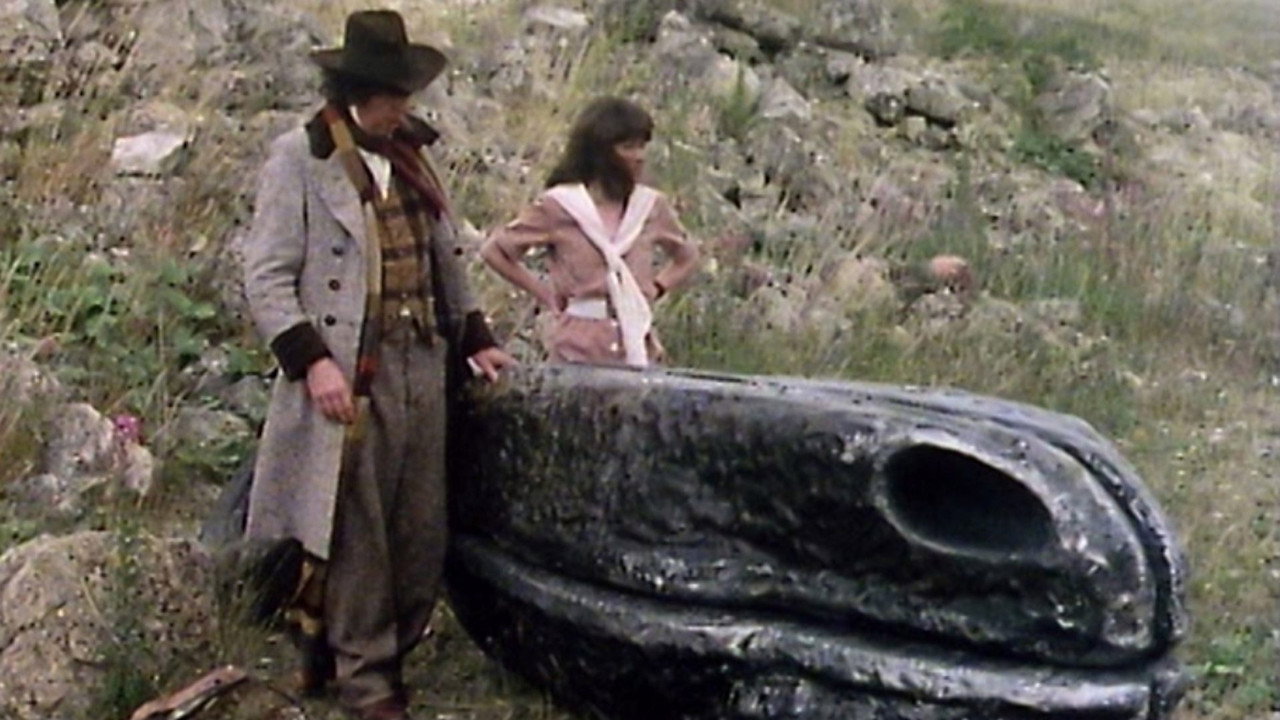
The Doctor and Sarah land near Devesham and are shot at by white-suited figures in opaque helmets who fire from their index fingers.
- The pub waits
In the village pub every customer stands motionless until the clock strikes, then carries on as if nothing happened.
- The defence station
At the Space Defence Station the Doctor meets Senior Defence Astronaut Guy Crayford, who has him thrown in a cell.
Not DeveshamSpoiler · tap to reveal
The village is a copy, built as a training ground by the Kraals, who plan to clear Earth of humans and take it over.
DoublesSpoiler · tap to reveal
On the real Earth the Doctor faces android copies of his friends, and one of himself.
Why it still matters
Terry Nation created the Daleks, and for eleven years every Doctor Who script he wrote had them in it. This is the exception: his first story since The Keys of Marinus in 1964 without them, and his last for the show until 1979. In their place he took his cue from Invasion of the Body Snatchers and set the story in a quiet English village with a pub, a space defence station down the road and locals who don't behave quite as they should.
It was directed by the former series producer Barry Letts, and he gets real unease out of very little: a pub full of people standing perfectly still, waiting for the clock. The village scenes were shot in East Hagbourne in Oxfordshire. The critic John Kenneth Muir called the result "an atmosphere-laden suspense thriller," though he also called it an idiot plot.
That split runs through everything written about it. The Discontinuity Guide found it "stupid, tiresome and very irritating," Mark Braxton of the Radio Times gave it two stars, and Kenneth Williams wrote in his diary after part two that "Doctor Who gets more and more silly." Ian Jane of DVD Talk thought it "a fun tale that breezes by at a good pace." Viewers kept watching either way: part three drew 12.1 million, more than any part of Pyramids of Mars, the story before it.
A rehearsal for an invasion
The Devesham the Doctor has been walking through is a replica on the Kraal planet Oseidon, a training ground where android villagers practise being human. The Kraals' world is becoming uninhabitable from radiation, so their leader, Styggron, plans to wipe out humanity with a virus and replace key people with androids. Crayford, the astronaut Earth left for dead, is helping because he believes the Kraals rescued him and rebuilt his body. The Doctor and Sarah stow away on Crayford's rocket back to Earth, followed by android copies of themselves.
On Earth, Colonel Faraday and Harry Sullivan have already been replaced. The Doctor tells Crayford the truth, that the Kraals never rebuilt him and only brainwashed him, and the distraction gives the Doctor time to switch on a device that jams every android in mid-step. Crayford attacks Styggron and is shot, and the Doctor finishes Styggron using his own reprogrammed double as a decoy. It is the last Doctor Who appearance for both Harry and Sergeant Benton.
Challenge the DNA
Is Crayford a traitor or a dupe?
Or skip ahead to our reading
A dupe, mostly, and the story treats him as one. He believes the Kraals rescued him and rebuilt his body. When the Doctor tells him they only brainwashed him, it's too late to undo what he helped build.
Behind the scenes
- Terry Nation's script was his first for the show since The Keys of Marinus (1964) without the Daleks, and his last Doctor Who script for four years, until Destiny of the Daleks in 1979. It was influenced by the 1956 film Invasion of the Body Snatchers.
- The director, Barry Letts, was the show's former producer.
- The village of Devesham was filmed in East Hagbourne, Oxfordshire, a few miles from Didcot. Scenes outside the Space Defence Station were shot at the National Radiological Protection Board at nearby Harwell.
- Nicholas Courtney was unavailable to play the Brigadier, so the part was rewritten as Colonel Faraday, played by Patrick Newell.
- Only three Kraals appear: Martin Friend as Styggron, Roy Skelton as Marshal Chedaki and, in one silent scene, the show's long-time stuntman Stuart Fell.
- Milton Johns, who plays Crayford, had appeared as Benik in The Enemy of the World (1967–68), also directed by Letts.
- The four parts drew 11.9, 11.3, 12.1 and 11.4 million viewers.
The thread
Pod people, perfect copies and the familiar place that's slightly wrong.
Came before
Shares DNA with
DNA strand
First Contact & Invaders
The Kraals don't arrive with a fleet. The first sign of them is a village where people act slightly wrong, which puts this story nearer the Body Snatchers films than Terry Nation's Daleks.
Every great sci-fi story is built from a handful of strands like this one. Each strand page explains how it works and traces it across shows, books and films.
If this one stayed with you
Where to go next, and why.
Watch · Film
Invasion of the Body Snatchers (1956)
The film Nation was drawing on: a small town, familiar faces and a growing sense that something is off.
Watch · Star Trek
"What Are Little Girls Made Of?"
Nine years earlier, Kirk meets a perfect android copy of himself, and the question is whether his crew can tell.
Watch · Doctor Who
"Pyramids of Mars"
The story broadcast just before this one, and the season at its most Gothic, if Devesham leaves you wanting a stronger villain.
Read · Novelisation
Doctor Who and the Android Invasion — Terrance Dicks
Terrance Dicks's 1978 Target book tells the same story briskly, for anyone who wants Devesham on the page.
Your next episode
Three directions to go from here, all on Sci-Fi DNA.

More of this feeling
Terror of the Zygons
Doctor Who
Another UNIT story where you can't trust the people around you.

Same question, different answer
The Monsters Are Due on Maple Street
The Twilight Zone
A quiet village where neighbours start to wonder about each other.

Something completely different
The Brain of Morbius
Doctor Who
Mad science on a stormy planet, in the Frankenstein tradition.
Sources
- “The Android Invasion,” Wikipedia
- “Doctor Who: The Android Invasion,” Radio Times, 2010
- “Doctor Who: The Android Invasion,” DVD Talk, 2012
- “A Critical History of Doctor Who on Television (Season 13),” John Kenneth Muir / McFarland
- “A Brief Guide to Doctor Who: The Android Invasion,” Mark Campbell / Constable & Robinson, 2011
- “The Android Invasion (Classic Episode Guide, archived),” BBC