The story in 5 beats
- Running away
After his father's death, Cooper travels the world and ignores his mother's calls. In London, a night with Sonja ends with his bank account drained.
- The mushroom
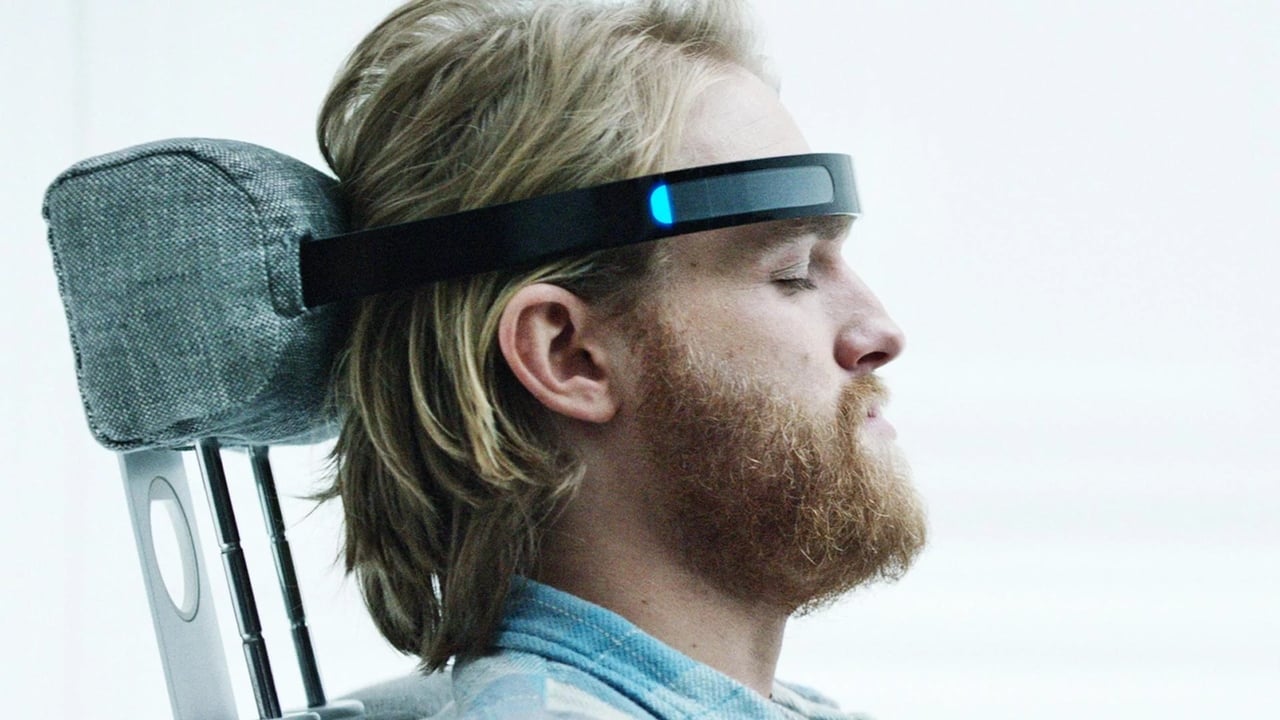
A paid playtest at SaitoGemu. Katie implants a small device in his neck, and an augmented-reality Whac-A-Mole game blows him away.
- Harlech House
The real test: a horror game in a mansion, tuned to his own fears. A spider, a face in a painting, the boy who bullied him at school.
LayersSpoiler · tap to reveal
Sonja turns up and tells him to run. Then the house starts taking his memories, and each escape turns out to be another room of the game.
MomSpoiler · tap to reveal
The whole thing lasted a fraction of a second. Someone was calling his phone.
Why it still matters
Black Mirror usually wants to make a point. This time Charlie Brooker mostly wanted to scare you, and he said so: he called "Playtest" a romp rather than a message episode. Cooper is a charming American who has been travelling the world to avoid a phone call home. Out of money in London, he takes a cash job testing a game for SaitoGemu, a legendary game studio. A small device goes into the back of his neck, and a haunted house goes to work on him.
It's a haunted-house story made by two former games journalists, and it shows. The mansion nods to Resident Evil, the villain's polite request nods to BioShock, and the scares come in layers, each one pulling the floor out from under the last. Underneath the jump scares is something sadder: a son who keeps not calling his mother, and a father lost to Alzheimer's.
Who was calling
After the fight with Sonja, the interrogation and the memory loss, Cooper wakes in Shou's office and is told the experiment lasted one second and none of it was real. He goes home, and his mother doesn't know who he is; she just keeps dialling his number. Then we're back in the test chair. Cooper's phone, which he switched back on to sneak photos for Sonja, rang. His mother's call interfered with the device, and it killed him within 0.04 seconds. Everything after the first seconds of the test happened inside his head as he died, calling for his mom.
Brooker added the phone call late; it wasn't in the original treatment, and he compared the ending to a Twilight Zone punchline. Some critics found the stacked twists too much. But it's the one Black Mirror ending where the technology doesn't fail because people are cruel. It fails because a man finally answered, too late, the call he'd been dodging all episode.
The Question Underneath
What are you most afraid of, and is it the thing you'd guess?
The game throws spiders, ghosts and a childhood bully at Cooper, and none of them is what gets him. What he has really been avoiding is the call home. The episode makes the scariest thing in it an ordinary, unanswered phone. Horror gadgets aside, its fear is about the people we keep putting off, and how little time there may be to stop.
Challenge the DNA
What really killed Cooper: the technology or the phone call he'd been avoiding?
Or skip ahead to our reading
We say the technology. The phone is the sad, perfect trigger, but a company that can kill a tester with one ringtone was always going to kill someone.
Behind the scenes
- Brooker and director Dan Trachtenberg found out they'd both been video game journalists: Brooker at PC Zone, Trachtenberg on The Totally Rad Show. Trachtenberg came to the episode around the time of his first feature, 10 Cloverfield Lane.
- The story was first set in Tokyo, but the writers couldn't justify a mansion there, so it moved to London. Englefield House stood in for SaitoGemu's exterior, and Harlech House was shot in an elderly woman's home.
- One draft had Cooper discover he was a character in Black Mirror and run into people and places from earlier episodes.
- Brooker had imagined a "nightmare mode" in which the episode played differently the second time you watched it. Alternate scenes became a key idea of the interactive film Bandersnatch.
- Hannah John-Kamen had already appeared in the series, as a singer in "Fifteen Million Merits." A scene playing that song on the radio fell through over licensing.
- Framestore built the giant spider and its deformed version. The episode was nominated for a BAFTA Craft Award for visual effects.
- It was the last episode of the series to be filmed, and it was placed second partly because Halloween came soon after the release date.
- Cooper's surname, Redfield, and the mansion both point at Resident Evil. Katie's "would you kindly" is a BioShock reference.
The thread
Haunted houses, rigged games and stories that keep pulling the floor away.
Came before
Shares DNA with
Left its mark on
DNA strand
Is Any of This Real?
Most "it was all a simulation" stories have one reveal. "Playtest" stacks them until you stop trusting any room Cooper walks into, including the last one. That's the trick: after enough false floors, the real one hits hardest because you'd stopped believing in it.
Every great sci-fi story is built from a handful of strands like this one. Each strand page explains how it works and traces it across shows, books and films.
If this one stayed with you
Where to go next, and why.
Watch · Red Dwarf
"Back to Reality"
The same rug-pull played for laughs: the crew are told their whole lives were a video game.
Watch · Film
eXistenZ (1999)
Cronenberg's game you plug into your spine. Stranger and slimier, with the same question of where the game ends.
Play · Game
Resident Evil (1996)
The mansion Harlech House is built on. Play it with the lights off.
Your next episode
Three directions to go from here, all on Sci-Fi DNA.
More of this feeling
Black Museum
Black Mirror
More Black Mirror played as an out-and-out horror show, with a tour guide you shouldn't trust.

Same question, different answer
Back to Reality
Red Dwarf
What if your whole life was a game? Red Dwarf asks it for laughs.

Something completely different
Parallels
Star Trek: The Next Generation
Another man who can't trust the room he walks into, but this time it's a comedy with cake.