
More from the film


Who this is for
You've seen Arrival and want the structure laid out plainly: what's past, what's future, how the language is supposed to work, and what the ending is asking you to feel.
What it covers
- Which scenes happen when
- The film's rules for the heptapod language
- The phone call, and how it's possible
- How the film differs from Ted Chiang's story
Spoiler boundary
The whole film, including the ending. Also spoils the ending of Ted Chiang's story "Story of Your Life" (1998), in the section on differences, which is clearly marked.
Show the full explanationHide the explanationContains spoilers: The whole film, including the ending.
How to read the labels
- Confirmed in the work
- Shown or stated on screen or on the page.
- Creator explanation
- What a writer or director has said outside the work.
- From another version
- From the book, story or cut it's based on, not the version we're explaining.
- Strong inference
- Not stated outright, but the evidence points one way.
- Interpretation
- A reading of what it means. Reasonable people differ.
- Unresolved
- The work doesn't answer this.
The short answer
The scenes with Louise's daughter Hannah aren't flashbacks. They're the future. Hannah hasn't been born yet when the film opens, and her father is Ian, the physicist Louise meets on the job.
Learning the heptapods' written language changes how Louise experiences time, so she starts to remember things that haven't happened. She uses that to stop a war, by calling China's General Shang and telling him something only he could know, something he will tell her himself at a celebration in the future. At the end she knows Hannah will die young, and she chooses to have her anyway.
What happens when
The film is edited so you assume the Hannah scenes are memories. Put in order, the story runs like this.
The arrival
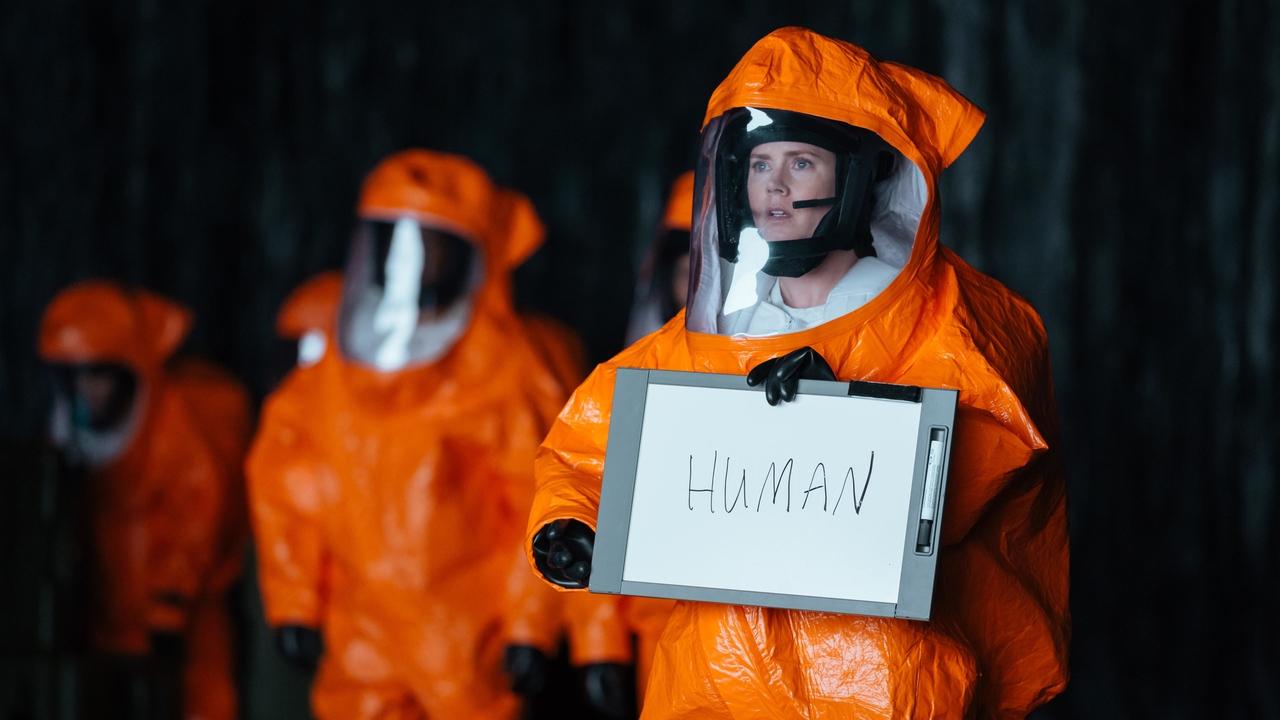
Confirmed in the work Twelve alien ships appear around the world. The US Army brings in linguist Louise Banks and physicist Ian Donnelly at the Montana site.
The work
Confirmed in the work Louise and Ian learn the heptapods' written language, round ink-like symbols. Ian nicknames the two aliens Abbott and Costello. Louise's visions begin.
The crisis
Confirmed in the work A heptapod message is read as "offer weapon." Countries stop sharing what they know. Rogue soldiers bomb the Montana ship and Abbott is fatally hurt.
The answer
Confirmed in the work Costello tells Louise they've come to help, because in 3,000 years they'll need humanity's help. The "weapon" is the language itself, and each of the twelve ships holds part of the gift.
The call
Confirmed in the work With China about to attack, Louise sees a future evening where General Shang tells her his private number and his late wife's last words. In the present, she calls him and says them. He stands down.
Some time later
Confirmed in the work The gala where Shang thanks her. Louise and Ian are together.
Later still
Confirmed in the work Hannah is born. She grows up, falls ill with a rare disease and dies young. Somewhere in that time Louise tells Ian what she knew, and he leaves.
The rules of the heptapod language
Confirmed in the work Heptapod writing has no start or end. Each symbol expresses a whole thought at once, and the writer has to know how a sentence ends before drawing the first stroke.
Confirmed in the work Ian brings up the idea that the language you think in shapes how you think, often called the Sapir-Whorf hypothesis. The film runs with the strongest possible version: learn a language without time order and you stop experiencing time in order.
Strong inference That's a story rule, not a claim about real linguistics. Most linguists today put little stock in the strong version of the idea, the one where language decides what you can think.[8]
Confirmed in the work The film's logograms were designed by production designer Patrice Vermette's team, from sketches by artist Martine Bertrand, and built into a working set of about a hundred symbols.[2]
Creator explanation The McGill University linguist Jessica Coon consulted on the film and helped check that the symbols stayed consistent each time a word came back.[7]
Clues you may have missed
- Confirmed in the workLouise's opening narration says she's no longer sure she believes in beginnings and endings. On a first watch that sounds like grief. It's actually a description of how she now experiences time.
- Confirmed in the workHannah's name reads the same forwards and backwards, and the film draws attention to it. A palindrome is a small version of the heptapod idea.
- Confirmed in the workIn one of the "memories," Hannah asks for the word for a deal where both sides win, and Louise tells her to ask her father. It's "non-zero-sum game," the phrase Ian uses back in Montana, and the idea Louise needs to understand the twelve ships.[10]
- Strong inferenceIan never appears in the Hannah scenes. Louise mentions that Hannah's father left after she told him something he couldn't accept, and once you know the Hannah scenes are the future, that's the clue that he's Ian.
What the ending means
The mechanics and the meaning pull on each other here, so it helps to take them one at a time.
Confirmed in the work Mechanics. Louise learns Shang's number and his wife's words from Shang himself, in the future, because she called him in the past. The information has no origin outside the loop. The film doesn't treat this as a problem, because in heptapod terms the whole event exists at once.
Creator explanation The film doesn't subtitle what Louise says to Shang; Villeneuve chose to leave it untranslated. Heisserer later shared the line at a Fantastic Fest Q&A: "In war, there are no winners, only widows."[11]
Confirmed in the work The choice. When Ian asks if she wants to make a baby, Louise says yes. She has already seen Hannah's whole life, including its end.
Interpretation Meaning. The film is less interested in whether Louise could change the future than in whether she would. She treats Hannah's life as worth having whole, short and all. Ian, finding out later, sees a choice made on his behalf, and that's a fair reading too. The film lets both stand.
Creator explanation Heisserer has said an earlier draft ended with the aliens giving humanity blueprints for a ship, and that the ending changed partly because Interstellar covered similar ground.[4]
Could Louise have changed anything?
No: she's choosing what she can't change
InterpretationSeeing the future means it's fixed. Louise's yes is acceptance rather than decision, and the dignity is in how she meets it.
What supports it
- The Shang call only works if the future is set: she relies on it like a fact.
What complicates it
- The film frames her yes as a real choice, with a pause before it.
Yes: she could, and doesn't
InterpretationKnowing the future doesn't bind you to it. Louise could say no to Ian, and the film's weight comes from her deciding not to.
What supports it
- Her own question to Ian: if you could see your whole life, would you change things?
What complicates it
- If she could change it, the Shang call becomes a gamble, and the film never plays it as one.
The question doesn't apply
InterpretationFor the heptapods, and now for Louise, cause and choice don't run one way. Asking whether she could have done otherwise is asking a linear question about a non-linear life.
What supports it
- The language rules: you know the end of the sentence as you write the start.
What complicates it
- It's the hardest reading to feel, which is why the film leans on Louise's emotions instead.
How the film differs from "Story of Your Life"
Spoilers for Ted Chiang's story from here. The film keeps the story's core idea and builds a thriller around it.
- From another versionThere's no global military standoff in the story, and no phone call to a general. The tension the film gets from China and the bombing was added for the screen.[6]
- From another versionThe heptapods' physics in the story rests on Fermat's principle of least time: light takes the fastest route, which only makes sense if you know where it's going. Louise works out that the heptapods can't start a sentence, or an action, without knowing how it ends. The film keeps the idea and drops the physics.[9]
- From another versionThe story's physicist is called Gary, not Ian, and the daughter dies in a rock-climbing accident at 25, not of an illness as a child.[9]
- Creator explanationTed Chiang has said he used to think his story couldn't be filmed, and changed his mind when he saw the film.[5]
What remains unanswered
- UnresolvedWhat humanity does for the heptapods in 3,000 years.
- UnresolvedWhether everyone who learns the language will see time the way Louise does, and what happens to a world full of people who can.
- UnresolvedWhat Louise and Ian say to each other when she finally tells him.
The Question Underneath
If you knew how it would end, would you still say yes?
Louise learns to see her life the way the heptapods see theirs, all at once. That includes the joy of her daughter and the loss of her. Arrival's answer is yes, and it doesn't treat that as a trick of fate. It treats it as the bravest kind of choice: taking the whole of something, knowing what's in it. The question reaches past sci-fi. Anyone who has loved someone they were always going to lose has already answered it.
Connections that give things away
- Similar story mechanismThe Inner Light Star Trek: The Next Generation · S5 E25
A whole life given to someone at once, and carried afterward.
Where to go next
More of this feeling
Star Trek: The Next Generation · S5 E25
Picard is handed another life in an afternoon. A quiet story with a long reach.
Same question, different answer
Star Trek: The Next Generation · S5 E2
An alien captain who speaks only in references, and Picard trying to meet him halfway.
Something completely different
Red Dwarf · S3 E2
Two crewmates stranded in a freezing shuttle, arguing about what's worth burning to keep warm.
How it connects
- Adapted fromStory of Your Life (1998) Short fiction · Ted Chiang
Heisserer pitched the adaptation for years after the story had what he called a profound effect on him. Source
- Similar themeDarmok Star Trek: The Next Generation · S5 E2
First contact as a language problem rather than a fight, solved by someone willing to learn how the other side thinks.
On the trail: Time loops that do more than repeat the day (stop 6 of 6)
Sources
- Arrival (film) · Wikipedia · accessed 2026-11-20
- 'Arrival' Invented a New and Insanely Complicated Alien Language · Inverse · accessed 2026-11-20
- Arrival Ending: One Exciting Mystery Has Now Been Solved · CinemaBlend · accessed 2026-11-20
- Interstellar caused ending of Arrival to change · The Film Stage · accessed 2026-11-20
- How Arrival Author Ted Chiang Feels About Denis Villeneuve's Movie Adaptation · /Film · accessed 2026-11-20
- Arrival Ending Explained: Changing The Source Material In Just The Right Way · /Film · accessed 2026-11-20
- Canadian crucial in helping Arrival sharpen alien tongue · Toronto Star (via PressReader), Dec 3, 2016 · accessed 2026-11-20
- Does the Linguistic Theory at the Center of the Film 'Arrival' Have Any Merit? · Smithsonian Magazine · accessed 2026-11-20
- 'Story of Your Life': The Mesmerizing Short Story That Inspired 'Arrival' · Yahoo Movies · accessed 2026-11-20
- Will "Arrival" bring linguistics into the popular consciousness? · Language Log · accessed 2026-11-20
- That untranslated Arrival line between Banks and Shang is revealed · ScienceFiction.com · accessed 2026-11-20
Plot summaries are in our own words. Labels mark what the work shows, what its makers have said, and what is our reading. Last reviewed 2026-11-20. Spot an error? Tell us.