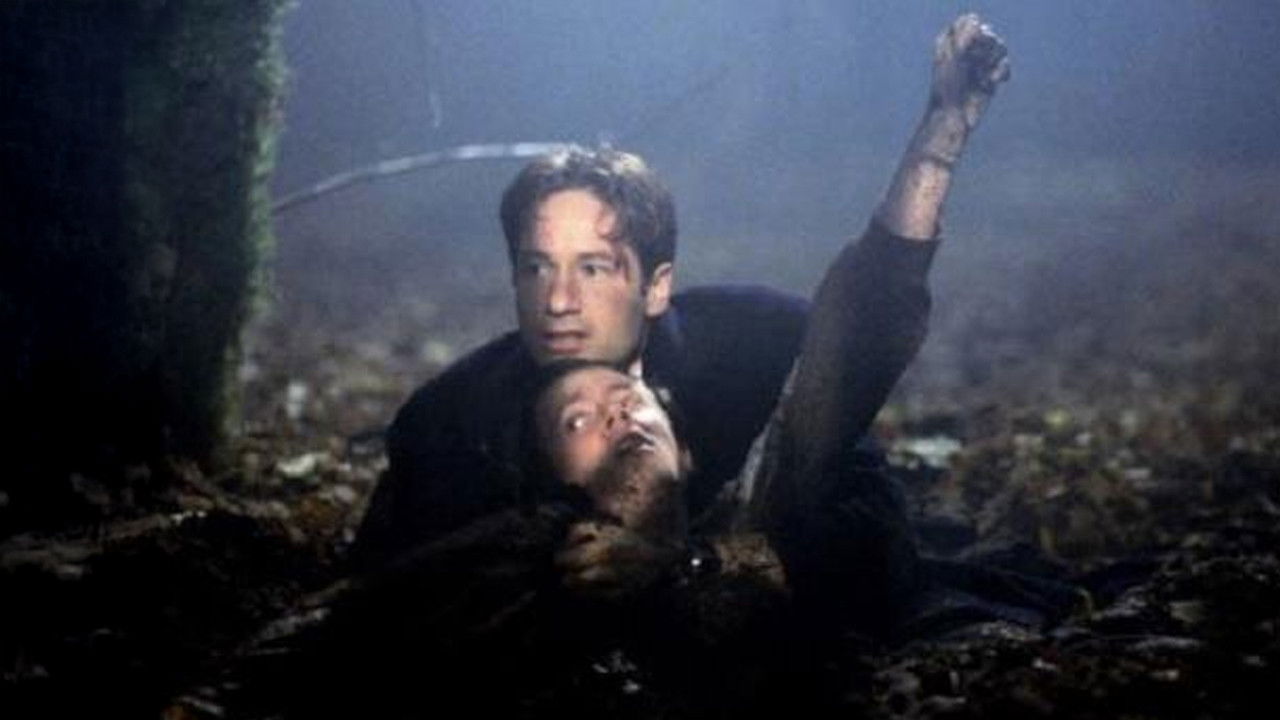
More from the episode


The story in 5 beats
- Yard work
In Coats Grove, Michigan, Bobby Rich fights with his stepfather Phil over chores and runs into the orchard. His mother finds Phil dying in a mud puddle, with Bobby beside him.
- The therapist
Scully thinks Bobby lured Phil into a pit trap. His therapist, Karin Matthews, tells the agents the boy has been physically abused, and Mulder starts to believe he's innocent.
- Through the window
Bobby's classmate Lisa, another of Matthews's patients, goes home to her abusive father, Eugene. Something like an arm bursts through the window and drags him outside.
- Twenty years ago
A splinter in Eugene's neck matches the trees outside. A man in the orchard warns the agents that a "bad man" is killing the trees, just as one did 20 years ago.
The root cellarSpoiler · tap to reveal
Lisa stays at Matthews's house, overhears an argument, and goes down into the root cellar. There's a body down there, and the door locks behind her.
Why it still matters
If you've heard of this one, it's probably as a punchline. The cast and crew called it "The Killer Tree Episode", and the critics weren't much kinder. Emily St. James gave it a D− in The A.V. Club and wrote that it "just might be the very worst episode of The X-Files"; Starpulse named its trees the worst monster of the week the show ever had; Francis Dass of the New Straits Times filed it among the season's weaker hours. It still drew 21.37 million U.S. viewers on its first broadcast.
It has defenders, up to a point. Robert Shearman and Lars Pearson gave it three and a half stars out of five in Wanting to Believe and singled out the first half, where director Ralph Hemecker makes it "a more honest-to-truth scary slice of X-File than has been offered in ages." Paula Vitaris, giving it two stars out of four in Cinefantastique, thought the plot was "more tangled than the episode's paranormal root system, but underneath lies some powerful themes", and those themes are about children who are hurt at home.
The bad man's daughter
Mulder learns that Karin Matthews's father was pulled from a mud puddle twenty years earlier. He digs up the man's grave and finds the coffin full of tree roots. Matthews has a split personality born of her father's abuse, and with it the power to control the trees. She kills Lisa's aunt, who has come to take the girl home. The agents find Lisa unharmed in the cellar, beside the father's corpse, pinned to the wall by roots. Matthews chases Bobby into the orchard, and both he and Mulder are nearly drowned in the mud before the man from the orchard cuts off her head with an axe, ending her hold over the trees.
Shearman and Pearson thought the nods to Psycho and the "lack of explanation" pushed the second half close to "nonsense". St. James felt that "the more Scott and Wollaeger try to continue explaining this and tie it into the idea of child abuse, the less it attains any of the power or tragedy they want it to have." For the shot of Matthews's body sinking into the mud, a stuntwoman was lowered slowly into the tank, so deep that the crew had to give her oxygen.
Challenge the DNA
Was Karin Matthews a villain or a victim?
Or skip ahead to our reading
The split personality grows out of her father's abuse, and she kills Lisa's aunt. The episode makes her both, and the roots in the coffin tie the two together.
Behind the scenes
- It was Jessica Scott and Mike Wollaeger's first script for the series, and according to Frank Spotnitz it "went through many, many incarnations and versions." The title is a biological term for cavities formed when existing cells separate.
- The orchard scenes were shot at Hazelgrove Farms near Fort Langley, British Columbia. The sinking-mud scenes were filmed on a soundstage at Lions Gate Studios fitted with more than 200 hazelnut trees, in a tank of soil, sphagnum moss and water heated so the actors wouldn't get cold.
- Katharine Isabelle, who plays Lisa, is the daughter of the show's production designer, Graeme Murray. Kate Robbins, Lisa's aunt, had been in the Season 3 episode "D.P.O."
- Fox's standards and practices department objected to Mulder calling Bobby "Dickweed", so David Duchovny re-recorded the line as "Dorkweed". Many of Chad Lindberg's lines were also dubbed in a studio, over worries that his delivery wasn't clear enough.
- Mark Snow was particularly proud of his score, which he built around synthesized woodwinds. Toby Lindala's department made the props, the moving tree roots among them.
The thread
Trees that reach for people, and small towns where something is wrong in the family homes.
Came before
Shares DNA with
DNA strand
Us vs. Them
The monster in Coats Grove grows in the orchard, but the episode keeps pointing at the houses, where fathers hit their kids and the kids carry it into therapy. The trees choose their victims from those homes.
Every great sci-fi story is built from a handful of strands like this one. Each strand page explains how it works and traces it across shows, books and films.
If this one stayed with you
Where to go next, and why.
Watch · Film
Ginger Snaps (2000)
Katharine Isabelle, Lisa here, plays a teenager in a Canadian suburb whose body starts turning into something else after an attack.
Read · Novel
The Day of the Triffids by John Wyndham
Walking, stinging plants and a sudden catastrophe leave the survivors of Britain at the mercy of the greenery.
Read · Novel
The Ruins by Scott Smith
Tourists on a jungle hill in Mexico find that the vines covering it are far more than scenery.
Your next episode
Three directions to go from here, all on Sci-Fi DNA.
More of this feeling
Kinda
Doctor Who
It has the same uneasy mood of a forest where something old seems to be listening.

Same question, different answer
Dark Page
Star Trek: The Next Generation
It asks what happens when a wound buried since childhood finally comes to the surface.

Something completely different
The Post-Modern Prometheus
The X-Files
For something warmer, try Chris Carter's black-and-white fairy tale about a lonely monster in small-town Indiana.