
More from the episode
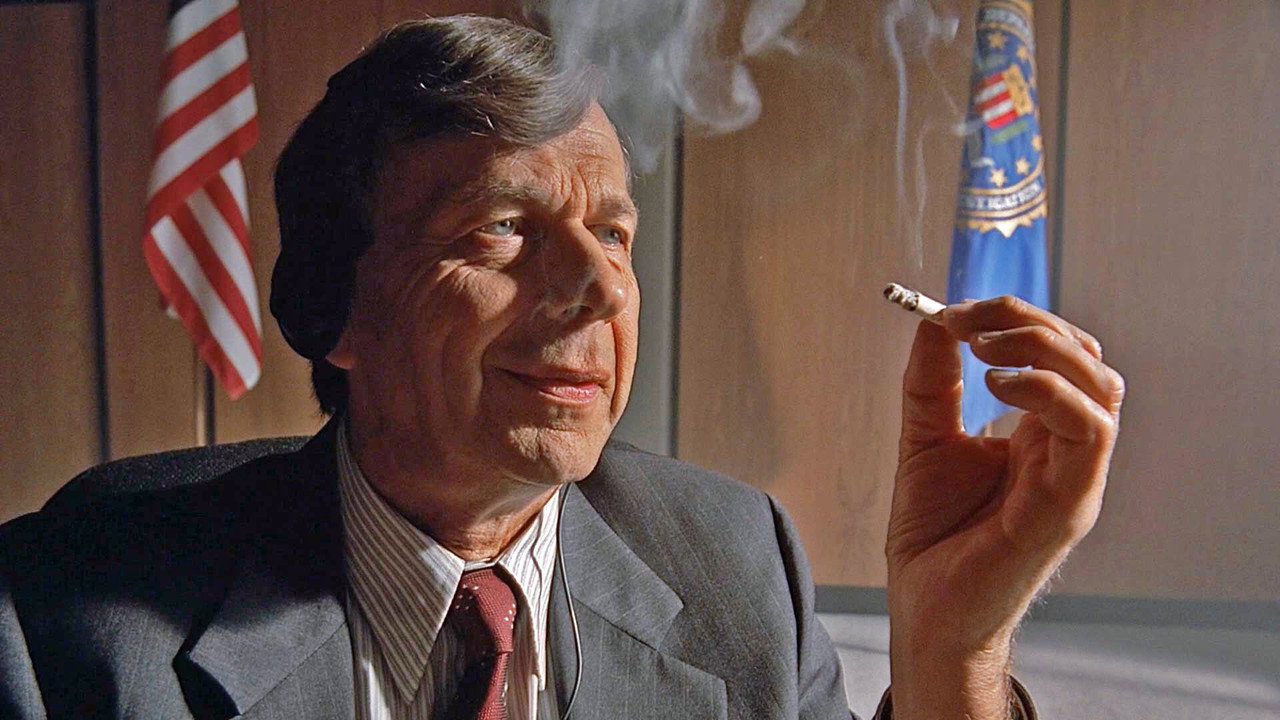

The story in 5 beats
- The rifle
The Cigarette Smoking Man sets up a sniper rifle and listening gear outside the building where Mulder, Scully and the Lone Gunmen are meeting.
- Frohike's discovery
Frohike tells the others he has dug up the man's past, and starts at the beginning. Outside, the man listens to every word.
- The younger man
The story jumps back decades. Chris Owens plays the man in his early years, and Davis takes over for the later ones.
Frohike's versionSpoiler · tap to reveal
Frohike's account follows the man across more than thirty years of American history, from the early 1960s to the present day.
Back to the presentSpoiler · tap to reveal
Frohike explains where he found the story and leaves to check whether it's true. The rifle follows him out.
Why it still matters
The show's most mysterious man gets an episode to himself. Glen Morgan wrote it and James Wong directed it, and they build the hour around William B. Davis instead of the two agents. Morgan said he wanted the episode to show that the Smoking Man was extremely dangerous. Chris Carter saw something else in it as well: a man whose vanity, once you see it this clearly, "makes him sort of a silly person."
Wong's work earned The X-Files its first Emmy nomination for Outstanding Directing for a Drama Series; he lost to Mark Tinker of NYPD Blue. Robert Shearman, in Wanting to Believe, called it "one of The X-Files' true masterpieces," and Zack Handlen of The A.V. Club wrote that it "transforms CSM from a living ghost into the walking dead": still dangerous, "but pitiable just the same." Not everyone agreed: Phil Farrand ranked it his fifth least favourite of the first four seasons.
Not today
In Frohike's telling, the man's father was an executed communist spy and he grew up in Midwest orphanages. In 1962 he is an Army captain at Fort Bragg, friends with Bill Mulder, and is picked to kill President Kennedy. In November 1963 he shoots Kennedy as "Mr. Hunt," frames Lee Harvey Oswald and smokes his first cigarette. In 1968 he talks a room including J. Edgar Hoover into having Martin Luther King Jr. killed, and volunteers to do it himself. By 1991 he claims credit for the Anita Hill hearings, the Rodney King trial and the Buffalo Bills losing the Super Bowl, gives every subordinate the same tie for Christmas, and flips a coin with Deep Throat over which of them must kill a surviving alien. In 1996 a magazine agrees to serialize his novel. He writes a resignation letter and quits smoking, then finds they have changed his ending, rants to a stranger on a bench that life is like a box of chocolates, tears up the letter and lights up again.
Frohike admits it all came from a story in a magazine he subscribes to. As he walks out, the man has him in his sights and lets him go, quoting the last line of his own unpublished book: "I can kill you whenever I please, but not today." Morgan's original ending had him shoot Frohike, and the show's executive staff vetoed it. The episode never settles how much of it is true. Frank Spotnitz said a lot of viewers took it as the character's real history, and as far as he was concerned it isn't, though "some of it may indeed be true." The novelist dream was modelled on E. Howard Hunt, the CIA officer who wrote a great deal of fiction.
Challenge the DNA
Is Frohike's story about the Smoking Man true?
Or skip ahead to our reading
The episode frames all of it as Frohike's telling, while the man outside has every reason to let a legend grow. It leaves us to decide, which seems to be the point.
Behind the scenes
- Mulder never appears on screen; David Duchovny is only heard, and Gillian Anderson appears only in archive footage. Nobody set out to give the leads a week off, but that's how it worked out, and Duchovny was very pleased.
- Chris Owens spent a long time studying how Davis smokes so that the younger and older versions would hold a cigarette the same way.
- Davis said many of the stage directions pointed toward farce, and that Wong told him to play against that and just let each situation play out.
- Davis felt the script made the man into something he wasn't. Chris Carter said he spent hours on the phone with him about it, explaining that even a destroyer can hope to be a creator.
- Morgan and Wong slipped in nods to Space: Above and Beyond, the Fox series they had co-created, including the phrase "classified compartmentalized" and the name Jack Colquitt.
The thread
Where the idea came from, the episode that first put this man in the room, and other stories about piecing together a powerful man's life or listening in on other people's.
Came before
Shares DNA with
DNA strand
The State Knows Best
This is the strand seen from the other side of the desk. For once the camera stays with the quiet man in the background of the conspiracy, instead of the agents trying to see past him.
Every great sci-fi story is built from a handful of strands like this one. Each strand page explains how it works and traces it across shows, books and films.
If this one stayed with you
Where to go next, and why.
Watch · Film
The Good Shepherd (2006)
Robert De Niro's film follows one CIA man over decades, and the job slowly hollows out everything else in his life.
Watch · Film
All the President's Men (1976)
Two reporters chase a government scandal with help from a source who will only meet them in a dark parking garage.
Read · Novel
Tinker Tailor Soldier Spy by John le Carré
A retired intelligence officer is brought back to find a traitor at the top of his own service, and the people he questions all have something to hide.
Your next episode
Three directions to go from here, all on Sci-Fi DNA.
More of this feeling
In the Pale Moonlight
Star Trek: Deep Space Nine
A man's dirty work behind closed doors, told looking back, gives it the same cold fascination.
Same question, different answer
The Conscience of the King
Star Trek
It asks whether a man's hidden past can ever be proved, or only told as a story.

Something completely different
Sanguinarium
The X-Files
For a stand-alone horror story, follow the agents into a plastic surgery clinic where the doctors start killing.
Sources
- “Musings of a Cigarette Smoking Man,” Wikipedia
- “The X-Files season 4,” Wikipedia
- “Lex Luthor: The Unauthorized Biography,” Wikipedia
- Zack Handlen, “'Musings of a Cigarette Smoking Man'/'Blood Relatives',” The A.V. Club, 2010
- “X Cyclopedia: The Ultimate Episode Guide, Season IV,” Entertainment Weekly, 1996