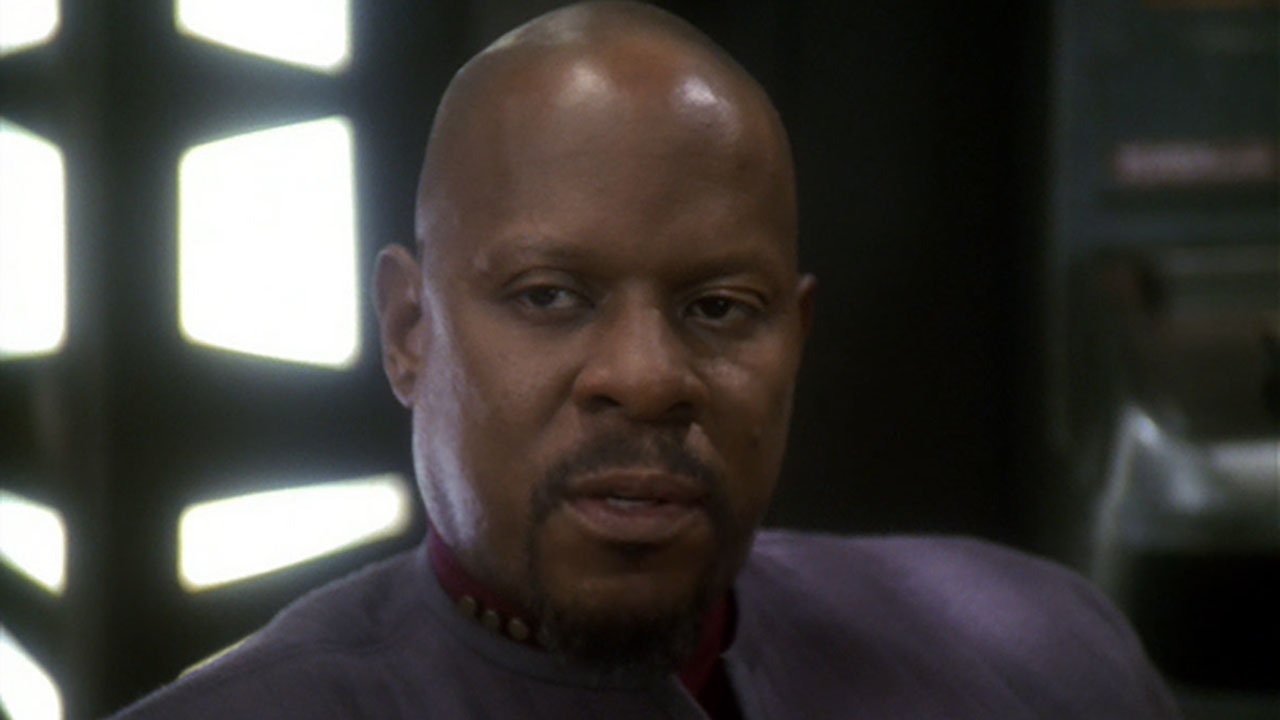
The story in 5 beats
- Personal log
Sisko starts recording a log, alone in his quarters, and goes back over the last two weeks. He talks straight to us.
- Dead ends
Garak's contacts in Cardassian space keep turning up dead soon after they talk to him. He suggests faking the proof instead, and after Betazed falls, Sisko gets Starfleet's approval.
- The forger
Sisko springs a forger, Grathon Tolar, from a Klingon prison, trades away dangerous bio-mimetic gel for a real data rod, and bribes Quark after Tolar stabs him. Tolar fakes a Dominion meeting.
The senatorSpoiler · tap to reveal
Sisko shows the recording to Vreenak, an influential Romulan senator. Vreenak spots the forgery and leaves, promising to expose it.
The bargainSpoiler · tap to reveal
Vreenak's ship is destroyed on the way home. Garak admits he planted the bomb, and the Romulans soon declare war on the Dominion.
Why it still matters
This is the episode people reach for when they want to show what Deep Space Nine could do that the other Star Trek shows wouldn't. Rick Berman, the franchise's executive producer, compared Starfleet officers under Gene Roddenberry's rules to Boy Scouts and called this episode the exception. A Starfleet captain, in a war that's going badly, sits down to record a personal log about the past two weeks, and over the hour we watch what he agreed to, one reasonable-sounding step at a time. Zack Handlen at The A.V. Club liked that the script "never overplays Sisko's deepening sense of crisis".
It's also a lesson in rewriting. According to Terry J. Erdmann and Paula M. Block's Deep Space Nine Companion, Ronald D. Moore joined Michael Taylor on the revision. Taylor called the final version "brilliant" and admitted Moore wrote most of it.
A Syfy survey at the end of the series named it the fans' favourite episode. Keith R. A. DeCandido, in his Tor.com rewatch, called Brooks's and Robinson's turns "bravura performances". Not everyone was floored: Mark Jones and Lance Parkin wrote in 2003 that it was good but "not half as shocking and dangerous as some fans would have you believe", since schemes like this were standard fare on Mission: Impossible.
What Sisko can live with
Garak had planned for failure. With Vreenak's ship blown up, the Romulans would search the wreckage, find the data rod, put any flaws down to the explosion, and conclude the Dominion killed the senator to stop him bringing it home. He had also killed Tolar. When Sisko confronts him, Garak points out that the Alpha Quadrant may have been saved at the cost of a senator, a criminal and Sisko's self-respect, and calls that a bargain. The Romulans declare war on the Dominion.
Back in the log, Sisko runs through the list: forgery, selling prohibited materials, bribery and murder. Then comes the line that made the episode: he can live with it, and if he had to, he would do it all again. He deletes the log. Ira Steven Behr added "I can live with it" as a reference to The Man Who Shot Liberty Valance. In 2016 Radio Times counted Sisko deleting the log as the 27th greatest moment in all of Star Trek.
Challenge the DNA
Can Sisko really live with it?
Or skip ahead to our reading
He says he can, and he says he'd do it again. Then he deletes the log. The episode lets you believe him and doubt him at once.
Behind the scenes
- It started in a writers' room conversation about Vietnam that drifted to Watergate. An early version, called "Patriot", had Jake Sisko digging up dirt on Shakaar, the Bajoran leader, that could bring down the government in wartime. Michael Taylor's script then had Jake investigating Garak and Sisko warning him off, but the writers didn't believe the father-son conflict.
- Ronald D. Moore dropped Jake. He and Michael Taylor were struggling with the pacing until Moore realized late one night, over a drink, that it would work as flashbacks. He pitched it the next morning, and the script was rewritten from scratch.
- The title comes from the Joker's line in Tim Burton's 1989 Batman: "Have you ever danced with the devil in the pale moonlight?" Moore didn't know it came from the film; he thought it was an old folk saying.
- Victor Lobl shot the log scenes almost in continuity, from only two angles, so the audience would believe in a single recording. The script had Sisko drink more as the log goes on, and Lobl added him taking off pieces of his uniform as he goes, to show him baring his soul.
- Andrew Robinson, talking about the episode in 2011, said Americans sometimes have to do very dirty things and pretend they don't, and that he didn't think the other Star Trek shows went as far as this one did.
The thread
Where the Romulans and the title came from, and another wartime story about what Starfleet will sign off on.
Came before
Shares DNA with
DNA strand
The State Knows Best
Most stories in this strand watch the state from outside, as the thing doing harm. This one sits inside it, with a captain who gets Starfleet's permission to forge evidence because he believes the Federation's survival depends on it, and who walks us through each decision in his own log. It's less interested in whether he's right than in how each step makes the next one easier.
Every great sci-fi story is built from a handful of strands like this one. Each strand page explains how it works and traces it across shows, books and films.
If this one stayed with you
Where to go next, and why.
Watch · Film
The Man Who Shot Liberty Valance (1962)
A John Ford western about a reputation built on something that can't be said out loud.
Watch · Star Trek: DS9 S3
"Improbable Cause" (1995)
A Garak story that shows how he works once a plan is in motion, and why Sisko would think to ask him for help.
Read · Novel
The Spy Who Came in from the Cold by John le Carré
A Cold War operation run from a desk, and what it asks of the people carrying it out. Le Carré weighs means against ends with the same cold eye.
Your next episode
Three directions to go from here, all on Sci-Fi DNA.

More of this feeling
Inter Arma Enim Silent Leges
Star Trek: Deep Space Nine
Bashir is sent to Romulus on a Section 31 job, and the war's dirty dealing with the Romulans comes back with another Starfleet officer caught inside it.

Same question, different answer
The Drumhead
Star Trek: The Next Generation
A spy hunt aboard the Enterprise grows past the evidence, and Picard has to decide where a Starfleet officer draws the line when security is at stake.
Something completely different
His Way
Star Trek: Deep Space Nine
A holographic Las Vegas lounge singer decides to fix Odo's love life, and it's the warmest, silliest palate cleanser this season has to offer.
Sources
- “In the Pale Moonlight,” Wikipedia
- “List of Star Trek: Deep Space Nine episodes,” Wikipedia
- Keith R. A. DeCandido, “Star Trek: Deep Space Nine Rewatch: "In the Pale Moonlight",” Tor.com, 2014
- Zack Handlen, “Star Trek: Deep Space Nine: "In The Pale Moonlight",” The A.V. Club, 2013
- “'Star Trek: Deep Space Nine' — The 20 Greatest Episodes,” The Hollywood Reporter, 2016
- Daniel Drezner, “The top 10 'Star Trek' episodes ever,” The Washington Post, 2016
- Elizabeth Howell, “The 10 Best 'Star Trek' Episodes Ever,” Space.com, 2017