More from the episode

The story in 5 beats
- T-minus one hour
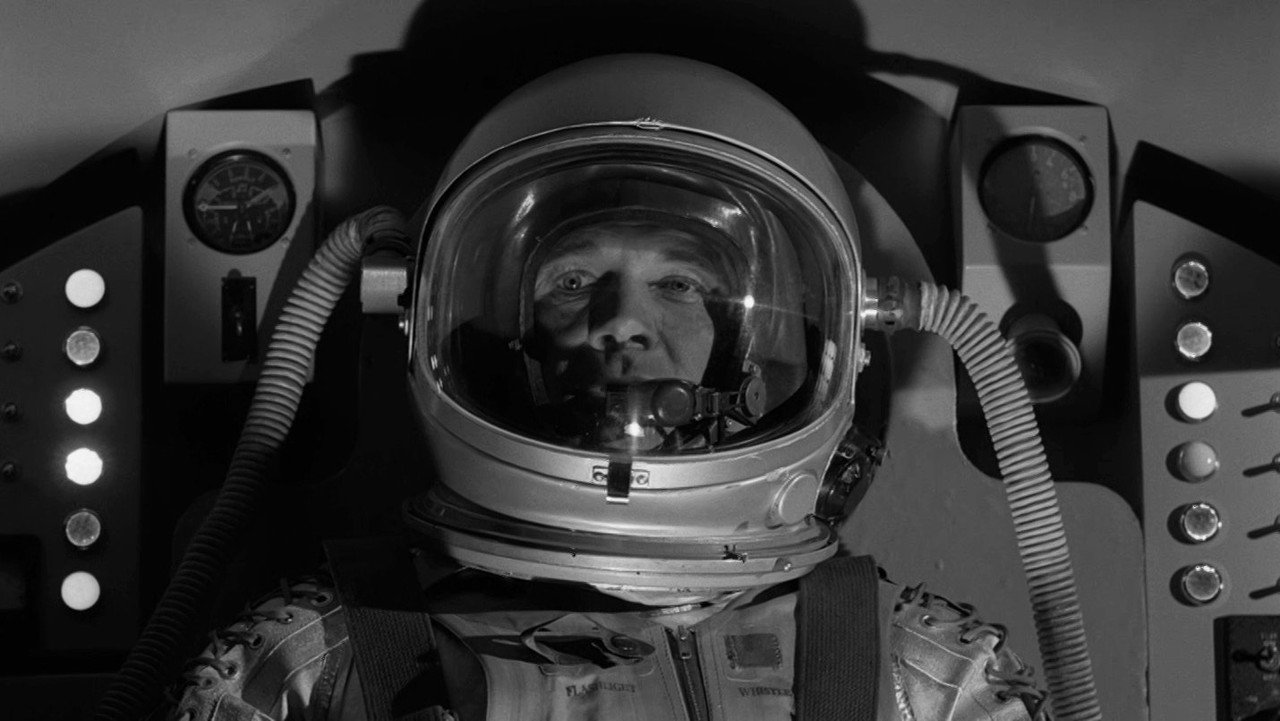
Major Robert Gaines launches on a multi-orbit flight while Helen and Maggie watch at home.
- Blackout
Contact is lost, a blinding light fills the capsule, and Gaines wakes in a hospital with no memory of landing.
- The picket fence
His house has a fence he doesn't remember, he's suddenly a colonel, and his daughter insists he's a stranger.
President who?Spoiler · tap to reveal
Gaines mentions President Kennedy. Nobody has heard of him, and the capsule he came back in isn't quite the one he flew.
The other ColonelSpoiler · tap to reveal
He's thrown back into orbit, lands for real, and mission control picks up a voice that sounds just like him.
Why it still matters
Major Robert Gaines is a 1963 hero: an astronaut on a multi-orbit flight, with his wife Helen and daughter Maggie watching on television. Then mission control loses him, a blinding light fills the capsule, and he wakes in a hospital bed with no memory of coming down. Everyone is relieved. Nobody else seems to notice that things are slightly off.
Serling wrote it a year after John Glenn's three orbits in Friendship 7, and he name-checks Glenn, Gus Grissom and Wally Schirra to make the space program feel real. The fun of it is the small stuff: the picket fence, a promotion everyone remembers but him, a daughter who looks at him like a stranger. The idea has turned up so often since that you'll recognize the shape of it right away.
Not everyone is sold. Zack Handlen at The A.V. Club liked the first half and gave up on the second. It's still worth your time for Steve Forrest's steady, puzzled performance, and for an idea that bigger shows would run with for decades.
Two men named Gaines
The clues add up to a parallel Earth. History runs differently there, Kennedy was never president, and the Gaines who lived in this house has been a colonel for months. When a mechanic reports that the capsule differs from the one that launched, Gaines goes to look, and he's pulled back to the moment of the blinding light. This time he lands in his own world. He tells his superiors he spent nearly a week on the other side, though only hours passed here, and they're ready to call it a nightmare.
Then ground control catches a broken transmission from Colonel Robert Gaines, the other one, before he drops off radar. The Major goes home. The fence is gone, and Maggie knows him. Serling's closing narration hands the question to the viewer with a challenge to prove it couldn't happen. The obvious follow-up, which one of Gaines's colleagues asks, is where the double was all week, and the episode leaves you to work that out for yourself.
Behind the scenes
- Serling started the script in 1961. Producer Herbert Hirschman and production manager Ralph W. Nelson disliked the first draft, so Serling added references to real astronauts. By the time it was approved, Bert Granet had taken over as producer.
- A writer named Stephen Masino claimed it used his unpublished story "Carbon Copy," which Cayuga Productions had turned down three times. Serling had never read it, but a copy turned up in the production files. The July 12, 1963 rerun was cancelled and Cayuga settled for $6,500.
- Steve Forrest was the brother of Dana Andrews, who starred in the episode broadcast the week before, "No Time Like the Past."
- The Gaines house exterior was used in "Mute" and "Stopover in a Quiet Town," and in The Philadelphia Story (1940).
- Gaines tells a colleague it depends on "the acceptable outer limits" of sanity, a line The Twilight Zone Vortex reads as a wink at The Outer Limits.
- There's no original score; the music is stock.
The thread
The space race, Serling's earlier doubles, and the mirror worlds that came after.
Came before
Shares DNA with
Left its mark on
DNA strand
Alternate Selves
The episode never shows the other Gaines, which is the smartest thing about it. You meet him only through the people who know him better than they know our hero: a wife who senses the difference when she kisses him, and a daughter who notices he's stopped taking sugar. All you learn about the double comes from the life he left behind.
Every great sci-fi story is built from a handful of strands like this one. Each strand page explains how it works and traces it across shows, books and films.
If this one stayed with you
Where to go next, and why.
Watch · TNG S7
"Parallels"
If the picket fence was your favorite clue, this is the same game at full speed: a man coming home to realities that keep shifting by one detail.
Watch · Film
Journey to the Far Side of the Sun (1969)
Another astronaut, another mission that loses contact, and a far bigger budget for the strangeness that follows.
Read · Novel
Dark Matter by Blake Crouch
A family man wakes up in a life where his marriage and his son never happened. It's Gaines's week told from the inside, with much higher stakes.
Sources
- “The Parallel,” Wikipedia
- JP, “The Parallel,” The Twilight Zone Vortex, 2019
- Zack Handlen, “The Twilight Zone: "The Parallel"/"I Dream Of Genie",” The A.V. Club, 2013
- “An American orbits Earth,” History.com
- “Journey to the Far Side of the Sun,” Wikipedia
- “What if you hadn't gotten married? 'Dark Matter' imagines an alternate life,” NPR, 2016
- “The Twilight Zone, season 4 episode guide,” TVmaze