
More from the episode

The story in 5 beats
- The $20 lamp
George buys a battered oil lamp for Ann's birthday. Roger gets there first with a nightgown, and Ann thanks him with a kiss.
- One wish only
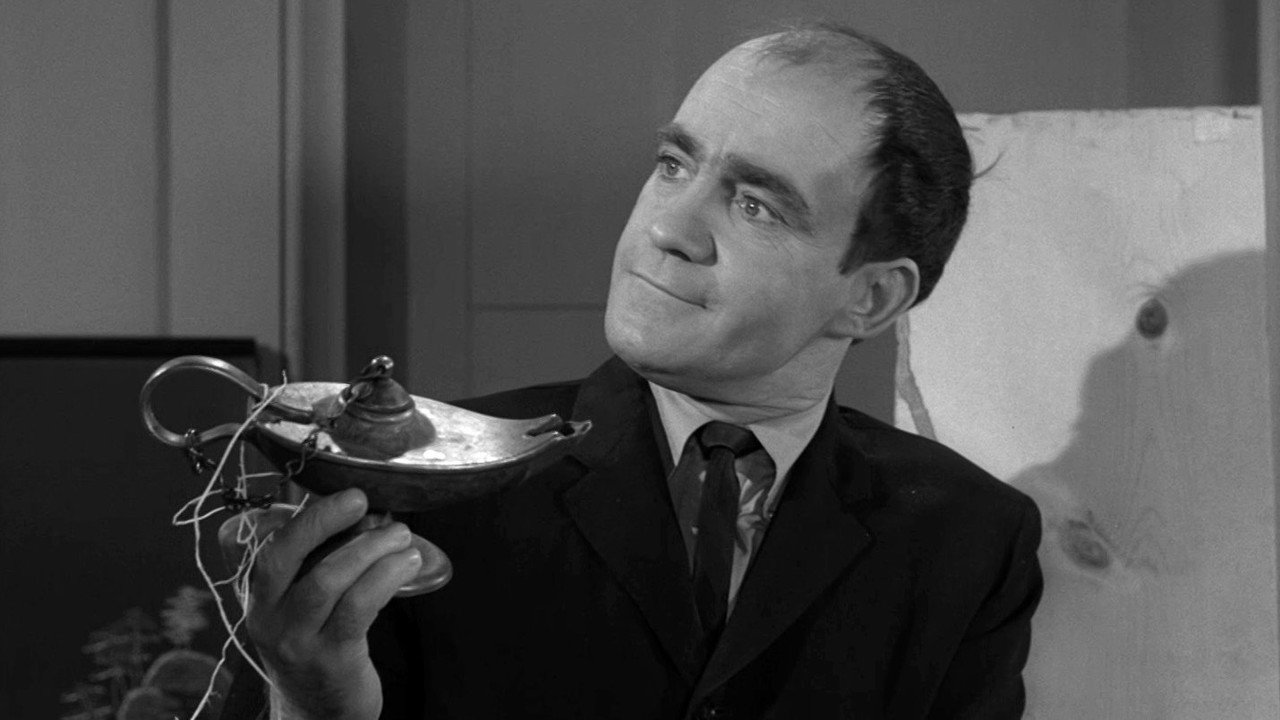
Polishing the lamp at home, George frees a genie who offers a single wish and lets him take his time choosing.
- Love and money
He daydreams of marrying Ann as a movie star, then of being tycoon G. Peter Hanley. Neither feels the way he hoped.
- Mr. President
Walking his dog Attila, George imagines being President, until a UFO crisis leaves him frozen.
The wishSpoiler · tap to reveal
George works out that new circumstances won't change who he is, and picks a wish none of his daydreams came near.
Why it still matters
George P. Hanley is the kind of man other people walk past. He buys an old oil lamp as a birthday present for Ann, the office secretary he adores, and a smoother co-worker beats him to her with a skimpy nightgown. So George takes the lamp home, rubs it, and meets a genie who offers him one wish instead of the usual three, and gives him time to think it over.
What follows is an hour of George thinking it over. He tries love, then money, then power, each as a daydream, and each one goes wrong for reasons that come back to George himself. It's a gentle comedy, closer to Thurber's Walter Mitty than to anything with a monster in it, and the cast swap roles from one fantasy to the next, which is the episode's neatest trick.
Howard Morris, best known as Ernest T. Bass on The Andy Griffith Show, is the reason to watch. Zack Handlen at The A.V. Club called him easily the best thing in it, though he and other critics found the hour too long for the joke. Go in expecting a light sketch with a good closing line and you'll have a nice time.
What George wished for
Every daydream fails for the same reason: George is still George. As a star he loses Ann to Roger anyway; as a tycoon, giving money away leaves him empty; as President he can't make a decision. He concludes that the only thing worth changing is himself, and the episode's answer to what that means is a sideways one.
A down-and-out man finds the lamp in a garbage can and polishes it. Out comes the new genie: George, with Attila at his side. He offers the finder his wishes on one condition, that the lamp goes back into the alley for the next person who needs it. Serling's closing narration sums him up: "Mr. George P. Hanley, former vocation: jerk. Present vocation: genie." It's a sweet idea, and it splits people. Witney Seibold at SlashFilm found the message muddled and saw no poetry or irony in it. Read kindly, it's a meek man finding the one job that suits him: granting other people's wishes.
Behind the scenes
- John Furia Jr. had little interest in science fiction and was reluctant to write for the show. Producer Herbert Hirschman told him he could write whatever he liked as long as it fit the strange and fantastic.
- Furia started from the Aladdin legend and wanted to write about the consequences of getting what you most desire. He tried several endings before settling on the ironic one.
- Production manager Ralph W. Nelson disliked Jack Albertson's performance as the genie and wrote to Serling asking to reshoot the whole sequence. Time and money ruled it out.
- One of George's daydreams has him as the first man on the moon, in the helmet and suit from the previous week's episode, "The Parallel."
- Jack Albertson later won an Oscar for The Subject Was Roses and an Emmy for Chico and the Man. He had already appeared in "The Shelter."
- Patricia Barry had been in the first-season "The Chaser" and came back for the "It's a Good Life" segment of Twilight Zone: The Movie (1983).
The thread
Lamps, daydreamers and bargains with something that grants wishes.
Came before
Shares DNA with
Left its mark on
DNA strand
Be Careful What You Wish For
Most wish stories punish the wisher after the wish. This one runs the punishment in George's head first, three times, so he can see each bad bargain coming. It's the rare Twilight Zone wish episode where the hero gets to learn the lesson before it costs him anything.
Every great sci-fi story is built from a handful of strands like this one. Each strand page explains how it works and traces it across shows, books and films.
If this one stayed with you
Where to go next, and why.
Watch · The Twilight Zone
"The Man in the Bottle"
If you wanted the genie to be a bit more dangerous, here's the show's earlier, darker take on wishes granted.
Watch · Film
Bedazzled (1967)
A lovestruck man, a woman he can't win, and a run of wishes that each go wrong. Funnier and much ruder.
Read · Short story
"The Secret Life of Walter Mitty" by James Thurber
The original meek daydreamer, five heroic fantasies on one errand-filled afternoon. A few pages, and George would recognize every one of them.
Sources
- “I Dream of Genie,” Wikipedia
- JP, “I Dream of Genie,” The Twilight Zone Vortex, 2019
- Zack Handlen, “The Twilight Zone: "The Parallel"/"I Dream Of Genie",” The A.V. Club, 2013
- Witney Seibold, “5 Most Disappointing Twilight Zone Episodes Of All Time,” SlashFilm, 2026
- “Bedazzled (1967 film),” Wikipedia
- “The Secret Life of Walter Mitty,” Wikipedia
- “The Twilight Zone, season 4 episode guide,” TVmaze