More from the episode

The story in 5 beats
- Murderers' Row
Ferguson's Wax Museum is closing. Martin, its curator, offers to keep the murderer figures at home until they're sold.
- The air conditioner
The figures need constant cooling. The power bills drain the savings, and Martin spends his evenings talking to them.
- Emma steps in
Worried about her husband, Emma goes down to the basement to switch the cooling off.
Three visitorsSpoiler · tap to reveal
Emma, then her brother Dave, then Ferguson himself never make it out of the house.
BrusselsSpoiler · tap to reveal
The figures accuse Martin, and a museum in Brussels gets a new exhibit.
Why it still matters
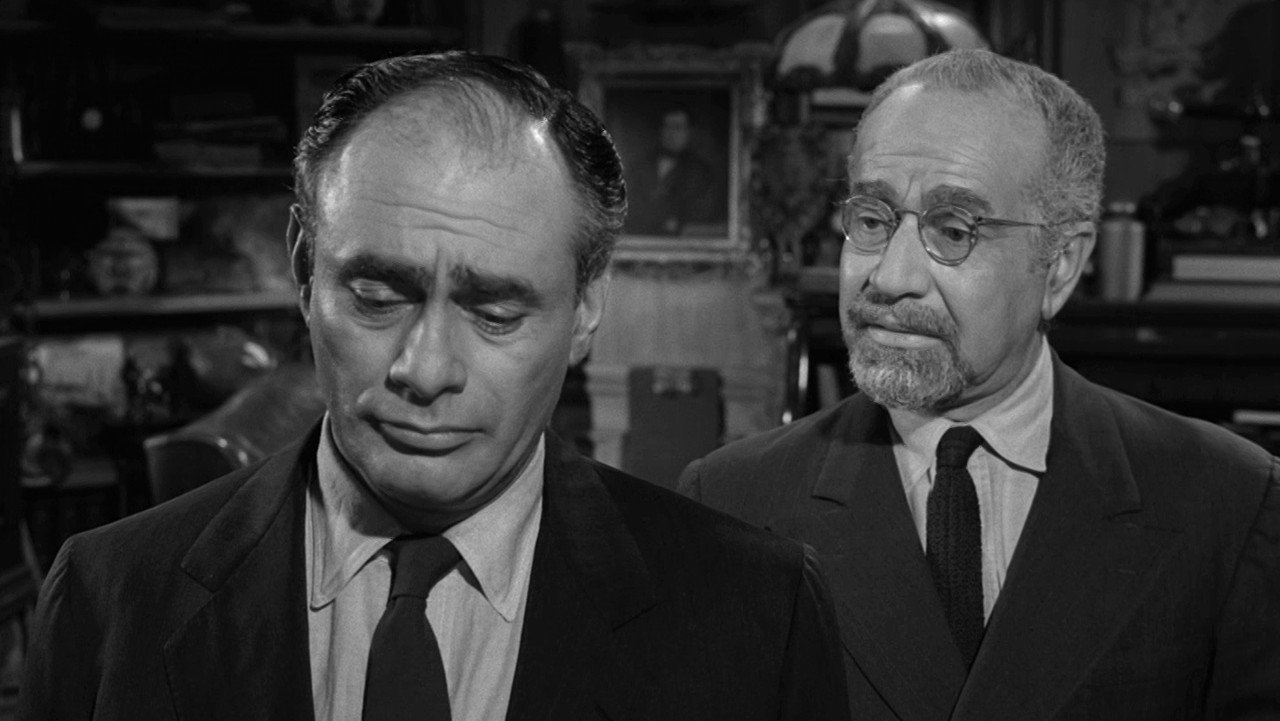
Martin Senescu has spent years tending the Murderers' Row exhibit at Ferguson's Wax Museum: Jack the Ripper, Landru, Burke and Hare, the axe murderer Albert W. Hicks. When old Mr. Ferguson sells up, Martin can't bear to see the figures scrapped, so he moves them into his basement until a buyer turns up. They need an air conditioner to keep from melting. The electric bill eats the family savings, Martin starts talking to them like old friends, and his wife Emma starts to worry.
It's one of the best-paced hours of an uneven season, and Martin Balsam is very good as a gentle man sliding somewhere dark without noticing. Director John Brahm shoots the figures in extreme close-up until you're not sure they aren't breathing. The A.V. Club's Emily St. James called the premise a marvelously creepy notion and gave it a B+.
Watch it with half an eye on the question it never settles. You can take it as a story about wax killers that come to life, or about a lonely man coming apart, and both work.
Who did the killing
Jack the Ripper kills Emma when she reaches for the switch, and Martin buries her in the basement. Dave comes looking for his sister and meets Hicks's axe. Ferguson drops by to say he's sold the figures to a museum in Brussels, and while Martin makes tea, Landru strangles him. Martin finally resolves to smash the lot. The figures come to life and turn on him: he's the murderer, they say, though he wasn't in the room for any of it.
The last scene is in Brussels. A new figure has joined Murderers' Row, Martin Senescu, billed as a killer who used a different method on each victim, and visitors find something unsettling in his eyes. The ending is the hinge for both readings. Either the figures framed him and somehow put him among them, or there was never anyone in that basement but Martin.
Behind the scenes
- The script is credited to Charles Beaumont but was written by Jerry Sohl. Emily St. James writes that the idea was Beaumont's and the two plotted it together, but Sohl wrote the final script with little to no input from him.
- Beaumont was ill with the condition that would kill him by 1967 and could no longer keep up with his assignments. Sohl wrote the scripts and took half the fee, largely because the Beaumont household was struggling for money. Using ghostwriters broke Writers Guild rules.
- It was the first of three episodes Sohl ghostwrote under Beaumont's name. The others were "Living Doll" and "Queen of the Nile."
- Milton Parsons, who plays the Landru figure, had appeared two weeks earlier in "I Dream of Genie."
- The Twilight Zone Vortex ranked it in its 2016 Halloween countdown and singled out Brahm's staging of the climax, where the framing makes it feel like a picture coming to life.
The thread
A century of waxworks that won't stay still, and the dolls that followed.
Came before
Shares DNA with
Left its mark on
DNA strand
Is Any of This Real?
The episode plays fair with both answers. Every killing happens while Martin is somewhere else, yet he's the one who buries Emma and the one the figures blame. The final shot in Brussels leaves the question open and shows you who ends up paying for it.
Every great sci-fi story is built from a handful of strands like this one. Each strand page explains how it works and traces it across shows, books and films.
If this one stayed with you
Where to go next, and why.
Watch · The Twilight Zone
"The Dummy"
If you liked not knowing whether the figures or the man were to blame, this is the same doubt with a ventriloquist and his act.
Watch · Film
Waxworks (1924)
An early wax-killer story on screen: a writer invents tales for a showman's figures, and the Ripper's figure ends up coming after him.
Read · Short story
"The Waxwork" by A.M. Burrage
One of the classics of waxwork horror and a short, sharp companion to Martin's basement.
Sources
- “The New Exhibit,” Wikipedia
- Emily St. James, “The Twilight Zone: "The New Exhibit"/"Of Late I Think Of Cliffordville",” The A.V. Club, 2013
- JP, “The Twilight Zone Vortex 2016 Halloween Countdown: "The New Exhibit",” The Twilight Zone Vortex, 2016
- “I Dream of Genie,” Wikipedia
- “Waxworks (1924 film),” Wikipedia
- “The New Exhibit (The Twilight Zone Radio Dramas),” Audible
- “The Twilight Zone, season 4 episode guide,” TVmaze