
More from the episode
The story in 5 beats
- The act
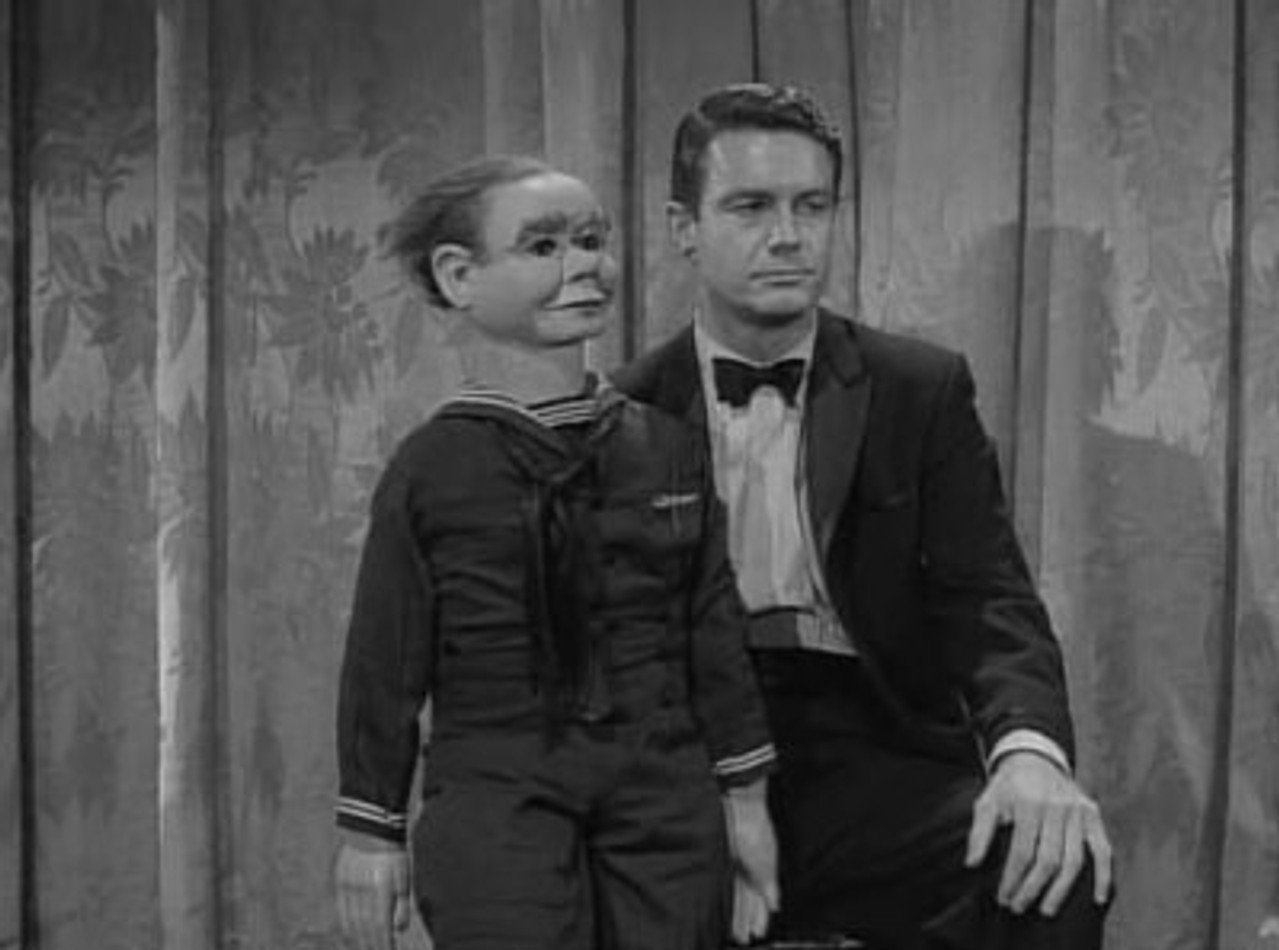
Jerry Etherson and his dummy Willy kill at a New York nightclub. Offstage, Jerry swears Willy bit his hand.
- The agent
His agent, Frank, has already pushed him to see a psychiatrist and is losing patience. Jerry is back on the bottle.
- Into the trunk
Jerry locks Willy away and goes on with a sweeter new dummy, Goofy Goggles. Frank quits anyway.
The alleySpoiler · tap to reveal
Leaving for Kansas City, Jerry hears Willy's voice and sees his shadow outside. Nobody else does.
Kansas CitySpoiler · tap to reveal
Jerry runs back to the dressing room and smashes the dummy in the trunk. Then the lights come on.
Why it still matters
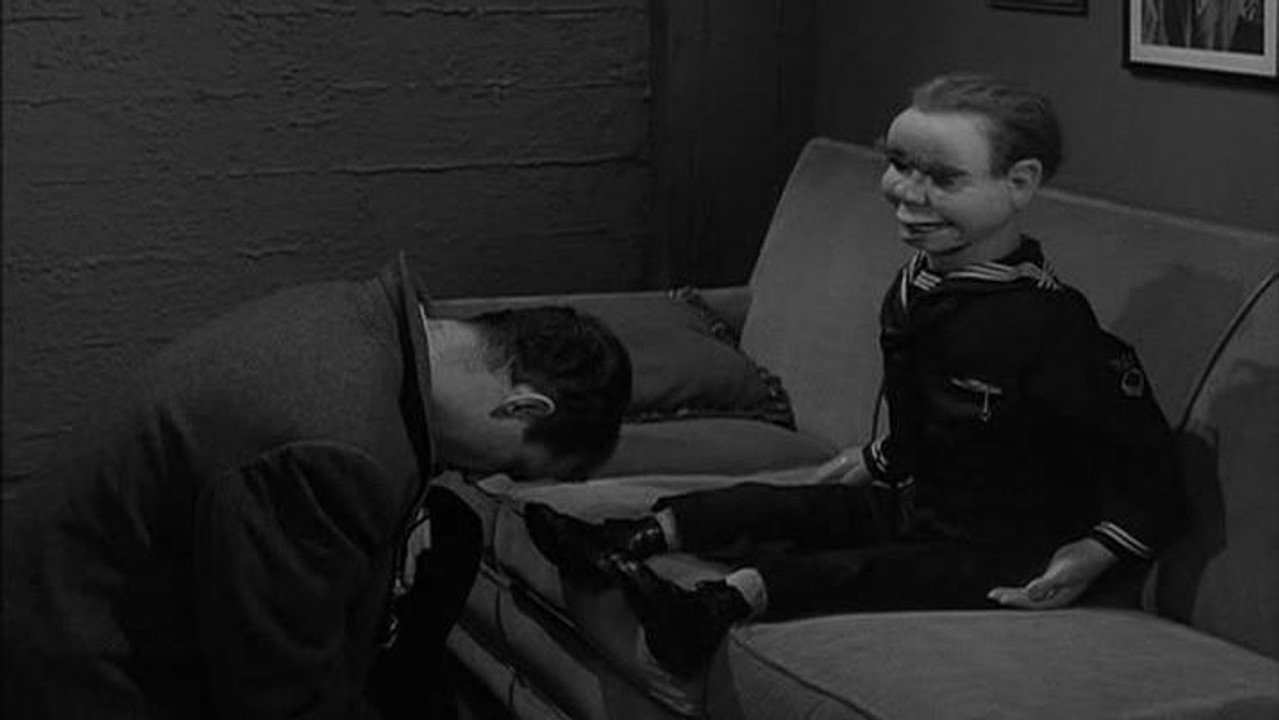
The evil ventriloquist's dummy was already an old idea by 1962, going back to the 1920s, and Serling gives it one of its best half hours. Jerry Etherson is a hit at a New York club, a voice-thrower par excellence, as Serling's narration puts it. He's also drinking again, because he's convinced the wisecracking dummy on his knee is alive and doesn't like him much.
The A.V. Club's Zack Handlen gave it an A and called it the most frightening Twilight Zone he'd ever seen, because it skips the usual handholds that let you decide it's all in Jerry's head. Cliff Robertson plays him with a muted resignation that makes the collapse worse. Mood carries it further than plot does: cramped dressing rooms, a trunk with a lock on it, a voice in an empty alley. Robertson does all the voices himself, Willy's included, which is worth listening for.
From boss to blockhead
Jerry smashes the dummy in the trunk and flips on the light. He has destroyed Goofy Goggles. Willy is sitting on the couch, laughing at him, and tells Jerry he's the one who made him real: he poured words into his head and moved his mouth. Jerry lowers his head while Willy cackles.
Then we're in a club in Kansas City, where the emcee introduces Jerry and Willy. The man on stage is Willy, now flesh and blood, played by George Murdock. On his knee is a wooden dummy with Jerry's face. Serling sums it up as the old switcheroo, from boss to blockhead in a few uneasy lessons. The whole episode kept you wondering whether Jerry was sick, and the last shot answers it in the worst possible way.
Behind the scenes
- Serling built the teleplay from a story idea by Lee Polk, a New York writer and programmer best known for children's and educational TV.
- Cliff Robertson had been booked on American Airlines Flight 1 to Los Angeles, which crashed into Jamaica Bay on March 1, 1962, killing all 95 aboard. He'd canceled because he learned he wouldn't be needed on set for days, he recalled in Steven Jay Rubin's The Twilight Zone Encyclopedia.
- It was Robertson's second Twilight Zone, after "A Hundred Yards Over the Rim." He later won an Oscar for Charly (1968).
- Frank Sutton, the agent, went on to play Gunnery Sergeant Vince Carter on Gomer Pyle, U.S.M.C.
- The Willy dummy was made in the 1940s by puppet maker Revello Petee and was used again in the 1964 episode "Caesar and Me." Willy and the Robertson figure from the final shot are now in David Copperfield's International Museum and Library of the Conjuring Arts in Las Vegas, restored by puppet expert Alan Semok.
- Director Abner Biberman, a character actor turned acting coach, also directed "Number 12 Looks Just Like You" and "I Am the Night—Color Me Black" for the series. The episode was shot at MGM with stock music.
The thread
Ventriloquists and the dummies who talk back, from the 1920s to the 1970s.
Came before
Shares DNA with
Left its mark on
DNA strand
Alternate Selves
Willy says everything Jerry won't: he's rude, confident and in charge. A ventriloquist's dummy is a second self you can hold on your knee, and the episode asks what happens when that self decides it's the real one, until the swap at the end makes the metaphor literal.
Every great sci-fi story is built from a handful of strands like this one. Each strand page explains how it works and traces it across shows, books and films.
If this one stayed with you
Where to go next, and why.
Watch · Film
Dead of Night (1945)
The British anthology that got there first. Its ventriloquist segment, with Michael Redgrave, is the one people still talk about, and it leaves more open than Serling does.
Watch · Film
Magic (1978)
Anthony Hopkins as a shy magician whose dummy does the talking. Jerry's story at feature length, in color and with more blood.
Read · Short story
"And So Died Riabouchinska" — Ray Bradbury
A ventriloquist, a murder investigation and a dummy who seems to know more than her owner will say. Bradbury makes it sad as well as creepy.
Sources
- “The Dummy,” Wikipedia
- “The Dummy,” The Twilight Zone Vortex, 2017
- Zack Handlen, “The Twilight Zone: "The Dummy"/"Young Man's Fancy",” The A.V. Club, 2013
- Josh Weiss, “How Cliff Robertson Was Nearly Killed for This Classic Episode of The Twilight Zone,” SYFY WIRE, 2025
- “Caesar and Me,” Wikipedia
- “The Twilight Zone 3x33: The Dummy,” TVmaze