The story in 5 beats
- Tryout day
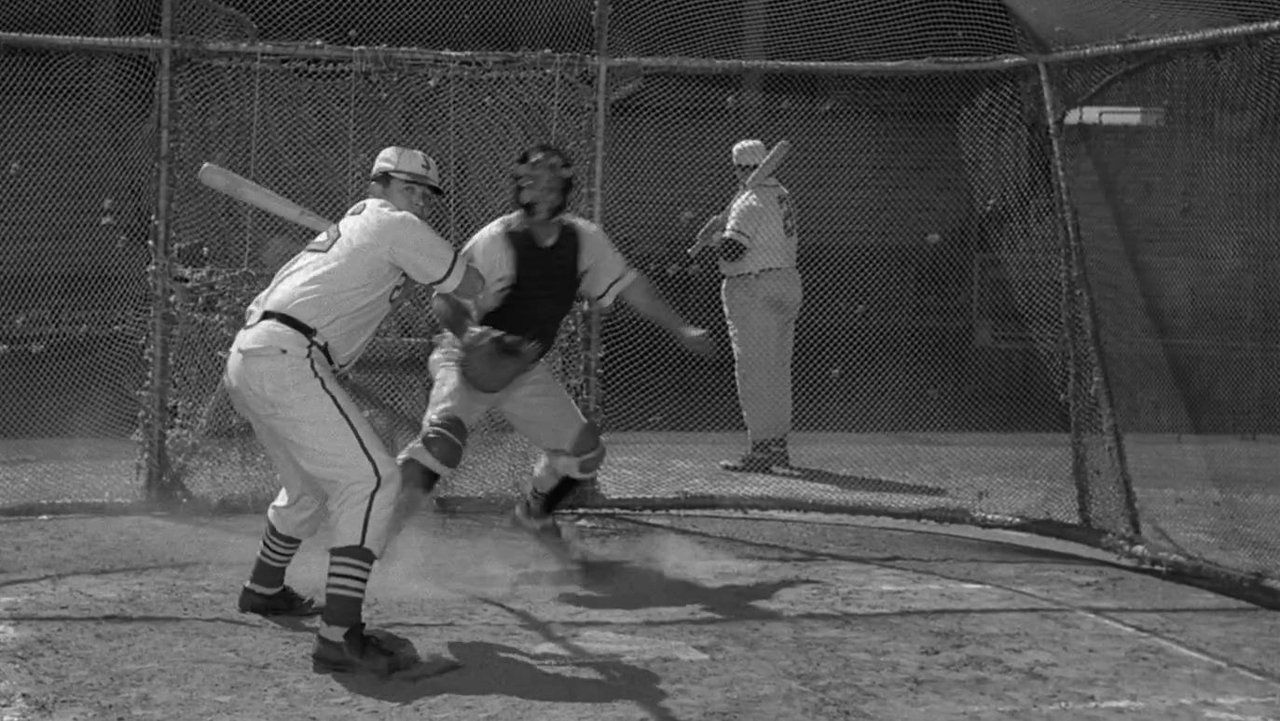
Mouth McGarry's Hoboken Zephyrs are stuck in last place. Dr. Stillman turns up at practice with a young left-handed pitcher named Casey.
- Nothing human
Casey's pitches come in at speeds and curves no batter can touch. Stillman quietly tells McGarry what Casey is, and a desperate McGarry signs him anyway.
- Fourth place
The Zephyrs climb the standings on shutouts. Then a ball hits Casey in the head, and the team doctor can't find a heartbeat.
Nine menSpoiler · tap to reveal
The league rules that a team must field nine men, and Casey doesn't count. McGarry's workaround is to have Stillman give him a heart.
Social workSpoiler · tap to reveal
The heart works too well. Casey can't bring himself to strike anyone out, and the blueprints give McGarry an idea of his own.
Why it still matters
Most Twilight Zone robots arrive with a warning attached. This one arrives with a fastball. The tone is a tall tale told in a dugout. Serling sets it in the Hoboken Zephyrs' ballpark, which his opening narration describes as a ghost of a stadium, then steps back in time to tell it as a make-believe fairy tale.
If you like the show's gentler side, it's a pleasant half hour built around Jack Warden's long-suffering manager, Mouth McGarry.
The history behind it is the best part. The episode was shot twice, with a different lead actor the first time, and the version you watch is a rescue job paid for by Serling himself. Watch the very last shot.
The heart that cost him the mound
Casey is a robot, so the commissioner reads the rulebook and benches him. Stillman builds him a heart so he qualifies as a man. The heart brings feelings with it, and Casey starts throwing hittable pitches because he can't stand the thought of ruining a batter's career. He announces that he's heading into social work, and Stillman hands McGarry the blueprints as a souvenir.
McGarry glances at the plans and has an idea. Serling's closing narration says that rumors later surfaced of a championship team of Casey-style robots out on the West Coast. McGarry learns the opposite of what the story seems to teach: a robot with feelings is a bad pitcher, so the answer is to build robots without them.
The West Coast line is also a baseball in-joke. The Hoboken Zephyrs are fictional, but Serling's first draft used the Brooklyn Dodgers, who had moved to Los Angeles in 1958, and the closing narration still points at that version.
Behind the scenes
- According to Martin Grams's book on the series, the whole episode was first filmed with Paul Douglas as the manager. Douglas had played a baseball manager before in the 1951 film Angels in the Outfield.
- Douglas died on Friday, September 11, 1959, the day after the shoot finished. He had been suffering an incipient coronary during filming, and on camera he looked mottled and out of breath.
- Serling felt Douglas's death cast a pall over a comedy and ordered a reshoot with Jack Warden. CBS wouldn't pay, so Serling's Cayuga Productions covered it. Marc Scott Zicree's The Twilight Zone Companion puts Serling's own cost at $27,000.
- The first director, Alvin Ganzer, wasn't available for the reshoot, so Robert Parrish was brought in. Both are credited. Serling wanted as much of the original footage kept as possible, and Wikipedia reports that the episode's final shot shows Douglas in the distance with his back to the camera.
- Serling's first draft used the Brooklyn Dodgers, with a stadium called "Tebbet's Field." He later adapted the script into prose for Stories from the Twilight Zone (Bantam, 1960).
- The stadium is meant to be in Hoboken, but the episode was shot in southern California, so palm trees show up beyond the outfield fence in at least one shot.
The thread
A baseball legend, a poem everyone knows and an earlier Serling script about a ballplayer.
Came before
Shares DNA with
Adapted and retold
DNA strand
Be Careful What You Wish For
McGarry gets the perfect pitcher and then does everything he can to keep him, which is exactly what ruins him. The fix works on the rulebook and fails on the mound. It's a wish story with a neat inversion: the cure for the problem turns out to be a more feeling robot.
Every great sci-fi story is built from a handful of strands like this one. Each strand page explains how it works and traces it across shows, books and films.
If this one stayed with you
Where to go next, and why.
Watch · The Twilight Zone
"The Lonely"
Jack Warden stars again in Serling's other robot story that season. It's quieter and sadder, and it makes a good double bill with a comedy.
Watch · Film
Angels in the Outfield (1951)
Paul Douglas, the actor who first played McGarry, stars as the manager of a losing ball club in this fantasy comedy. It's a good way to see what the first version of this episode might have had going for it.
Read · Book
Stories from the Twilight Zone — Rod Serling
Serling's own prose version of this story is in here, so you can compare the Dodgers draft with the broadcast.
Sources
- “The Mighty Casey,” Wikipedia
- “The Twilight Zone Vortex: "The Mighty Casey",” The Twilight Zone Vortex, 2012
- “The Twilight Zone: S1E35 - The Mighty Casey - Cast & Crew,” The Movie Database (TMDB)
- “Twilight Zone - The Mighty Casey,” Power Pop, 2021
- “The Twilight Zone: Season 1, Episode 35,” Rotten Tomatoes
- “A Real-Life Tragedy Forced The Twilight Zone To Reshoot An Entire Episode,” SlashFilm
- “Old MacDonald Had A Curve,” Wikipedia
- “The Twilight Zone season 1 The After Hours,” Metacritic
- “This date in "Twilight Zone" history,” The Spokesman-Review