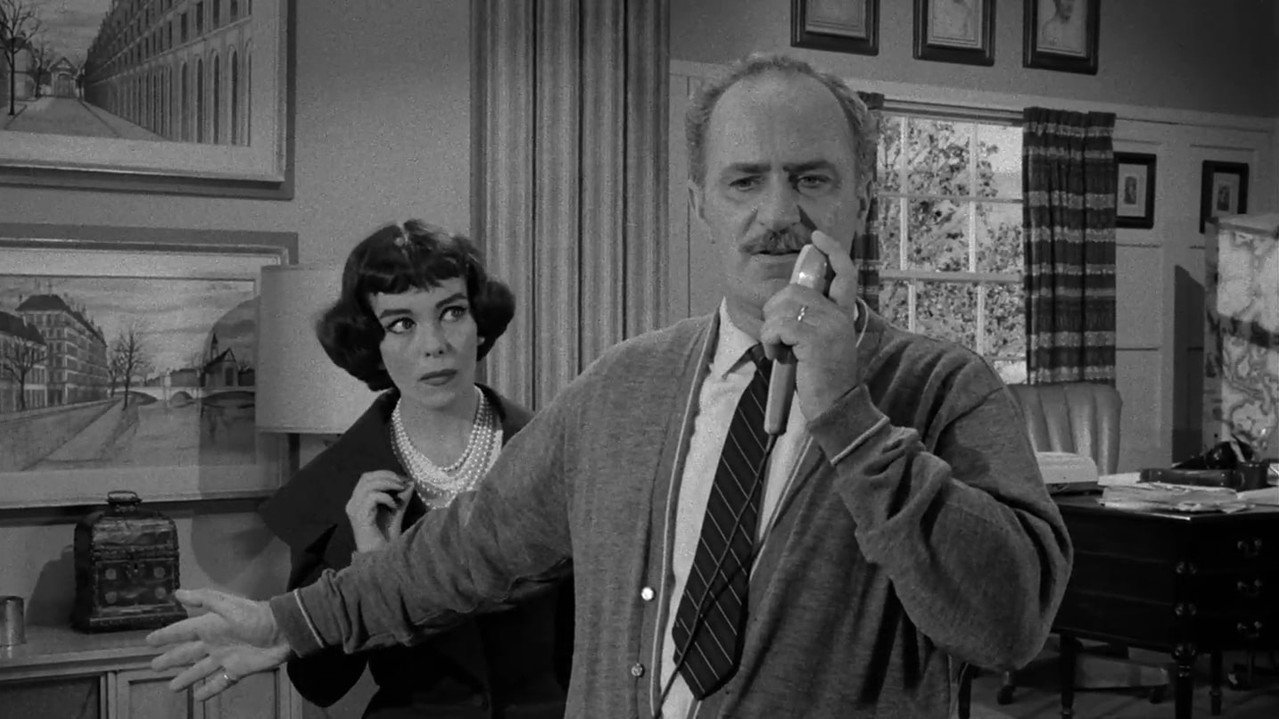
More from the episode

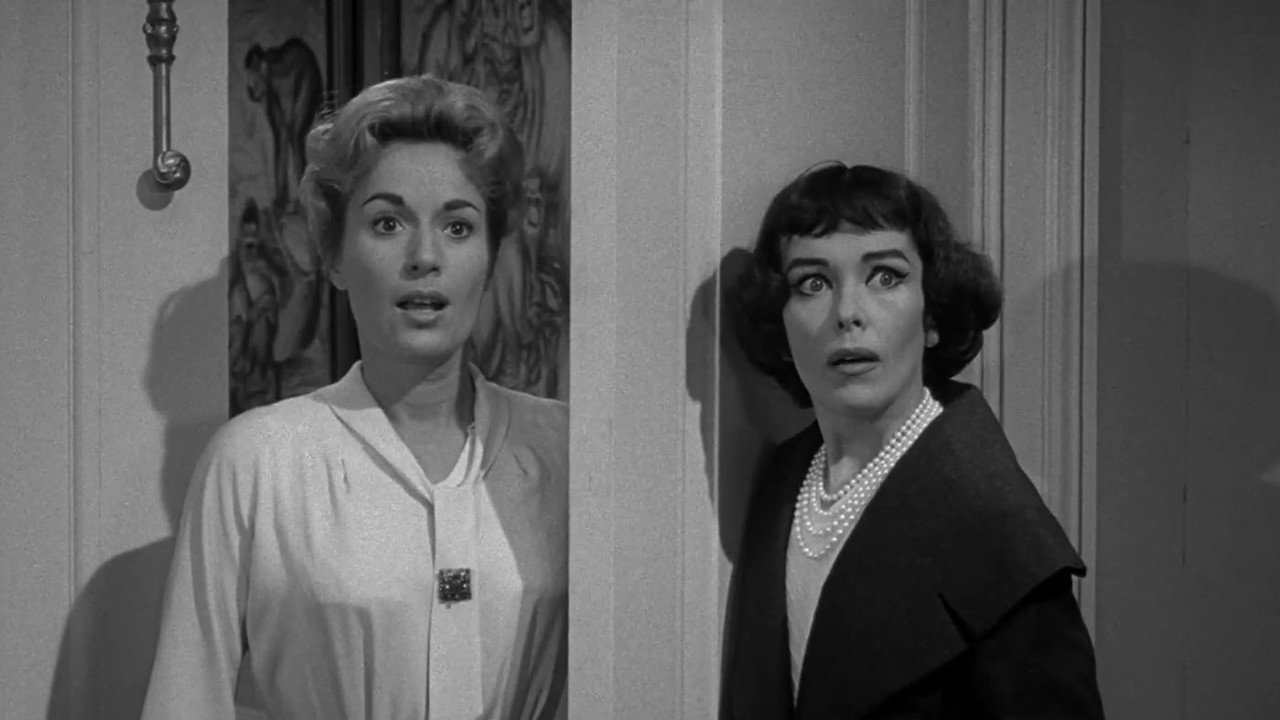
The story in 5 beats
- A woman in the study
Victoria peers through the window and sees her husband, a famous playwright, alone with a young blonde woman. By the time she storms in, the woman has vanished.
- The dictation machine
Gregory explains that whatever he describes into his dictation machine comes to life. Victoria's first thought is that he needs to be committed.
- Mary at the door
To prove it, Gregory dictates Mary into being. She arrives with a knock at the door.
Mary unmade, Victoria corneredSpoiler · tap to reveal
Gregory sends Mary away again. Victoria tries to flee, and an elephant stops her. Then he tells her she is a character too, and she throws her tape on the fire.
In controlSpoiler · tap to reveal
Victoria vanishes, and Gregory brings Mary back. Rod Serling arrives to wrap things up, and Gregory deals with him the same way.
Why it still matters
The Twilight Zone closed its first season with a joke. Richard Matheson, the writer behind the paranoia of "The Invaders" and "Nightmare at 20,000 Feet," turned in a domestic comedy about Gregory West, one of America's most noted playwrights, whose dictation machine makes whatever he describes walk through the door.
The script has an odd history. Matheson had already written a short story, "And Now I'm Waiting," in a much darker key, and he reworked it into a comedy when he pitched it to the series. The Twilight Zone Vortex blog praises the finished episode for leaning on wordplay rather than screwball antics, which is a fair description of why it holds up better than some of the show's other comedies.
Watch Keenan Wynn and Phyllis Kirk sparring in the first half, and keep an eye on who actually seems to be in charge of each scene. The episode also gets more interesting if you read it as two writers, Matheson and Serling, poking fun at their own trade. Modern critics have raised pointed questions about its politics, which come after the spoiler marker.
Who wrote whom
Gregory's wife is one of his creations. He shows Victoria the recording he used to invent her, and she hurls it into the fireplace. She disappears with it. Gregory then summons Mary again, picking the agreeable woman over the argumentative one.
Serling then turns up to deliver his usual wrap-up. Gregory objects to the interruption and burns Serling's tape too, so the host fades away. It's a neat gag for a season finale: the show's own creator turns out to be somebody else's character.
Not everyone finds it as charming now. One reviewer finds Gregory's casual swap of the difficult wife for the agreeable one callous. Whether Matheson meant the joke to land that way is still worth arguing about after the credits.
Behind the scenes
- It was the last episode of the first season, and it is essentially comic in tone.
- "And Now I'm Waiting," the darker short story Matheson reworked into this domestic comedy, first appeared in print in Twilight Zone Magazine in April 1983.
- The episode has no original score. It used stock music.
- Matheson wrote 16 episodes of the series, and this was one of them.
The thread
A writer whose creations take on lives of their own is an old idea, and Matheson had already tried a darker version of it.
Came before
Shares DNA with
Echoes
DNA strand
Is Any of This Real?
Gregory's study seems ordinary until the people in it start to look suspicious. The episode treats reality as something that can be dictated and then erased, and the funny version of that idea ends up somewhere slightly unsettling.
Every great sci-fi story is built from a handful of strands like this one. Each strand page explains how it works and traces it across shows, books and films.
If this one stayed with you
Where to go next, and why.
Watch · Film
Stranger Than Fiction (2006)
If you liked the idea of a writer's work taking over the real world, this comedy-drama has its own take on it.
Watch · Twilight Zone
"The Mighty Casey"
If you want more of the show in a lighter mood, this is another of the series' comedies, and a good test of how well it does comedy.
Read · Short story
"And Now I'm Waiting" — Richard Matheson
The darker original that became this episode, if you want to see what the comedy was built from.
Sources
- “A World of His Own,” Wikipedia
- “The Twilight Zone Vortex: "A World of His Own",” The Twilight Zone Vortex, 2012
- “This 65-Year-Old Twilight Zone Episode Broke a Major Series Trend (& It Worked Perfectly),” CBR
- “"A World of His Own" and the Replaceability of Women in The Twilight Zone,” Horror Homeroom
- “The Twilight Zone "A World Of His Own",” Gabbing Geek, 2025
- “The Twilight Zone Episode 36: A World of His Own,” Midnite Reviews, 2016
- “The Twilight Zone: S1E36 - A World of His Own (1960) - Cast & Crew,” The Movie Database (TMDB)
- “A World of His Own - The Twilight Zone 1x36,” TVmaze
- “A World of His Own (infobox),” Wikipedia
- “A World of His Own,” Wikiwand (Wikipedia mirror)
- “The Twilight Zone episode review — 1.36 — A World of His Own,” Medium
- “Richard Matheson,” Wikipedia
- “The Twilight Zone season 2,” Wikipedia
- “Stranger than Fiction (2006 film),” Wikiwand (Wikipedia mirror)