
More from the episode
The story in 5 beats
- A cloud over France
A Royal Flying Corps pilot named Decker flies through a strange cloud in March 1917 and lands at an American air base in France.
- Wrong year
The base commander and his provost marshal take him into custody and tell him the year. Decker is stunned.
- Old Leadbottom
Decker learns his flying partner Mackaye is now a decorated air vice-marshal, arriving that day for an inspection. Decker insists Mackaye is dead.
The confessionSpoiler · tap to reveal
Decker admits he fled a dogfight and left Mackaye to die. Told Mackaye must have had help, he sees a second chance, breaks out and flies back into the cloud.
Sit down, Old LeadbottomSpoiler · tap to reveal
Mackaye arrives and says Decker saved his life, coming back against seven German planes. Wilson tells him to sit down, "Old Leadbottom."
Why it still matters
This is where Richard Matheson properly enters The Twilight Zone. Serling had already adapted two of his short stories, "And When the Sky Was Opened" and "Third from the Sun," but this was the first episode Matheson scripted himself. He has said he sold the idea to Serling and producer Buck Houghton with a single sentence.
The time-travel trick is an old one, and Matheson doesn't pretend otherwise. He adds detail and a human problem. Decker arrives somewhere impossible, can't prove who he is, and has a very good reason to want out of the interrogation room. Kenneth Haigh carries most of it.
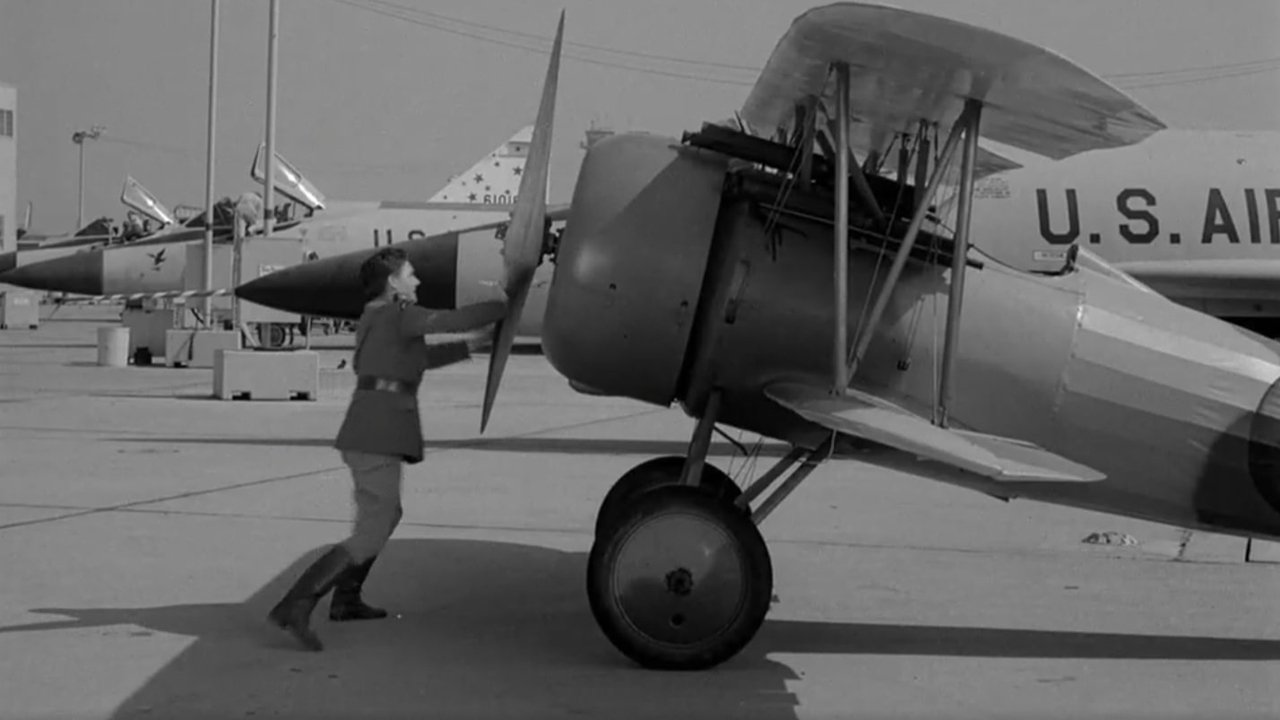
Watch the two officers who question him. Major Wilson is willing to wonder and General Harper isn't, and the story turns on which of them is right. Shooting on a working air force base with a vintage biplane gives the half hour a plain, documentary feel.
What happened over France
Decker finally confesses that he is a coward who avoided combat and deliberately abandoned Mackaye when seven German aircraft jumped them. He can't believe Mackaye survived. When Wilson suggests someone must have helped, Decker works out that no one else was within fifty miles, so if Mackaye lived, Decker must have gone back himself. He assaults Wilson and a guard and reaches his plane. Wilson puts a pistol to his head, Decker tells him he'll have to shoot, and Wilson hesitates and lets him go. Decker flies into the cloud and vanishes.
Mackaye arrives for the inspection and tells Wilson that Decker saved his life. He thought Decker had fled, then watched him come diving out of nowhere with guns blazing. Decker shot down three German planes before he was shot down himself. Harper shows Mackaye Decker's identification card and personal effects, and Wilson, who has heard the nickname, tells him to sit down, "Old Leadbottom." The episode never explains the cloud, and doesn't need to. The loop is the thing to argue about: Decker only becomes the hero because he saw the future first. Matheson later said he liked a title with a double meaning: a flight from cowardice, and a flight from the past to the future. Serling closes on Hamlet's line to Horatio about more things in heaven and earth.
Behind the scenes
- It was the first episode of the series scripted by Richard Matheson. Serling had previously adapted his stories "And When the Sky Was Opened" and "Third from the Sun."
- Matheson has said he sold the idea with one sentence. His working title for the script was "Flight."
- Part of the episode was shot on location at Norton Air Force Base in San Bernardino, California. The vintage 1918 Nieuport biplane was owned and flown by Frank Gifford Tallman, and it had appeared in many World War I films.
- Radio historian Martin Grams Jr. noted the similarities to a 1948 episode of the radio series Quiet, Please called "One for the Book." According to Grams, Serling was concerned enough to try to buy the rights to it.
- There's no original score. The music is stock, taken from Bernard Herrmann's work for the pilot, "Where Is Everybody?"
- The only rank slip is in Serling's opening narration, which calls Decker a flight lieutenant. Decker calls himself a second lieutenant, the correct Royal Flying Corps rank, during the episode.
- Serling wrote the opening and closing narrations. Matheson wrote the rest.
The thread
A pilot out of his time has a long pedigree, and this episode sits alongside a radio play, a Shakespeare line and Matheson's own earlier stories.
Came before
Shares DNA with
Adaptations and echoes
DNA strand
Time Loops & Timelines
Decker's trip to 1959 matters because of what it does to 1917. Matheson makes the paradox personal instead of technical, and the story never explains the cloud because it doesn't need to. What lingers is the second chance, and what it costs.
Every great sci-fi story is built from a handful of strands like this one. Each strand page explains how it works and traces it across shows, books and films.
If this one stayed with you
Where to go next, and why.
Watch · The Twilight Zone
"King Nine Will Not Return"
Another airman, another past that won't stay buried.
Watch · Film
Somewhere in Time (1980)
A Matheson story of a man dropped into another era, played as a romance, with the same sincerity.
Read · Novel
Bid Time Return — Richard Matheson
The novel behind that film. If you want more of Matheson treating time travel as an emotional problem, start here.
Sources
- “The Last Flight (The Twilight Zone),” Wikipedia
- “The Last Flight (The Twilight Zone) (2020 Wikipedia mirror),” Wikipedia (mirror)
- “The Last Flight (The Twilight Zone) (Wikiwand),” Wikipedia via Wikiwand
- “The Twilight Zone season 1,” Wikipedia
- “The Twilight Zone (radio series),” Wikipedia
- Brian Durant, “The Twilight Zone Vortex: "The Last Flight",” The Twilight Zone Vortex, 2011
- “The Twilight Zone: Season 1, Episode Eighteen "The Last Flight",” Great Books Guy, 2021
- “Shakespeare in The Twilight Zone: "The Last Flight",” Bardfilm, 2013
- “Episode Spotlight: "The Fear",” My Life in the Shadow of The Twilight Zone, 2014
- “The Twilight Zone: Season 1 - The Last Flight, Cast & Crew,” The Movie Database (TMDB)
- “The Last Flight (Q2657502),” Wikidata
- “The Last Flight: The Twilight Zone Radio Dramas,” Audible
- “Somewhere in Time (film),” Wikipedia
- “King Nine Will Not Return,” Wikipedia
- “This Twilight Zone Episode Was So Similar To Another Story That Rod Serling Almost Bought The Rights,” SlashFilm
- “The Twilight Zone (1959) episode guide,” epguides
- “05x35 - The Fear - Transcript,” Forever Dreaming