The story in 5 beats
- A prize trip
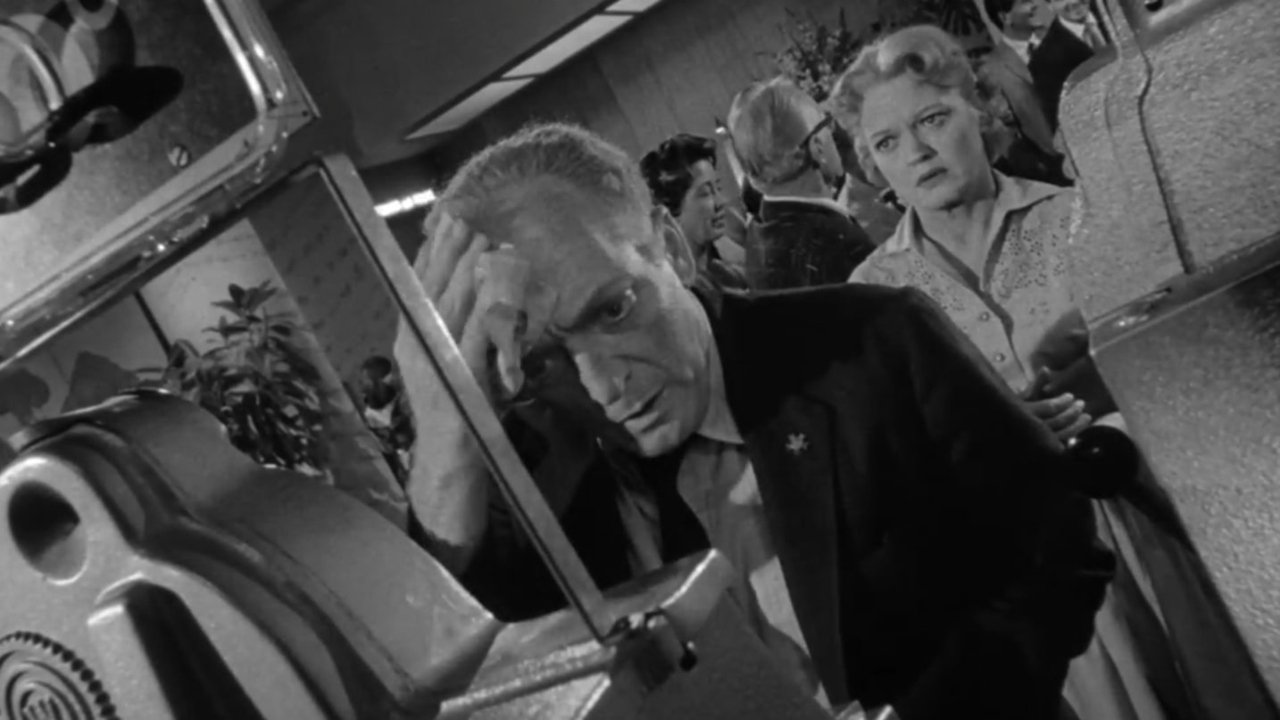
Franklin and Flora Gibbs arrive in Las Vegas for three days and two nights, all expenses paid, won by Flora in a slogan contest. Franklin hates every minute of it.
- One coin
A drunk hands Franklin a silver dollar and insists he play a slot machine. Franklin does, and wins.
- Tainted money
Unable to sleep, Franklin announces he'll give his winnings back to the machine. Within hours he is feeding it coins and drawing a crowd.
- The last dollar
Flora begs him to come to bed. He puts in his last dollar, the machine jams, and he knocks it over and is hauled away.
The hallwaySpoiler · tap to reveal
Back in the room, Franklin sees the machine coming for him and Flora sees nothing. He backs through the window to his death, and the machine turns up outside to return his dollar.
Why it still matters
This is Rod Serling in sermon mode, and he knew the subject from the inside. By the account in one episode write-up, the story grew out of a celebratory Las Vegas trip when the series was first signed. His wife Carol had good luck at the tables, while Serling kept losing to a slot machine and fought it for a good while. Franklin Gibbs is a man who has never had that kind of afternoon. He sneers at every gambler in sight, and the episode takes its time deciding how that smugness should be repaid.
Everett Sloane carries it. He'd already starred in both the film and television versions of Serling's Patterns, and he plays Franklin at a pitch somewhere between tragedy and farce. Not everyone buys the speed of the collapse: one reviewer felt the turn from scold to addict needed more time to build, and another called the episode somewhat farcical. Listen for the machine, though, which ends up with a voice of its own.
It's one of the shorter, odder entries of the first season, and a second viewing pays off because it keeps you guessing about what Franklin is actually up against.
What follows Franklin down the hall
By the end Franklin has convinced himself the machine is alive. He says it teases and sucks you in, and that it jammed on purpose rather than pay him what he was owed. In the hotel room he hears it calling his name and sees it coming down the hallway toward him, while Flora tells him there is nothing there. He backs away, trips, and goes out the window to his death.
The episode then refuses to settle the question. The camera finds the slot machine outside, smiling, and it hands over the last silver dollar Franklin put in. If it's all in his head, the machine shouldn't be able to do that. Serling's closing narration has it both ways: he lists the machine's ordinary names, then says the Twilight Zone will go with the definition Franklin himself used, a monster with a will of its own.
Read it as a morality play and Franklin is the self-righteous man who learns he is no better than the fools he looked down on. Read it as horror and the machine really did want him. The episode is built so that both readings hold, which is probably why it has outlasted its modest reputation.
Behind the scenes
- Serling wrote the story after a Las Vegas trip taken when The Twilight Zone was first signed. His wife Carol won at the casino, and he lost to a slot machine.
- Though set in Las Vegas, the episode was shot in California, where slot machines were illegal. Producer Buck Houghton said that even a facsimile couldn't be built, so the crew borrowed a seized machine from the police, who kept an officer on set. Marc Scott Zicree's The Twilight Zone Companion is the source.
- The machine was a Watling Rol-A-Top, a model made only from 1935 to 1938 and a type found in illegal casinos of the Depression.
- The casino was built on MGM's stage 20 for about $1,200, plus $250 to rent the gambling equipment. The close shots of the slot machine were filmed on stage 21 on the third day of shooting.
- The machine's voice was created by mixing an actor's voice with the sound of falling coins. Sound engineers Franklin Milton and Jean Valentino worked on it with director Robert Florey.
- A similar slot machine was used again in the later episode "The Prime Mover."
- Serling also wrote the story up as prose for Stories from the Twilight Zone, published in 1960.
The thread
Serling's own losing streak in Las Vegas, and a few stories of people followed by things only they can see.
Came before
Shares DNA with
Retold and reused
DNA strand
Is Any of This Real?
Only Franklin ever sees the machine moving, so for most of the half hour it reads as a breakdown. The last shot offers physical proof, or something close to it, and takes the easy explanation away. It works because Serling gives the skeptic and the believer equal footing.
Every great sci-fi story is built from a handful of strands like this one. Each strand page explains how it works and traces it across shows, books and films.
If this one stayed with you
Where to go next, and why.
Watch · The Twilight Zone
"Nightmare at 20,000 Feet"
If you liked deciding whether the thing in the hallway was real, this is the same argument at thirty-seven thousand feet, with a man nobody believes.
Watch · Film
Leaving Las Vegas (1995)
If Franklin's fall made you want a Vegas story that takes addiction seriously, this film from Mike Figgis is far bleaker and has no machine to blame.
Read · Novel
The Gambler — Fyodor Dostoevsky
If the pull of one more try is what stayed with you, Dostoevsky wrote the classic account of a gambling habit tightening around a man, drawn from his own time at the tables.
Read · Short story
"The Fever" — Rod Serling
If you want to see how Serling shaped the same story on the page, his prose version appeared in Stories from the Twilight Zone in 1960.
Sources
- “The Twilight Zone: Season 1, Episode Seventeen "The Fever",” Great Books Guy, 2021
- “One Twilight Zone Prop Was So Illegal It Came With A Police Escort,” SlashFilm
- “The Twilight Zone Vortex: "The Fever",” The Twilight Zone Vortex, 2011
- “Twilight Zone – The Fever,” Powerpop, 2021
- “The Fever (Twilight Zone First Season),” Twilight Zone episode guide (tzone.the-croc.com)
- “The Twilight Zone Archives - TZ Guide, Season 1,” twilightzone.org
- “Everett Sloane,” Wikipedia