The story in 5 beats
- The wreck
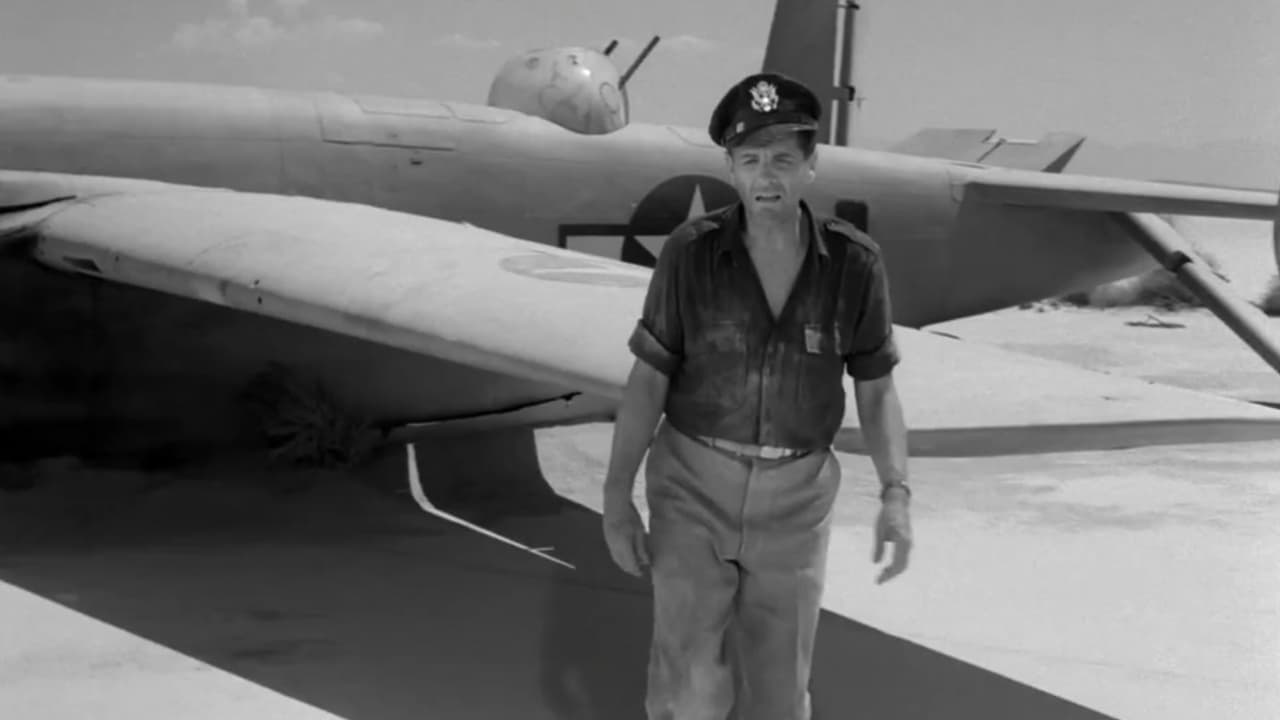
Embry wakes beside his crashed bomber in the desert. There's no sign of his crew.
- Searching
He calls their names, sees glimpses of them, and starts to wonder whether he's dreaming or dead.
- The grave
He finds a grave marker dated April 5, 1943.
JetsSpoiler · tap to reveal
Modern jet fighters fly over the desert. In 1943, they're impossible.
SandSpoiler · tap to reveal
Embry wakes up somewhere else entirely. The doctors have an explanation. His shoes have another.
Why it still matters
Captain James Embry comes to in the sand next to the King Nine, a B-25 bomber that has come down in the desert. His crew has vanished. He searches, shouts, talks to men who aren't there, finds a grave, and watches jet fighters scream overhead in what should be 1943. Robert Cummings, better known for comedy, carries almost the whole half hour alone.
Serling took it straight from the news. The wreck of the Lady Be Good, an American bomber lost in the Libyan desert in 1943, had been found, and the remains of its crew were turning up through 1960. It was the opening episode of season two, the first with Serling on camera at the start and the first with the theme music everyone knows. It's also his second try at the story of "Where Is Everybody?", and this time he got to use the ending he wanted.
Seventeen years later
Embry is in a hospital bed, seventeen years after the war. He collapsed after seeing a newspaper story: the long-lost King Nine has been found in the desert. He had been due to fly that mission but came down with a fever and was replaced. The doctors tell him guilt sent him back to the crash site in his mind, and nowhere else.
Then a nurse turns one of his shoes on its side, and sand pours out. Serling doesn't explain it, and the A.V. Club notes the logic is left open. It's the kind of last-second wink the show would make its signature, and the critic points out it's the twist Serling had wanted for "Where Is Everybody?" but couldn't get away with.
The Question Underneath
What would you do if you woke up and everyone you were responsible for was gone?
Embry missed the flight that killed his crew, and the episode suggests part of him has been out in that desert ever since. Whether he really went back or his guilt took him there, the feeling is the same. The show treats survivor's guilt with unusual seriousness for 1960: as a wound that can pull a man out of time.
Challenge the DNA
Did Embry really go back to the desert?
Or skip ahead to our reading
We say both, which is why it works. The doctors are right about his guilt, and the sand means the episode doesn't have to choose.
Behind the scenes
- The Lady Be Good, a B-24, crash-landed in the Libyan desert in April 1943. The bodies of eight of its nine crew were found between February and August 1960, the last just weeks before this episode aired.
- The bomber on screen is a North American B-25C. It still exists, in storage with Aero Trader in Borrego Springs, California.
- It was the first episode to use the Marius Constant theme most people now hum as "the Twilight Zone music."
- It was also the first where Serling introduced the story on camera at the start, instead of only as a voice.
- Fred Steiner's score was reused in later episodes.
- Walter B. Gibson turned it into a short story, "Return From Oblivion," for the 1963 collection Rod Serling's Twilight Zone. It follows the episode closely.
The thread
One man alone in a landscape that won't explain itself.
Came before
Shares DNA with
Left its mark on
DNA strand
Last Person on Earth
Serling kept coming back to a man completely alone, and he usually let the loneliness be the point. Here it's guilt. Embry isn't the last man on Earth; he's the one who wasn't on the plane, and the desert is where his mind keeps putting him.
Every great sci-fi story is built from a handful of strands like this one. Each strand page explains how it works and traces it across shows, books and films.
If this one stayed with you
Where to go next, and why.
Watch · Twilight Zone
"Where Is Everybody?"
The pilot this rewrites. Watch them back to back and see what Serling changed.
Watch · Twilight Zone
"Nightmare at 20,000 Feet"
Planes, panic and a man nobody believes, with William Shatner at the window.
Read · Short story
"Return From Oblivion" — Walter B. Gibson
The episode as prose, in the first book of Twilight Zone stories.
Your next episode
Three directions to go from here, all on Sci-Fi DNA.

More of this feeling
Where Is Everybody?
The Twilight Zone
The pilot this one rewrites: one man, no people, and no idea why.
Same question, different answer
Nightmare at 20,000 Feet
The Twilight Zone
Is he seeing things, or is it really there? Shatner on a stormy flight.

Something completely different
Parallels
Star Trek: The Next Generation
A man who notices the world changing around him, played for laughs and birthday cake.