
More from the episode

The story in 5 beats
- The blowout
Nan Adams, driving from Manhattan to Los Angeles, blows a tire in Pennsylvania.
- The same man
Back on the road, Nan keeps seeing the same scruffy hitch-hiker, thumb out. However fast she drives, he's always somewhere ahead of her.
- The crossing
Trying to get away from him, Nan stalls her car on a railroad crossing with a train bearing down. She gets out just in time.
The sailorSpoiler · tap to reveal
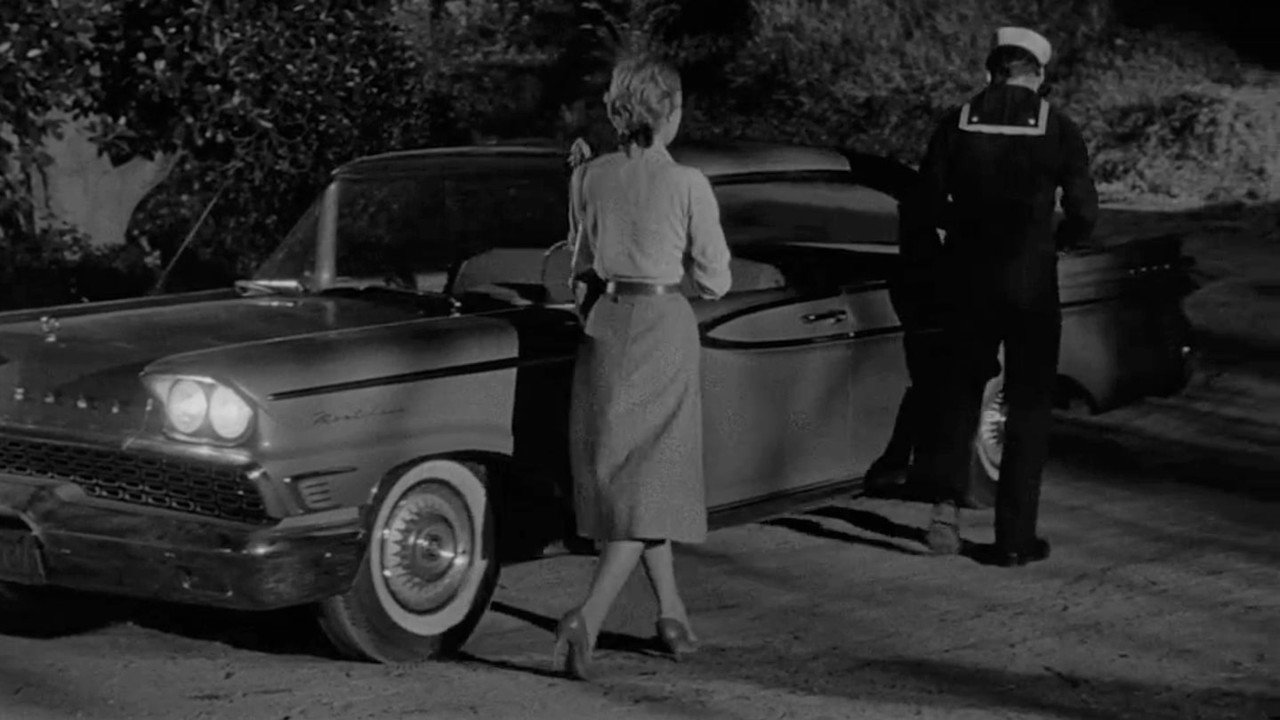
Desperate for company, Nan offers a sailor a ride to San Diego. When she points out the hitch-hiker, the sailor sees nothing and bails out.
The phone callSpoiler · tap to reveal
Nan phones her mother for a familiar voice. A stranger answers and tells her Nan died six days ago in a car accident. Then she sees who's in her back seat.
Why it still matters
This is one of the cleanest ghost stories the series ever told, and it began as a radio play. Lucille Fletcher wrote "The Hitch-Hiker" for Orson Welles in 1941, and Rod Serling remembered it from radio and wanted it for television. The result is a half hour built almost entirely from a road, a car and a stranger on the shoulder with his thumb out.
Nan Adams is a 27-year-old woman driving from New York to Los Angeles. A blown tire is the only thing that goes wrong, until she starts noticing the same shabby man at the roadside, again and again, always somewhere she hasn't reached yet. Inger Stevens plays her fear as a slow tightening rather than a scream, and she also supplies the inner-monologue narration. Leonard Strong, as the hitch-hiker, barely does anything except be there.
The episode spends very little time on explanation. The scares are few and plain, like a train on a crossing. It's a good case study in setting up a twist without announcing one.
Who's been waiting on the road
When Nan calls home, the voice on the line is a Mrs. Whitney, not her mother. She explains that Nan's mother has had a nervous breakdown because Nan was killed six days earlier. The blown tire was her death, not an accident she walked away from, and everything since has been her trip with a passenger she kept refusing to pick up. The hitch-hiker is Death, and he's been collecting her the whole way.
The earlier scenes were seeded for this. The sailor who sees nothing is where the story tells you it's about Nan alone. The episode ends with Nan, past arguing, finding the hitch-hiker in her back seat and hearing him say she's going his way.
The radio play ends differently. Ronald Adams hangs up after the same phone call and is left alone in New Mexico, wondering where the hitch-hiker has gone and who he himself is. Serling's version spells out the answer.
Behind the scenes
- Welles performed Lucille Fletcher's radio play on four radio programs in all, first on The Orson Welles Show in November 1941 and last on The Mercury Summer Theatre of the Air in 1946.
- Fletcher got the idea on a cross-country trip with her then-husband, the composer Bernard Herrmann. They saw an odd-looking man first on the Brooklyn Bridge and then on the Pulaski Skyway, and never saw him again.
- Serling made the lead a woman, where the radio play's driver is a man named Ronald Adams, and, according to Wikipedia, named her after his daughter.
- Herrmann's score for the radio play was re-recorded as stock music for CBS and is heard, usually uncredited, on the soundtracks of several CBS series, including this episode.
The thread
A story that began with a real road trip and a radio star, and took a few forms before television.
Came before
Shares DNA with
Back to radio
DNA strand
The Cruel Twist
Nan runs from a stranger for the whole episode, and the twist is that he was never the one chasing her. The clues are in plain sight from the first scene, which is why it works on a rewatch. The repeated sightings, the sailor who sees nothing and the missing mother all pay off once you know.
Every great sci-fi story is built from a handful of strands like this one. Each strand page explains how it works and traces it across shows, books and films.
If this one stayed with you
Where to go next, and why.
Watch · Film
Carnival of Souls (1962)
A woman on a long drive, followed by a pale figure no one else notices. It's more dreamlike, and if you liked the road-trip dread it's worth the detour.
Read · Play
Sorry, Wrong Number and The Hitch-Hiker — Lucille Fletcher
Read the original one-act version and see what Serling kept and changed. The companion piece is another Fletcher story that builds its suspense over a telephone line.
Sources
- “The Hitch-Hiker (The Twilight Zone),” Wikipedia
- “The Hitch-Hiker (radio play),” Wikipedia
- “One Of The Twilight Zone's First Episodes Adapted An Orson Welles Radio Play,” TVLine, 2026
- “The Twilight Zone: Season 1, Episode Sixteen "The Hitch-Hiker",” Great Books Guy, 2021
- “The Suspense Project: 1942-09-02 The Hitch-hiker,” Internet Archive
- “The Twilight Zone: S1E16 - The Hitch-Hiker (1960) - Cast & Crew,” The Movie Database (TMDB)
- “The Twilight Zone: The Hitch-Hiker (TV) (1960),” Filmaffinity
- “Media Birthday: Twilight Zone's "The Hitch-Hiker",” File 770
- “Lucille Fletcher,” Wikipedia
- “List of The Twilight Zone episodes,” Wikipedia
- “The Hitch-Hiker (The Twilight Zone) plot (Wikipedia mirror),” Wikipedia mirror
- “The Twilight Zone Season 1,” TheTVDB
- “Twilight Zone episode review 1.16 The Hitch-Hiker,” Medium
- “The Spectre of Loneliness in Carnival of Souls (1962),” Lazy Girls Film Club
- “The Twilight Zone Review & Trivia: The Hitch-Hiker,” Ringside Report