
More from the episode
The story in 5 beats
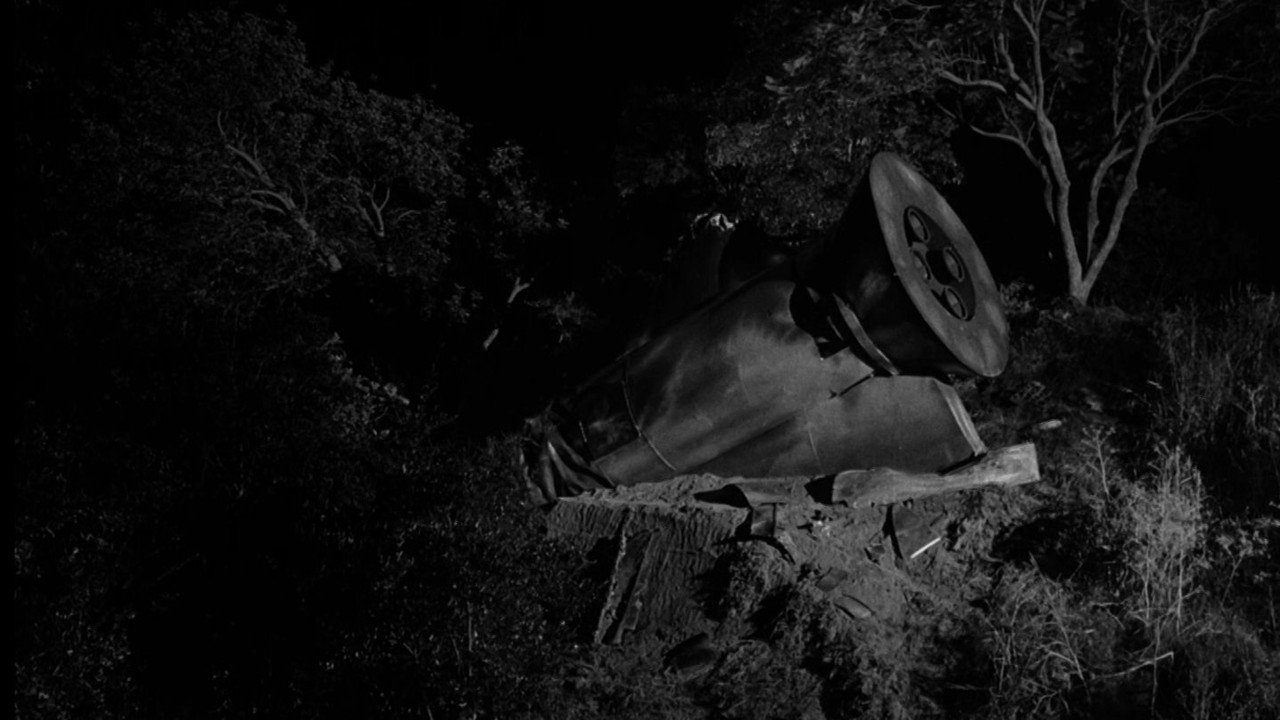
- Crash landing
Cook is stranded on a planet about 4.3 light years from home, injured, his equipment mostly destroyed.
- No rescue
General Larrabee tells him there's no ship to send. Then news comes of an attack on the coast, and the retaliation.
- Someone else is here
Strange drawings appear in the dirt, and a rock knocks Cook out. He misses the last call from home.
NordaSpoiler · tap to reveal
A frightened woman hiding near his ship turns out to be another lone survivor. They talk in sketches and gestures.
The gardenSpoiler · tap to reveal
They trade names, Adam and Eve, and she calls the planet Earth. She offers him a fruit she calls a seppla.
Why it still matters
Colonel Adam Cook has come down on a planet 4.3 light years from home, with a broken arm, a cracked rib and a ship that won't fly again. Its gravity and air are close to his own world's, which is the only good news. Over the radio, General Larrabee is honest with him: there's no rescue ship, and the home world is sliding toward war. Each call after that brings worse news.
Richard Basehart, a year before Voyage to the Bottom of the Sea made him a TV fixture, spends much of the episode alone in the dark (the planet's sun never seems to rise), talking to a voice that's getting harder to reach. It's a sad, patient half hour about the end of one world, heard over the radio from very far away, and it doesn't stay on that note for the whole running time.
Its air date came out of a national tragedy. "Night Call" was scheduled for November 22, 1963, and was pulled after President Kennedy was assassinated, so "Probe 7" went out the following week: a story about a world destroying itself, broadcast a week after Dallas.
Adam, Eve and a seppla
Cook's home world is finished. Larrabee's final message, which Cook misses while he's unconscious, warns of lethal radiation and hopes for a future without fear, anger or hate. On the strange planet, the woman who has been watching him turns out to be Norda, the only survivor of another world, one that drifted out of its orbit. After a bad start (she takes his stick as a threat and scratches his face), she comes back to apologize, and the two walk off together.
They find a fertile place Cook says is like a garden. He introduces himself as Adam Cook; she is Eve Norda. She calls the planet "Earth" and hands him a fruit she calls a "seppla," which is "apples" spelled backward. Serling's closing narration says the names may be part fable, part fantasy, and that their destination may not be called Eden. It's a shaggy-god story, the kind that ends on a famous beginning, and Serling picks the oldest one there is.
For all the garden imagery, the ending is bleak. One civilization has just wiped itself out with bombs, and the episode's answer is to start the human story again from scratch, somewhere else.
Behind the scenes
- The crashed ship was built by a crew led by Jack Poplin for The Outer Limits episode "Specimen: Unknown." According to Bob Stahl in TV Guide (April 4, 1964), Serling's Cayuga Productions bought it from Daystar, the Outer Limits company, which sold it to recoup costs; it was repainted for The Twilight Zone. "Probe 7" aired about three months before "Specimen: Unknown" did.
- General Larrabee's and Lieutenant Blane's costumes came from Forbidden Planet (1956).
- Producer William Froug said Serling's script ran over forty-five pages, about twenty minutes too long. Froug cut ten pages of dialogue with Serling's permission, and Ted Post trimmed more in post-production.
- Post told historian Martin Grams that Serling, who felt the script could have been better, gave him room to improve the scenes. Post later recorded a commentary with Marc Scott Zicree, included on the 2016 Blu-ray.
- It was meant to follow "Night Call" on November 22, 1963. After the Kennedy assassination, "Night Call" was pulled and finally aired on February 7, 1964.
- Antoinette Bower went on to play a guest role in Star Trek's "Catspaw."
- A Twilight Zone radio drama version starred Louis Gossett Jr.
The thread
Last survivors, borrowed spaceships and the oldest story in the book.
Came before
Shares DNA with
Left its mark on
DNA strand
The Cruel Twist
The twist here is gentle on the surface, a love story and a garden, but it rests on a world that just bombed itself out of existence. Serling makes the punchline an origin myth, so the end of one civilization becomes the start of ours, and leaves you to wonder how long that one will last.
Every great sci-fi story is built from a handful of strands like this one. Each strand page explains how it works and traces it across shows, books and films.
If this one stayed with you
Where to go next, and why.
Watch · Twilight Zone S3
"Two"
If the wordless getting-to-know-you between Cook and Norda was the best part, this whole episode is built on it.
Watch · Twilight Zone S1
"Third from the Sun"
Serling's earlier story of people trying to get off a planet before its war starts. Watch it before anyone tells you how it ends.
Read · Novel
On the Beach by Nevil Shute
The waiting half of Cook's story: survivors far from the war, listening to the radio for news that isn't coming.
Watch · Film
Forbidden Planet (1956)
The film the uniforms came from, and a much grander story about a crew landing on a strange world.
Sources
- “Probe 7, Over and Out,” Wikipedia
- “The Twilight Zone (1959 TV series) season 5,” Wikipedia
- Josh Weiss, “How The Twilight Zone Borrowed a Spaceship From Rival Series The Outer Limits,” SYFY WIRE, 2026
- Jordan Prejean, “Probe 7, Over and Out,” The Twilight Zone Vortex, 2024
- “The Twilight Zone: Season 5, Episode Nine, Probe 7, Over and Out,” Great Books Guy