
More from the episode

The story in 5 beats
- Pitchville Flats
Frisby holds court at his store, spinning stories about his inventions and his famous friends. Nobody believes him, and nobody minds.
- Two strangers
Two men in identical clothes stop for gas. Frisby tells them he designed the American automobile and forecasts the weather.
- A voice on the road
That night a voice tells Frisby to step outside and walk down the road. He ends up aboard a spaceship.
The prize specimenSpoiler · tap to reveal
The visitors want to show him off on their home planet. They have no idea what a lie is, and his confession gets nowhere.
Red River ValleySpoiler · tap to reveal
Frisby escapes with his harmonica and races home to tell his friends. They've thrown him a party, and they laugh.
Why it still matters
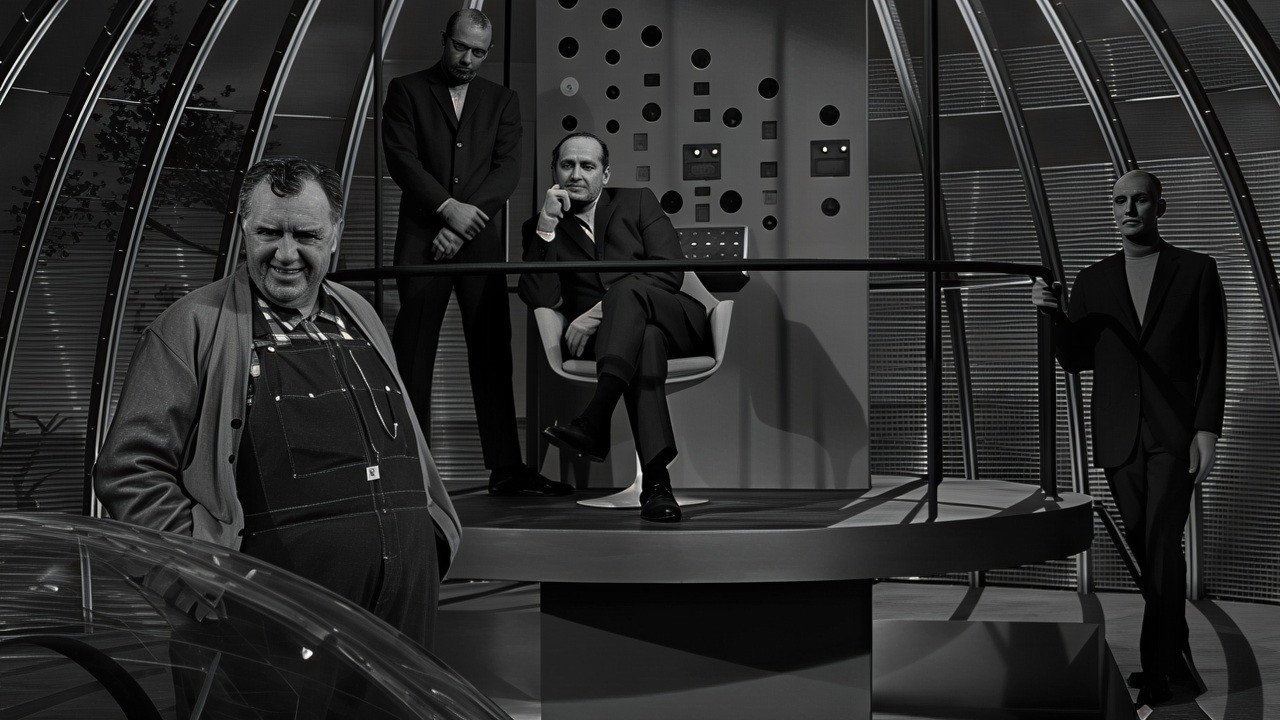
Somerset Frisby runs the general store and gas station in a sleepy little town, and his real trade is the tall tale. He has, by his own account, advised presidents, won the war and invented half of what you can buy. His friends at the cracker barrel have heard it all and enjoy every word without believing one. Serling's opening narration says Frisby has all the drive of a broken camshaft, and he means it fondly.
This is the show in its gentle, folksy mode, and Andy Devine is why it works. He had been in pictures since the silent era, working for directors like John Ford, and his gravel voice turns a braggart into someone you'd happily sit next to by the stove. The A.V. Club's Zack Handlen called it an old-fashioned fable with a slightly modern twist. Watch for the moment Frisby finally tries telling the truth: it's the closest the half hour comes to real drama, and Devine plays it straight.
The truth, for once
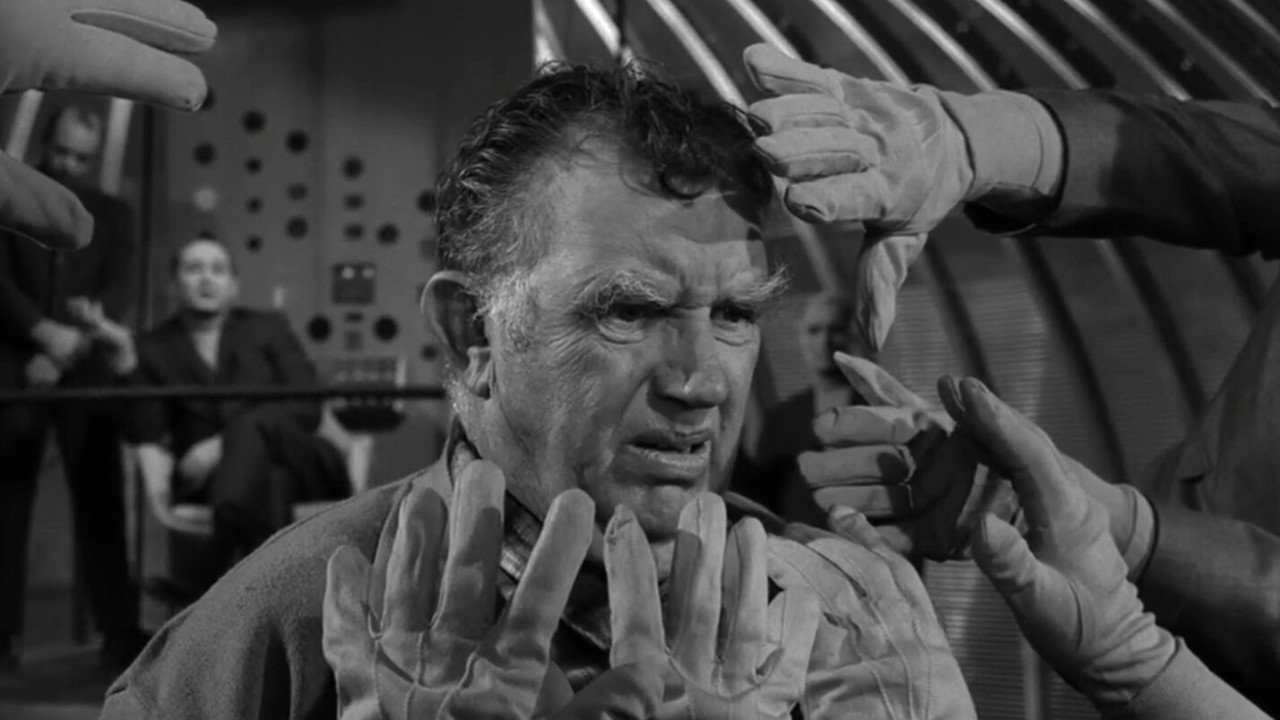
The strangers are aliens, and they took Frisby's bragging as a field report. Their people have no concept of dishonesty, so as far as they can tell they've found a model human, ready to be put on display back home. Frisby admits he made it all up, and the words mean nothing to them. He punches one, and the face breaks away to show what's underneath. What finally saves him is the harmonica: a few bars leave the visitors in agony, and they let him go.
He runs back to the store, where his friends have a surprise birthday party waiting, and he tells them the one true story of his life. They roar, and hand him an award for his lying. Serling's closing narration suggests Frisby might have profited from an Aesop fable about a boy who cried wolf. The twist is soft, closer to a joke than a sting. As the A.V. Club saw it, he finally has an experience to match his stories, and nobody believes him.
Behind the scenes
- It was the second Frederic Louis Fox story Serling adapted, after "Showdown with Rance McGrew" that February. Serling sent Fox a copy of that script as a goodwill gesture, and Fox answered with a paragraph-long treatment called "Mister Tibbs and the Flying Saucer," about a service station owner who tells tall tales.
- In Fox's version, the tall tales were being broadcast on Martian radio. Serling cut that, and he passed on Fox's casting idea, Ed Wynn, in favor of Andy Devine.
- Fox, who lived from 1902 to 1981, wrote mostly for TV westerns, including Bonanza, Lawman and Zane Grey Theatre.
- The alien ship is the saucer from MGM's Forbidden Planet (1956), and William Tuttle made the alien masks.
- The harmonica is Tommy Morgan, a session player who also played on the show's "Dust." He picked the western standard "Red River Valley" as Frisby's theme.
- Frisby's friend Mitchell is Howard McNear, Floyd the Barber on The Andy Griffith Show. Peter Brocco, one of the aliens, also turned up in "The Four of Us Are Dying" and, two decades later, in Twilight Zone: The Movie.
The thread
A liar nobody believes, and the visitors who believe him far too readily.
Came before
Shares DNA with
DNA strand
Sci-Fi Played for Laughs
The alien abduction here sets up a punchline about credibility. Serling borrows the shape of a first-contact story and lets it land as a small-town joke, with a harmonica where the ray gun should be. The laughs come from Frisby himself, a man whose only real skill is talk.
Every great sci-fi story is built from a handful of strands like this one. Each strand page explains how it works and traces it across shows, books and films.
If this one stayed with you
Where to go next, and why.
Watch · Twilight Zone S2
"Mr. Dingle, the Strong" (1961)
More visiting aliens choosing an ordinary braggart as their test subject, played for laughs in a neighborhood bar.
Watch · Film
Big Fish (2003)
If you liked Frisby's stories more than the aliens, Tim Burton's film is about a father whose tall tales his son can't stand, and what's buried inside them.
Read · Novel
Big Fish — Daniel Wallace
The book behind the film, told as a string of the father's legends. It's the cracker-barrel monologue stretched into a novel.
Sources
- “Hocus-Pocus and Frisby,” Wikipedia
- Brian Durant, “Hocus-Pocus and Frisby,” The Twilight Zone Vortex, 2017
- Zack Handlen, “The Twilight Zone: "Four O'Clock"/"Hocus-Pocus And Frisby",” The A.V. Club, 2013
- Peter Martin, “Exploring The Twilight Zone, Episode #95: "Hocus-Pocus and Frisby",” ScreenAnarchy, 2011
- “The Twilight Zone 3x30: Hocus-Pocus and Frisby,” TVmaze