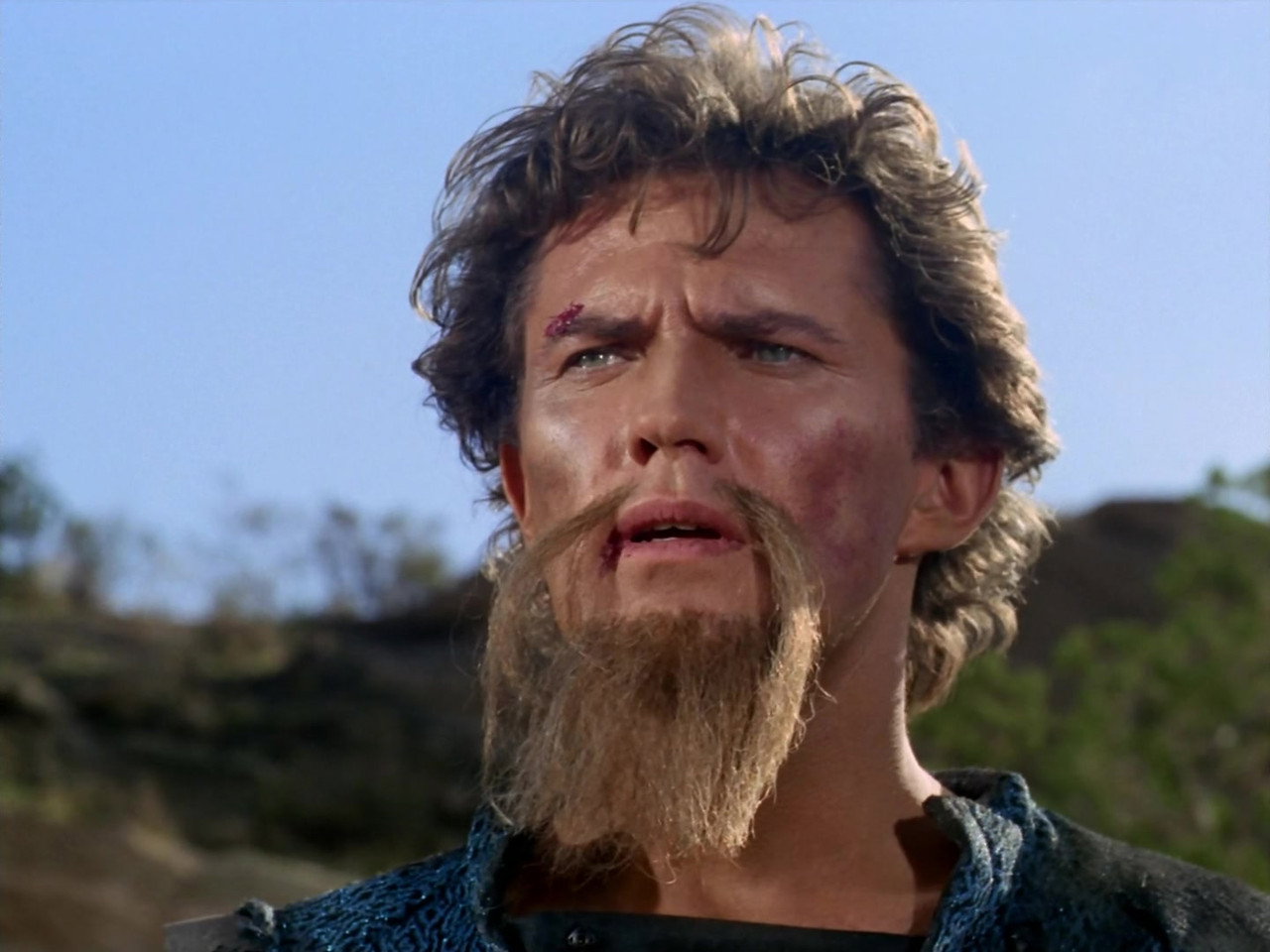
More from the episode

The story in 5 beats
- The wink
The Enterprise is hit by a strange pulse, and for an instant, space itself seems to switch off. Below, on a lifeless planet, a man appears who wasn't there before.
- Lazarus
His name is Lazarus. He's injured and frantic, he has a small ship, and he says an enemy is out there who will destroy the universe.
- Every quadrant
Starfleet reports the same effect across the galaxy and fears an invasion. Every ship pulls back except the Enterprise, which has to find the cause.
Two of himSpoiler · tap to reveal
Lazarus steals the ship's dilithium, then denies it. Kirk and Spock realise there are two men: one from our universe, and one from its anti-matter twin.
The corridorSpoiler · tap to reveal
If the two meet outside the passage between their worlds, both universes end. Kirk finds the only way to keep them apart.
Why it still matters
Star Trek's first parallel universe turned up half a year before "Mirror, Mirror" and its goatee, in a much stranger story, with the kind of cosmic stakes the show didn't often try in its first season.
Its reputation is rough. Fans and critics have been hard on it for decades, and the plot can be tough to follow. Jordan Hoffman, writing for StarTrek.com, called it the original series' first real stinker, and also the most surreal episode of the lot. Both are fair, and the second is the reason to watch.
The ending stays with you longer than the muddle before it would lead you to expect. Robert Brown, who stepped into the lead at almost no notice, gives it everything he has.
What of Lazarus?
The enemy Lazarus is chasing is himself. There is a matter universe and an anti-matter universe, joined by a corridor between dimensions, and each holds a Lazarus. Ours is mad with hatred for his double. The other one is rational, and has been trying to stop him. If the two ever meet outside the corridor, matter and anti-matter cancel out, and both universes are annihilated.
Kirk is pulled through to the other side and meets the sane Lazarus, who tells him the only fix: trap both men in the corridor and destroy the doors at either end. Kirk shoves our Lazarus in, returns to the Enterprise and orders the phasers fired on the ship that holds the gateway. The last thing we see is the two of them locked together, fighting, in a corridor sealed forever. The universes are safe, and Kirk is left wondering what that eternity is like for the Lazarus who was trying to do the right thing.
Behind the scenes
- John Drew Barrymore was cast as Lazarus and simply didn't turn up for filming. Robert Brown was brought in at short notice, and the schedule slipped by two days.
- The producers complained to the Screen Actors Guild, which suspended Barrymore's membership for six months, keeping him from acting in that time.
- It was the last original series episode directed by Gerd Oswald.
- Gene Roddenberry was reportedly pleased enough with Don Ingalls's script to bring him back to write "A Private Little War" in season 2.
- It aired 27th but was made earlier: its production number is 20.
- In 2016, at a 50th-anniversary convention in Las Vegas, an audience vote reported by CNET ranked it the ninth worst Star Trek episode of any series.
The thread
The franchise's first trip to another universe, and the much more famous ones that followed it.
Came before
Shares DNA with
Where Trek went next
DNA strand
Alternate Selves
Most alternate-self stories are about meeting your double. This one is about the danger of meeting him at all. The two Lazaruses can't share a universe, and the episode turns the old idea of fighting your other self into a literal, endless fight.
Every great sci-fi story is built from a handful of strands like this one. Each strand page explains how it works and traces it across shows, books and films.
If this one stayed with you
Where to go next, and why.
Watch · Star Trek
"Mirror, Mirror"
Half a year later the show went back to the parallel-universe well and came up with one of its best-loved hours.
Watch · Star Trek: TNG
"Parallels"
If the idea of universes brushing against each other grabbed you, this one runs with it, with a lot more clarity and a lot more fun.
Read · Novel
The Gods Themselves — Isaac Asimov
A link between our universe and another, a gift that looks too good to be true, and the slow discovery of what it's costing.