
More from the episode
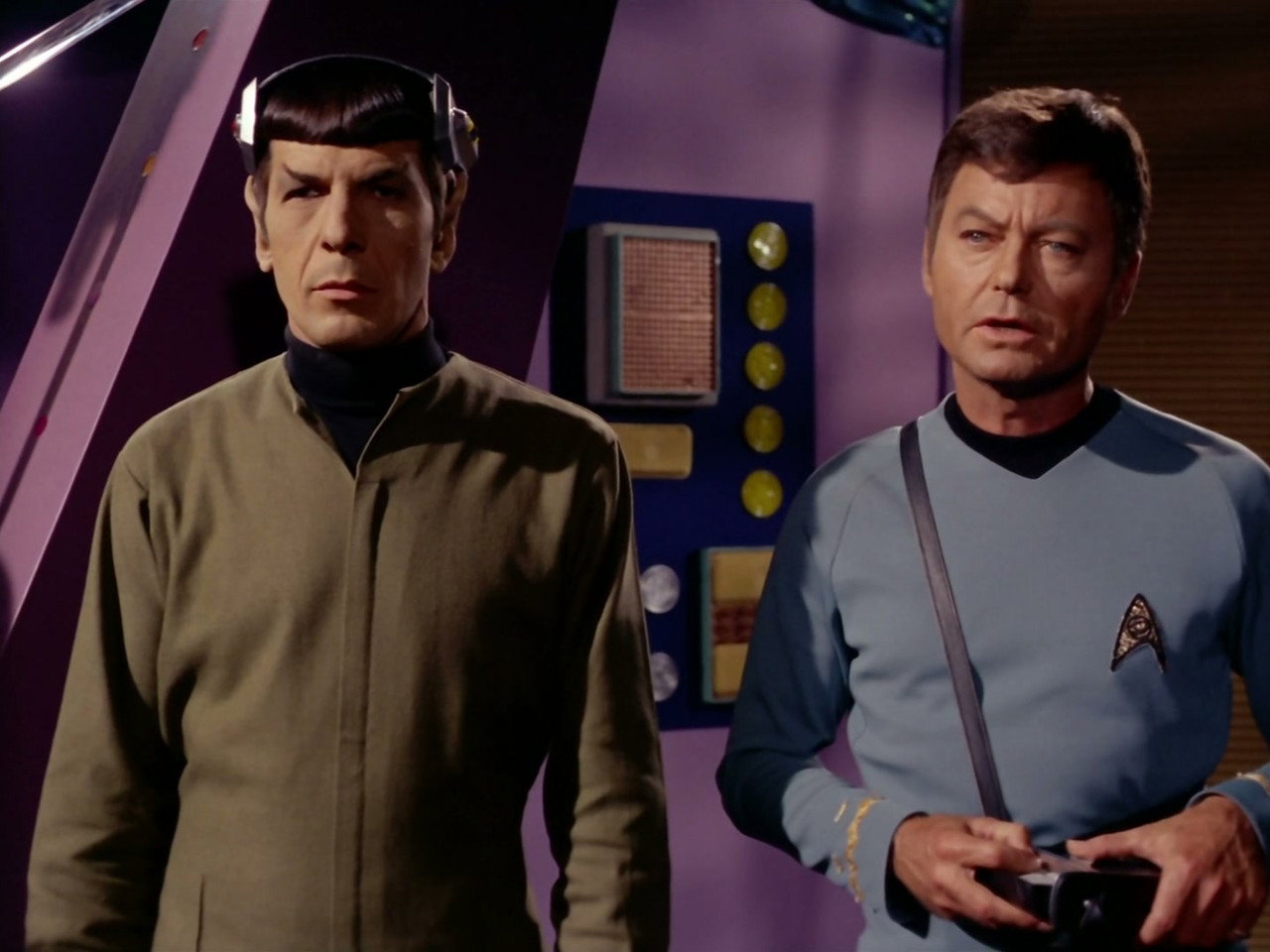

The story in 5 beats
- The visitor
A woman beams onto the bridge, knocks everyone out and takes a close interest in Spock.
- Brainless
McCoy finds Spock alive in sickbay, minus his brain. Vulcan biology gives him a day at most.
- The remote
McCoy builds a device that lets him walk Spock's body around the planet. It is exactly as dignified as it sounds.
The ControllerSpoiler · tap to reveal
Underground, the women's leader has no idea what a brain is. Her whole civilization now runs on Spock's.
The TeacherSpoiler · tap to reveal
McCoy borrows a machine's surgical know-how. It starts wearing off mid-operation.
Why it still matters
Fans had mounted one of television's most famous letter-writing campaigns to win Star Trek a third season, and this is what they got first. NBC had moved the show to 10 p.m. on Fridays, Gene Roddenberry had stepped back, and the season opened with a woman stealing Spock's brain to run her people's underground city. Fans and people who worked on it have called it the worst episode of the series ever since.
And yet everyone keeps watching it. The A.V. Club gave it a D and still found a lumpy B-movie charm, Wired called it underrated, and CBR listed it among episodes so bad they must be seen. It may even have been in on the joke: William Shatner later described it as a tribute to the NBC executives who mishandled the show, a story about a society in desperate need of a brain.
Brain surgery for beginners
Kara has no idea what a brain is. Her people's know-how comes from a machine called the Teacher, which pours a skill into your head for about three hours, and that's how she managed the operation in the first place. McCoy takes a turn, starts putting Spock back together and feels the knowledge draining away before he's finished. Once Spock's speech is reconnected, Spock talks him through the rest of his own surgery.
Kirk assures Kara that the men and women of her planet can learn to live together on the surface without the Controller. Then Spock, fully restored, starts telling everyone the planet's history at great length, to McCoy's visible regret.
The Question Underneath
Can you use knowledge you don't understand, and should you?
Kara performs surgery she can't explain because a machine poured the skill into her head. That's a silly premise, and the episode knows it, but the question underneath is serious enough. Knowing how isn't the same as knowing why, and a society that has forgotten the difference has lost something even if the lights still work.
Challenge the DNA
Was it meant to be funny?
Or skip ahead to our reading
We suspect a bit of both. Coon knew how to write comedy, but a lot of what makes it funny came from the rewrites and the rush.
Behind the scenes
- "Lee Cronin" was Gene L. Coon, the show's former producer, writing under a pen name because his contract at Universal didn't let him write for other studios.
- Coon's April 1968 outline was very different: the brain was taken during an asteroid survey by aliens called the Nefelese, and there was no Teacher. New producer Fred Freiberger reworked the story outline between Coon's drafts, and Arthur H. Singer wrote the final draft.
- It was the first episode to air after NBC moved the show from 8:30 to 10 p.m. on Fridays, a slot known as the Friday night death slot.
- Leonard Nimoy wrote that he was embarrassed during the entire shoot.
- The rankings are consistent: 78th of 79 original-series episodes at Hollywood.com, and third-worst in all of Star Trek at ScreenRant in 2017. Den of Geek ranked it the second-best "best worst" episode.
- Phish has a song called "Spock's Brain."
The thread
Brains in jars before it, and a long tail of affectionate mockery after.
Came before
Shares DNA with
Left its mark on
DNA strand
Sci-Fi Played for Laughs
Whether it meant to be funny is the eternal argument. Either way it's the original series at its most cheerfully ridiculous, and it plays best with friends and no expectations at all.
Every great sci-fi story is built from a handful of strands like this one. Each strand page explains how it works and traces it across shows, books and films.
If this one stayed with you
Where to go next, and why.
Watch · Star Trek
"The Trouble with Tribbles"
If you'd like to see Star Trek being funny on purpose. Same crew, much better jokes.
Watch · Star Trek
"The Devil in the Dark"
Gene L. Coon two seasons earlier, at his best: another misunderstood civilization under the ground.
Read · Novel
Donovan's Brain — Curt Siodmak
The 1940s classic about a brain kept alive in a tank. Played completely straight, and much creepier.
Your next episode
Three directions to go from here, all on Sci-Fi DNA.

More of this feeling
The Trouble with Tribbles
Star Trek
Star Trek being funny on purpose, with much better jokes.

Same question, different answer
The Devil in the Dark
Star Trek
Another misunderstood civilization underground, from the same writer at his best.

Something completely different
The Lonely
The Twilight Zone
A machine, a man and a much harder question, done completely straight.