The 60-second version
- Scientists grow real neurons from stem cells and wire them to electrodes, so a computer can talk to them and they can learn.
- They've learned to play Pong, recognize voices and play DOOM, and you can now buy or rent time on them.
- They're used as processors, not batteries. The appeal is efficiency: a brain runs on about 20 watts.
The idea in a minute
A living computer uses real neurons, the cells your brain is made of, as part of the hardware. Scientists grow them from stem cells, sometimes as flat layers and sometimes as tiny 3D clumps called organoids, and place them on a grid of electrodes. The computer sends signals in, the neurons fire back, and over time the cells change how they respond. That's learning, the same basic trick your brain uses.
Why bother? Because brains are absurdly efficient. A human brain runs on about 20 watts, roughly a dim light bulb, while training today's AI takes data centers. Nobody expects a dish of neurons to replace your laptop. The bet is that living cells could someday handle some kinds of learning far more cheaply than chips can.
Myth or real?
5 things people say. Make your guess, then tap to flip.
Brain-cell computers run on human "battery power," like in The Matrix.
MYTHIt's the other way round. The neurons are the processor, and they have to be fed a nutrient solution to stay alive. A body uses far more energy than it could ever give back.Source
Lab-grown brain cells have learned to play a video game.
REALIn 2022, Cortical Labs' DishBrain learned Pong within about five minutes. In 2026 the company showed cells on its CL1 playing DOOM.Source
The scientists behind DishBrain said their neurons showed "sentience."
REALThe word is in their paper's title. Other neuroscientists published a reply arguing that it stretched the meaning of the word far past what the experiment showed.Source
Today's brain organoids are tiny human brains that can think.
MYTHThey're clusters of cells a few millimeters across, with no blood supply and none of a brain's structure. They're useful models for study, not minds.Source
You can rent time on living human neurons over the internet.
REALFinalSpark in Switzerland rents researchers remote access to its organoids, and Cortical Labs sells time on its CL1 through its cloud service.Source
Where it came from
- 1968 · fictionStar Trek's "Spock's Brain": aliens steal Spock's brain to run their civilization's machinery.
- 1978 · fictionThe Hitchhiker's Guide to the Galaxy reveals that Earth is an organic computer, built to work out the Ultimate Question.
- 1994Leonard Adleman uses DNA in test tubes to solve a small routing puzzle. Biology has computed something on purpose.
- 1995 · fictionStar Trek: Voyager's starship runs on "bio-neural gel packs."
- 1999 · fictionThe Matrix imagines humans farmed as batteries, the version everyone remembers.
- 2004At the University of Florida, Thomas DeMarse's dish of rat neurons learns to fly a fighter-jet simulator.
- 2013Madeline Lancaster and Jürgen Knoblich grow "cerebral organoids": tiny 3D clusters of human brain tissue.
- 2022Cortical Labs' DishBrain learns Pong. The paper's use of the word "sentience" starts an argument among neuroscientists.
- 2023Johns Hopkins researchers name the field "organoid intelligence." Indiana University's Brainoware learns to recognize voices.
- 2024Swiss startup FinalSpark starts renting researchers remote access to its organoids.
- 2025Cortical Labs launches the CL1, sold as the first commercial computer built from living human neurons.
- 2026Neurons on a CL1 play DOOM. In August, a 20-unit CL1 prototype data centre opens at the National University of Singapore.
Why it grabs us
It's the rare sci-fi idea that arrived early and stranger than promised. We were braced for brains in jars and humans in pods. What showed up is a dish of cells, a grid of electrodes and a game of Pong. It's both less dramatic and more unsettling, because it's real.
And it pokes at two fears at once. One is the old Frankenstein worry about using living tissue as a tool. The other is the newer worry about AI's appetite for electricity. Biocomputing promises to ease the second fear by leaning into the first.
Try it
Real lab or sci-fi?
Six living computers. Some are in labs right now. Some only exist on screen or in books. Which is which?
“Rat brain cells in a dish learn to fly a fighter-jet simulator.”
“A planet-sized organic computer is built to work out the Ultimate Question.”
“A clump of lab-grown brain tissue learns to tell people apart by their voices.”
“A starship's computer runs on bio-neural gel packs, which can catch a cold.”
“Human neurons on a chip learn to play DOOM.”
“A stolen brain is used to run an entire civilization's machinery.”
What the science says, and where fiction cheats
What's established, and where the movies take liberties.
What the science says
- REALNeurons learn by themselves. Give them feedback and they adapt without being programmed. DishBrain's cells got better at Pong within minutes.
- REALBrains are efficient. A human brain runs on about 20 watts. Even a small slice of that efficiency would matter in an industry worried about power bills.
- REALIt's on sale. Cortical Labs' CL1 went on sale in 2025, and both it and FinalSpark offer remote access, so researchers can experiment without a wet lab.
Where fiction cheats
- REALBatteries, backwards. The Matrix's power plant breaks basic physics: you can't get more energy out of a body than you put in as food. Real systems spend energy keeping neurons alive.
- REALTiny, simple and fragile. Today's organoids are a few millimeters across, with no blood supply, and the ones wired into biocomputers last about three months. They're nowhere near a brain in a jar.
- REALNot a mind (as far as anyone can tell). When the DishBrain paper used the word "sentience," other neuroscientists published a reply saying the experiment showed learning, not feeling.
- GUESSScale is the hard part. Nobody yet knows whether living hardware can be grown, kept alive and wired up at a scale that competes with silicon.
Where that leaves us: Real, early, and weirder than the movies: tiny clusters of neurons doing simple tasks. Not batteries, not brains in jars, and not conscious as far as anyone can tell. This time the ethics conversation started before the technology took off.
The ethics question
Could a dish of neurons feel anything?
Almost certainly not today. The cultures are far too small and simple, and the 2023 reply to the DishBrain paper argued that learning to hit a ball is not the same as having experiences.
But the people building this aren't waving the question away. The Johns Hopkins team that coined "organoid intelligence" called for ethicists to work alongside the scientists from the start. It's the same question as our Can Machines Be Conscious? page, with one twist: this time the machine is made of the same stuff we are.
Sources: In vitro neurons learn and exhibit sentience when embodied in a simulated game-world (and the published reply, "A response to claims of emergent intelligence and sentience in a dish") · Organoid intelligence (OI): the new frontier in biocomputing and intelligence-in-a-dish · Could future computers run on human brain cells?
Where sci-fi took it
Three ways stories imagined living machines. Spoiler-free. Twists stay hidden until you tap.
Brains as machinery
People as power
 ClipOfficial trailer · Warner Bros. · 2:32
The mind in a box
After reading · vote again
Finished reading? Did you move?
Would you trust a computer made of living brain cells?
Big Idea vs. DNA strand
Do Machines Dream?
That's the storytelling strand: machines with inner lives. Living computers turn it inside out. Instead of a machine that might have a mind, it's a mind's raw material being used as a machine.
Start here
If you only try a few, try these.
Watch · Bloomberg Primer
Here's How Biocomputing Works And Matters For AI
Twenty-four minutes that cover the whole field. Start here if you only watch one thing.
Watch · Film
The Matrix (1999)
Rewatch the battery speech knowing that real labs do the opposite. It's even more fun.

Watch · Star Trek
“Spock's Brain”
Famously one of the silliest episodes of the original series. Watch it with friends.
Read · The paper
“Organoid intelligence (OI): the new frontier in biocomputing and intelligence-in-a-dish”
Free to read, and surprisingly clear about the hopes, the limits and the ethics.
Go deeper on YouTube
Hand-picked videos from the people who made them. Thumbnails load from YouTube; the player starts only when you tap. The player starts only when you tap.
Clip thumbnails load from YouTube's image servers. Video players only load after you tap play, using YouTube's privacy-enhanced mode. More
See it working
 YouTube · Official · New Scientist0:59
Human brain cells in a dish learn to play Pong
One minute: the DishBrain experiment that started the headlines.
 YouTube · Official · Cortical Labs6:29
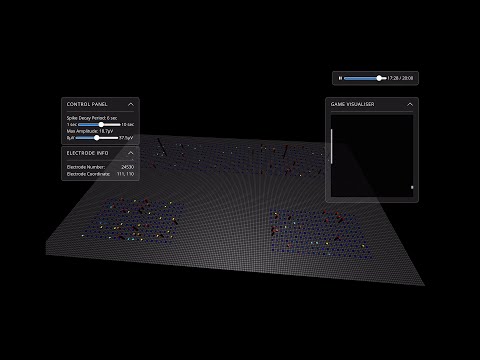
Living Human Brain Cells Play DOOM on a CL1
The company's own footage of neurons playing *DOOM*.
 YouTube · Official · FinalSpark1:20
FinalSpark Neuroplatform used to control remotely the flight of a virtual butterfly.
Organoids in Switzerland steering a virtual butterfly, controlled over the internet.
 YouTube · Official · Reuters2:34
This computer runs on living human brain cells
A short news report from the CL1 launch.
Go deeper
 YouTube · Official · Bloomberg Originals24:01
Here's How Biocomputing Works And Matters For AI | Bloomberg Primer
The best long explainer: how it works, who's building it and why the AI industry cares.
 YouTube · Official · Clarified Mind15:36
We're Not Ready for Biocomputing
The video that made biocomputing go viral this year, built around the CL1 *DOOM* footage.
 YouTube · Official · Sabine Hossenfelder6:33
Crazy: Scientists Compute With Human Brain Cells
A physicist's quick, skeptical tour of the main teams and how far they really are.
 YouTube · Official · CNA2:29
Brain power: Researchers get prototype data centre run on human brain cells, not chips
A look inside Singapore's prototype data centre, which runs on living brain cells instead of chips.
Sources
- “Brain cells in a dish learn to play Pong”, Monash University, 2022
- Kagan et al. (Neuron, 2022), “In vitro neurons learn and exhibit sentience when embodied in a simulated game-world (and the published reply, "A response to claims of emergent intelligence and sentience in a dish")”, Neuron / PubMed Central, 2022
- “World's first computer that combines human brain with silicon now available”, Live Science, 2025
- “UF scientist: "Brain" in a dish acts as autopilot, living computer”, University of Florida News, 2004
- “Brain tissue on a chip achieves voice recognition”, Tech Xplore, 2023
- “Human brain organoid bioprocessors now available to rent”, Tom's Hardware, 2024
- Lena Smirnova, Thomas Hartung et al., “Organoid intelligence (OI): the new frontier in biocomputing and intelligence-in-a-dish”, Frontiers in Science, 2023
- “Could future computers run on human brain cells?”, Johns Hopkins University Hub, 2023
- “The human brain runs on 20 watts of power”, IFLScience
- “Living Human Brain Cells Play DOOM on a CL1”, Cortical Labs (YouTube), 2026
- “DNA computing”, Wikipedia
- “Brain power: Researchers get prototype data centre run on human brain cells, not chips”, CNA (YouTube), 2026
- “The Hitchhiker's Guide to the Galaxy”, Wikipedia
- “Learning Curve (Star Trek: Voyager)”, Wikipedia
- “Spock's Brain”, Wikipedia
- Fuat Balci et al., “A response to claims of emergent intelligence and sentience in a dish”, Neuron, 2023
- Madeline A. Lancaster et al., “Cerebral organoids model human brain development and microcephaly”, Nature, 2013
- “World-first biological data center uses 16 million living human neurons to process data”, Interesting Engineering, 2026