
More from the episode
The story in 5 beats
- A stolen shuttle
On a mission to decontaminate a planet, the Enterprise picks up a stolen Federation shuttle and its pilot, Lokai.
- The pursuer
A second ship gives chase and breaks apart. Its pilot, Bele, beams onto the bridge and demands Lokai, his quarry of 50,000 years.
- Who's in charge
Bele takes over the ship by willpower. Kirk answers with the auto-destruct countdown.
- The obvious difference
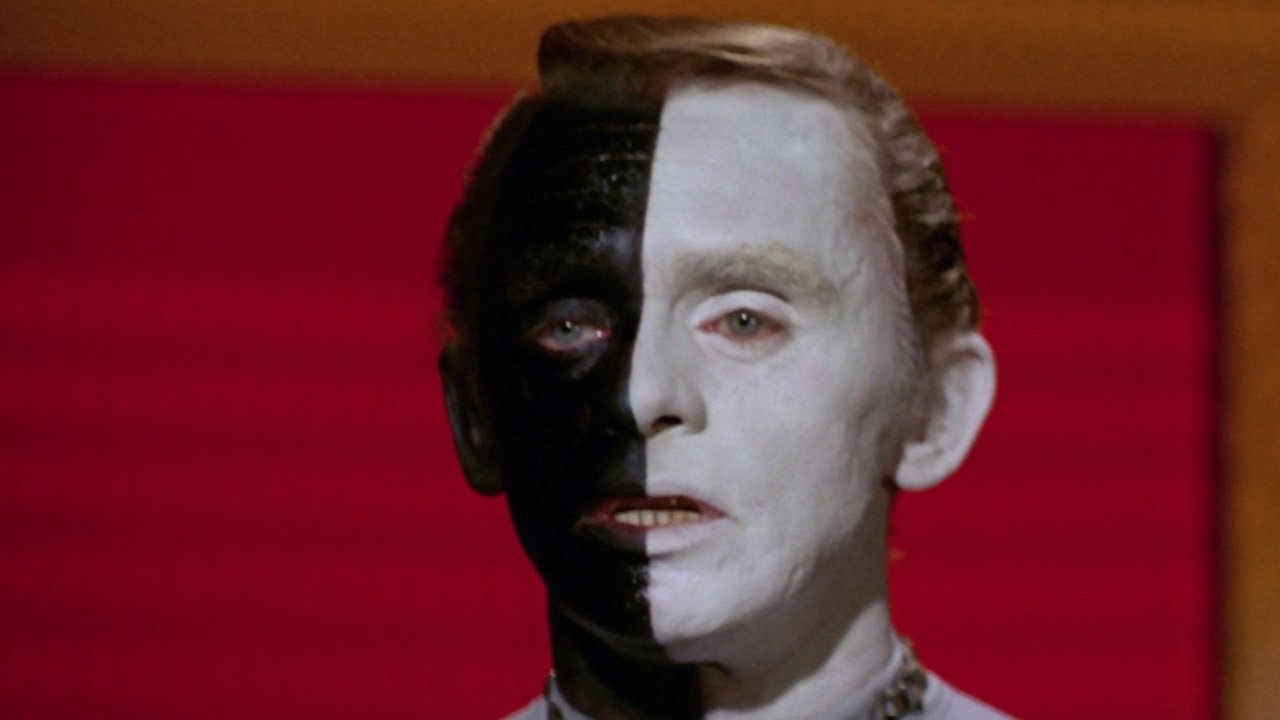
Bele explains it slowly, for the humans: his people are black on the right side. Lokai's are white on the right.
Home at lastSpoiler · tap to reveal
The ship reaches Cheron and finds the whole planet dead. The two of them keep fighting anyway.
Why it still matters
This is the half-black, half-white episode, and that image is why people remember it. Lokai, a fugitive in a stolen shuttle, says he's a refugee. Bele, the officer who has chased him across the galaxy, says he's a traitor. Both have the same two-tone skin, and it takes Kirk and Spock an embarrassingly long time to notice what the two of them think is obvious.
Nobody has ever called it subtle. The A.V. Club gave it a C+ for a message that swamps its good moments, and Reactor's rewatch thought fifteen minutes of story had been stretched to an hour. But it keeps landing on best-of lists anyway: ninth best of the original series for SciFiNow in 2010, eleventh in all of Trek for The Hollywood Reporter in 2016, and a New Yorker piece that year read it as a drama about slavery and racism.
Frank Gorshin, best known as the Riddler on Batman, is the reason it works. His Bele is aggressively nasty, and Lou Antonio matches him as the wounded, self-righteous Lokai. Listen to the self-destruct sequence too: the codes Kirk uses here come back, word for word, in Star Trek III.
The last two people on Cheron
Bele finally gets his way and the Enterprise arrives at Cheron. Spock's scans find no intelligent life at all. While these two chased each other across the galaxy, their peoples destroyed one another in civil war. Bele and Lokai are the last of the Cheronians.
Neither of them stops. They go for each other, their force fields threatening the ship, and then Lokai runs, Bele follows, and both beam down to the ruins to carry on. Over their flight through the corridors the episode lays footage of real cities burning after the bombing raids of the Second World War. On the bridge, the crew talk sadly about two men who won't give up their hate, and Kirk sets course for Starbase 4.
Behind the scenes
- The story began as a 1966 outline by Gene L. Coon for the first season that went unused. Oliver Crawford turned it into a teleplay, and it was Coon's final episode, credited to his pen name, Lee Cronin. The script also grew from an earlier Barry Trivers outline called "A Portrait in Black and White."
- Gene Roddenberry liked the script, but NBC executive Stanley Robertson first turned it down.
- The aliens' look was settled only a week before filming, from an offhand comment by director Jud Taylor.
- It's the first time the Enterprise has a planned self-destruct system, and its codes (11A, 11A2B, 1B2B3, and "000 destruct 0") were reused in Star Trek III: The Search for Spock.
- The burning cities behind Bele and Lokai's chase are stock footage of European cities after Second World War air raids.
- A shot of Chekov's hand working the decontamination controls is reused from "The Doomsday Machine", and the hand is actually Kirk's.
- Co-producer Robert Justman left after this episode.
The thread
A 1960s parable about race, with a planned self-destruct that Trek would come back to.
Came before
Shares DNA with
Left its mark on
DNA strand
Us vs. Them
The difference between Bele and Lokai is so small that the humans can't see it, and so large to them that it outlasts their whole species. It's a blunt instrument on purpose: seen from outside, their hatred looks completely arbitrary.
Every great sci-fi story is built from a handful of strands like this one. Each strand page explains how it works and traces it across shows, books and films.
If this one stayed with you
Where to go next, and why.
Watch · The Twilight Zone
"The Monsters Are Due on Maple Street"
If the ending stayed with you, this is the same warning set on one ordinary street, where neighbours need only one evening to turn on each other.
Watch · The Twilight Zone
"Eye of the Beholder"
Another story about who decides what a normal face looks like, told with one of television's great camera tricks.
Watch · Film
Star Trek III: The Search for Spock
To hear those self-destruct codes again, word for word, with a lot more riding on them.
Sources
- “Let That Be Your Last Battlefield,” Wikipedia
- Keith R.A. DeCandido, “Star Trek: The Original Series Rewatch: "Let That Be Your Last Battlefield",” Reactor
- “Let That Be Your Last Battlefield, 47 Years Later,” StarTrek.com, 2016
- Keith R.A. DeCandido, “Star Trek: The Original Series Rewatch: "Whom Gods Destroy",” Reactor